Wild Category
Absolute Value & Quadratic
Inverse Functions
Graphing & Transformations
Polynomials, rate of change
100
Define even/odd functions
Even: f(-x) = f(x)
Odd: f(-x) = -f(x)
100
Solve |x|=5
x=5 or -5
100
What is the process of finding the inverse of a function? How do you verify that two functions are inverse are each other?
-switch x and y
-solve for y
-set y=f-1(x)
f(g(x))=g(f(x))=x
100
Describe the following transformations:
-f(x)
f(-x)
f(x+c)
Reflection over x
Reflection over y
Left c
100
What is the leading term, degree, and coefficient of the following:
f(x) = 3x2+5x+2
3x2
Degree: 2
Coefficient: 3
200
If f(x) = x+5
and g(x) = x2-4x+3
Find f(g(x))
g(f(x)) = (x+5)2-4(x+5)+3
= x2+10x+25-4x+20+3
=x2+6x+48
200
Solve 5|x+3|-8=7
x=0 or -6
200
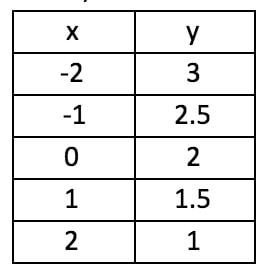
Evaluate the following:
f(1)
f-1(1)
f-1(3)
f(1) = 1.5
f-1(1) = 2
f-1(3) = -2
200
Graph the parent functions and the correct transformations:
f(x) = -(x-3)2
Desmos
Parabola
Reflection down, right 3
200
What is the leading term, degree, and coefficient of the following:
f(x) = 4x + 5 -7x6+9x11+3x2
9x11
Degree: 11
Coefficient: 9
300
Determine the domain and range for the following function:
f(x) = sqrt(x-4)
Domain: [4,inf)
Range: [0,inf)
300
Solve |3x-1|>8
Write in interval notation
(-inf,-7/3) U (3,inf)
300
Find the inverse of the following function:
f(x) = 2x/x-3
f-1(x) = 3x/(x-2)
300
Determine the intervals of increasing and decreasing for the following graph. Also state any local min/max.

Increasing: (-inf,0) U (2,inf)
Decreasing: (0,2)
Local max at (0,4)
Local min at (2,-4)
300
Find the average rate of change of the following:
f(x) = x3+5x over the interval [1,4]
f(4) = 84
f(1) = 6
Average rate of change = 78/3
400
Does the following set of ordered pairs represent a function? Is it one to one?
{(1,3), (4,7),(9,1),(0,7)}
Function, not one-to-one
400
Find the axis of symmetry, vertex, and intercepts of the following:
f(x) = x2-5x+6
Axis of symmetry: x=-b/2a = 5/2
Vertex: (5/2, -1/4)
y-intercept: (0,6)
x-intercepts: (3,0),(2,0)
400
Verify the following functions are inverses of each other:
f(x) = 3x-4 and g(x) = x+4/3
f(g(x)) = 3(x+4/3) -4 = x = g(f(x))
400
Sketch the following:
f(x) = -1/5(x-3)2
Reflected down
Stretched by 1/5
right 3
Desmos
400
Describe the end behavior of the following function:
f(x) = -4x7+6x2+8
as x goes to inf, f(x) goes to -inf
as x goes to -inf, f(x) goes to inf
500
For the following piecewise function: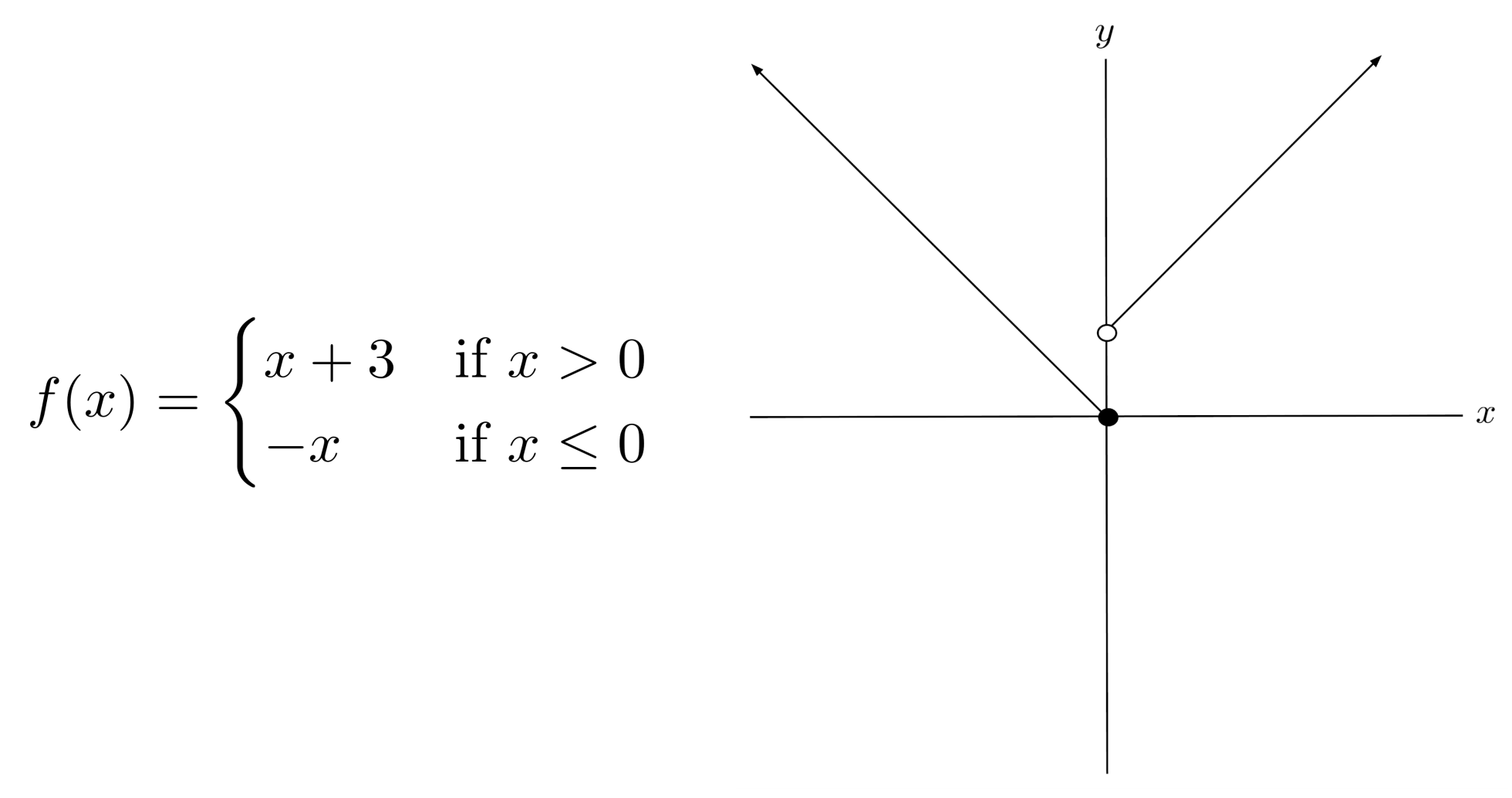
Evaluate:
f(5)
f(-3)
f(0)
f(5) = 8
f(-3) = 3
f(0) = 0
500
Rewrite the following general form quadratic into standard form:
f(x) = x2+ 14x + 24
f(x) = (x+7)2-25
500
Find the inverse of f(x) = (x-3)2+6
Determine the restriction on the domain
x>=3 for f(x)
f-1(x) = sqrt(x-6) + 3
500
Sketch the following:
f(x) = 2|x-4|-6
Determine the x and y intercepts
Right 4, down 6, stretch by 2
x-intercepts: (7,0), (1,0)
y-intercept: (0,2)
500
Find the average rate of change for the following:
f(x) = x2+5
over the interval [x,x+h]
(x+h)2+5 - x2-5/h
Average rate of change = 2x+h