Chapter 2 Review
Random
Radiation YAY
More Radiation
More Chapter 3
100
What is Earths tilt?
23.5 degrees
100
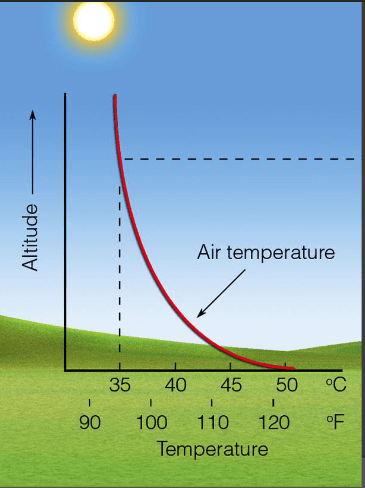
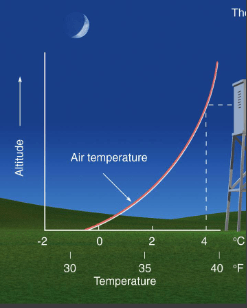
Sketch he temperature profile above the ground during the day and night
100
These two things are really good absorbers of long wave radiation
CO2 and H2O (water vapor)
100
What is earths albedo
.3 or 30%
100
When does the daily maximum temperature happen
midafternoon, when absorbed solar radiation equals net longwave radiation loss.
200
Name that law: the higher the temperature of an
object the shorter the wavelength of
maximum emission of that object.
Wein's Law
200
Where is the Tropopause and name where at least 2 inversions are. 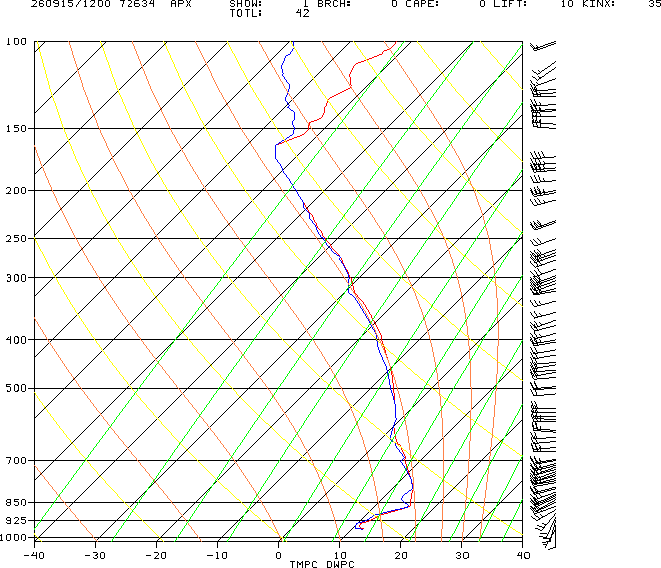
around 160mb tropopause
inversion at 950 mb
200
What does it mean when Earth is a "selective absorber"?
it is not equally effective at absorbing different wavelengths of radiation.
200
What is direct radiation.
Radiation that is not scattered or absorbed by the atmosphere.
200
When does the minimum temperature happen?
right after sunrise, when energy lost (net longwave) equals energy gained (absorbed solar radiation)
300
Name that law: As temperature of an object increases, the total radiation emitted by the object increases.
Stefan-Boltzman Law
300
Where does the largest daily temperature differences occur?
At the surface
300
What um is the atmospheric window?
~ 7um to 12um
300
What are the three things that can happen to solar radiation as it passes through the atmosphere
scattering
reflection
absorption
300
What are the two different types of convection and describe them.
Free convection: mixing due to a lighter
fluid becoming more buoyant than a
denser fluid.
forced convection: fluid breaks into eddies
during large-scale flow.
400
Name that Law:
Objects that are good emitters of radiation at a
given wavelength are also good absorbers of
radiation at that wavelength
Kirchoff’s Law.
400
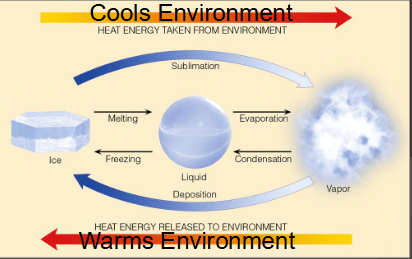
this is the energy involved in change of state
latent heat
400
List if these wavelengths will be absorbed by the atmospheric window
1. 0.5 um
2. 9 um
3. 6 um
1. No
2. Yes
3. No
400
Some energy that is scattered still reaches earth, what type of radiation is this
diffuse radiation
400
four things that control temperature
latitude
land/water heating contrasts
ocean currents
elevations
500
Name and explain the 3 things that affect seasons
Earths tilt: Is the location tilted towards or away from the sun.
Earths orbital path: where is it in is ellipse shaped path, close or away from the sun
Sun radiation angle: what angle is the sun's rays hitting the earth
500
describe the impact of greenhouse gases on the radiation budget
The surface emits longwave radiation and which is absorbed and re-emitted in all direction including the surface.
500
Draw SW and LW radiation during the day and at night during cloudy and clear sky weather (should have 4 images
***On board
500
Why is the sky blue and the sunsets red?
The sky is blue since the atmosphere scatters shorter wavelengths stronger than the longer ones (blue < red)
The sunsets are read since the sun is lower in the atmosphere and scatters most of the blue and green away and the light is dominated by the longer wavelengths.
500
Draw the phase changes of water and label whether or not energy is released or absorbed from the enviroment.