Where Does Energy Come From? Part 1 (pg. 102)
Where Does Energy Come From? Part 2 (pg. 102)
How the Havasupai Came to Be/People of the Blue-Green Waters
Part 1 (pg. 115/117)
Part 1 (pg. 115/117)
How the Havasupai Came to Be/People of the Blue-Green Waters
Part 2 (pg. 115/117)
Part 2 (pg. 115/117)
Fixing Fences
(pg. 110)
(pg. 110)
100
PAGE 107
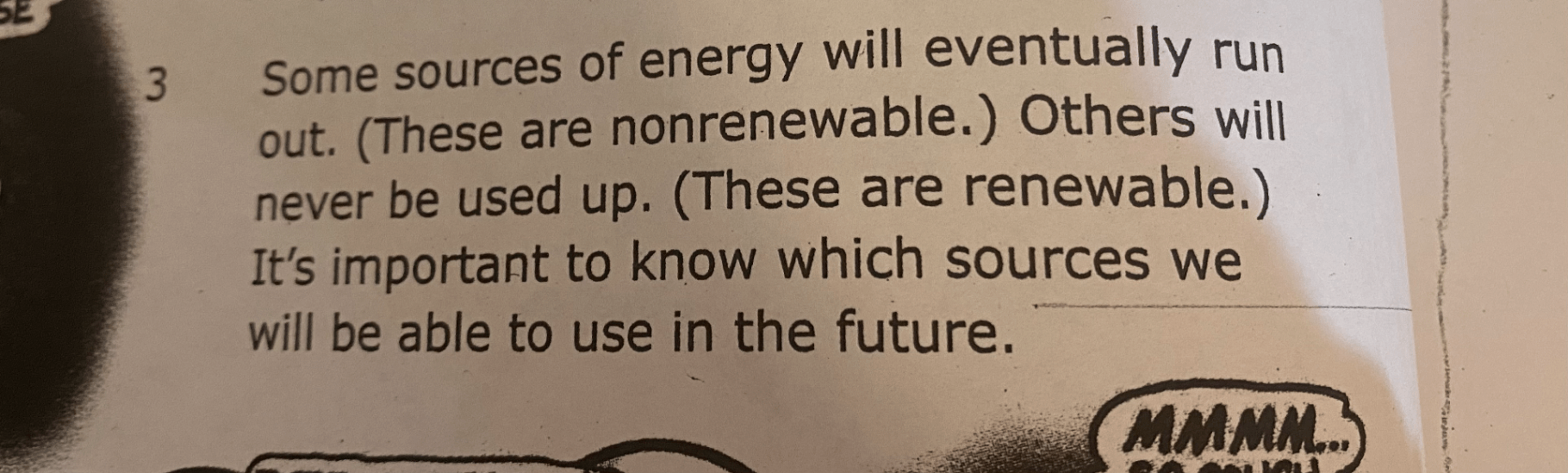
3) Which lines from the passage tells you the difference between nonrenewable and renewable energy. (RI 2.6)
a) "Anything that moves, plugs in or creates head or cold needs some kind of energy to make it work." (paragraph 1)
b) "Making and using sources of energy can hurt life on our planet." "Making and using others does little or no harm." (paragraph 2)
c) "Some sources of energy will eventually run out. Others will never be used up." (paragraph 3)
d) "It takes energy to set cars in motion, to cool refrigerators, and to run factories. Anything that moves, plugs in, or creates heat or cold needs some kind of energy to make it work." (paragraph 1)
c) "Some sources of energy will eventually run out. Others will never be used up." (paragraph 3)
100
PAGE 108
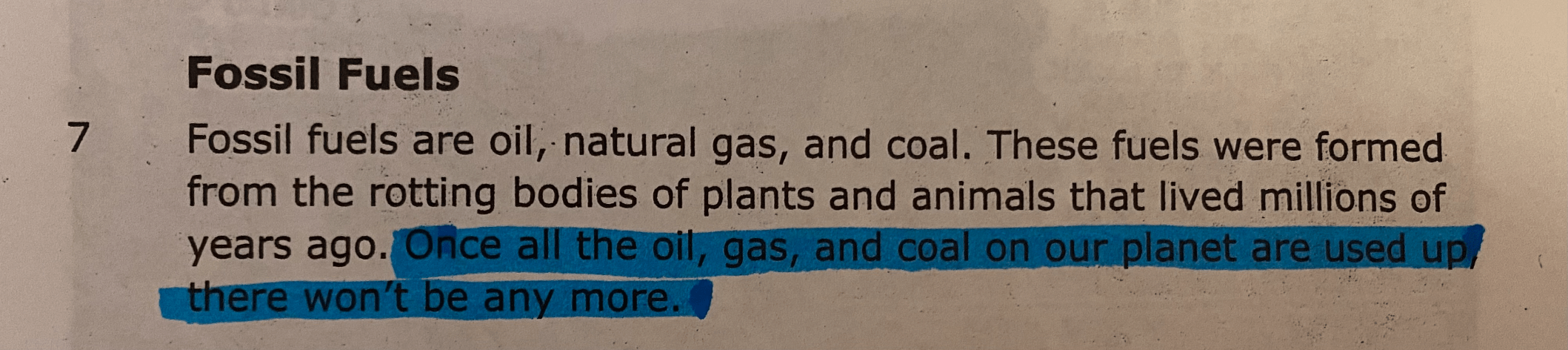
4) Does the option describe renewable or nonrenewable energy in the passage? (RI 1.1)
Fossil Fuels
a) Renewable Energy
b) Nonrenewable Energy
b) Nonrenewable Energy
100
PAGE 120
16) Tochapa and Hokomata experienced different feeling in "How the Havasupai Came to Be." Fill in the circle to select whether the option describes Tochapa or Hokomata. (RL 1.3)
Support
a) Tochapa
b) Hokomata
a) Tochapa
100
PAGE 126
25) Which sentence from paragraph 4 of "People of the Blue-Green Waters" describes where the name "Havasu Baaja" came from? (RI 1.1)
a) "They believed their people came into the world from the Grand Canyon."
b) "People of the blue-green waters."
c) "To them, the sacred canyon is the Heart of Mother Earth."
d) "Their religion teaches that the tribe is the guardian of Grandmother Canyon, the place where the world is reborn and renewed each year."
a) "They believed their people came into the world from the Grand Canyon."
100
PAGE 112
10) Which choice best explains how the poem is written?
a) a set of stanzas, randomly lined
b) a block of 16 lines
c) a series of 16 sentences
d) a group of 4 paragraphs
a) a set of stanzas, randomly lined
200
PAGE 108
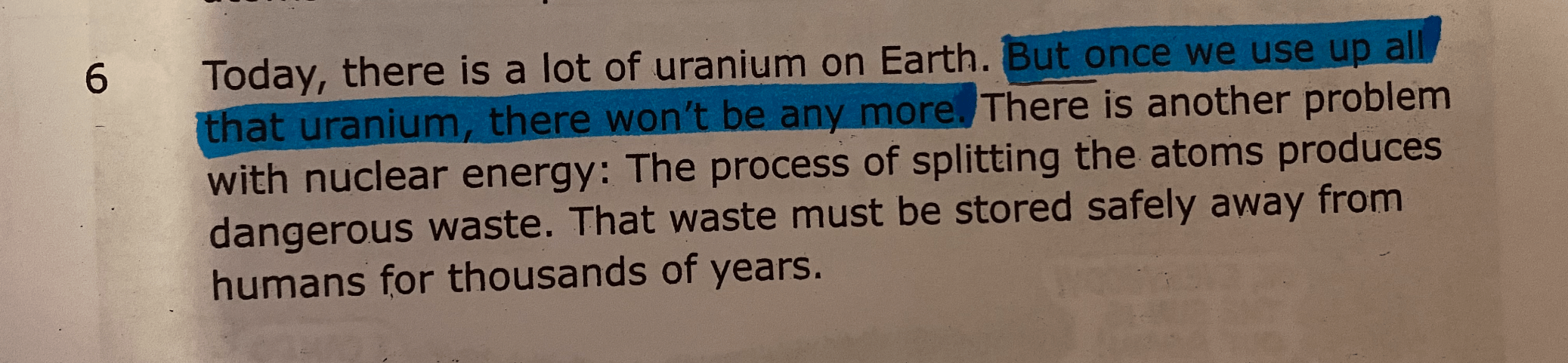
4) Does the option describe renewable or nonrenewable energy in the passage? (RI 1.1)
Nuclear Power
a) Renewable
b) Nonrenewable
b) Nonrenewable
From the section Nuclear Energy
200
PAGE 108
4) Does the option describe renewable or nonrenewable energy in the passage? (RI 1.1)
Hydro Power
a) Renewable
b) Nonrenewable
a) Renewable
From the section "HydroPower"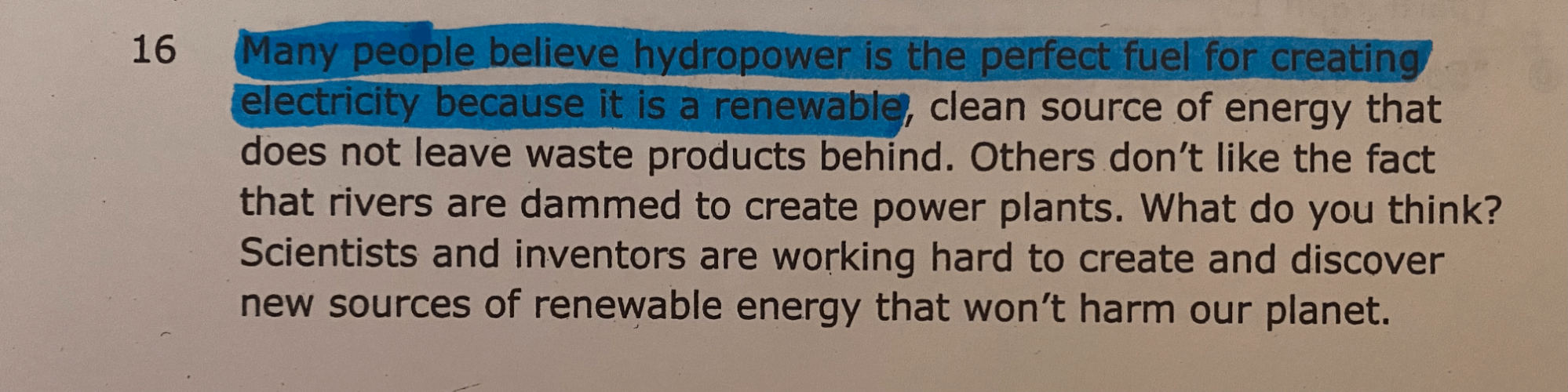
200
PAGE 120
16) Tochapa and Hokomata experienced different feeling in "How the Havasupai Came to Be." Fill in the circle to select whether the option describes Tochapa or Hokomata. (RL 1.3)
Anger
a) Tochapa
b) Hokomata
b) Hokomata
200
PAGE 126
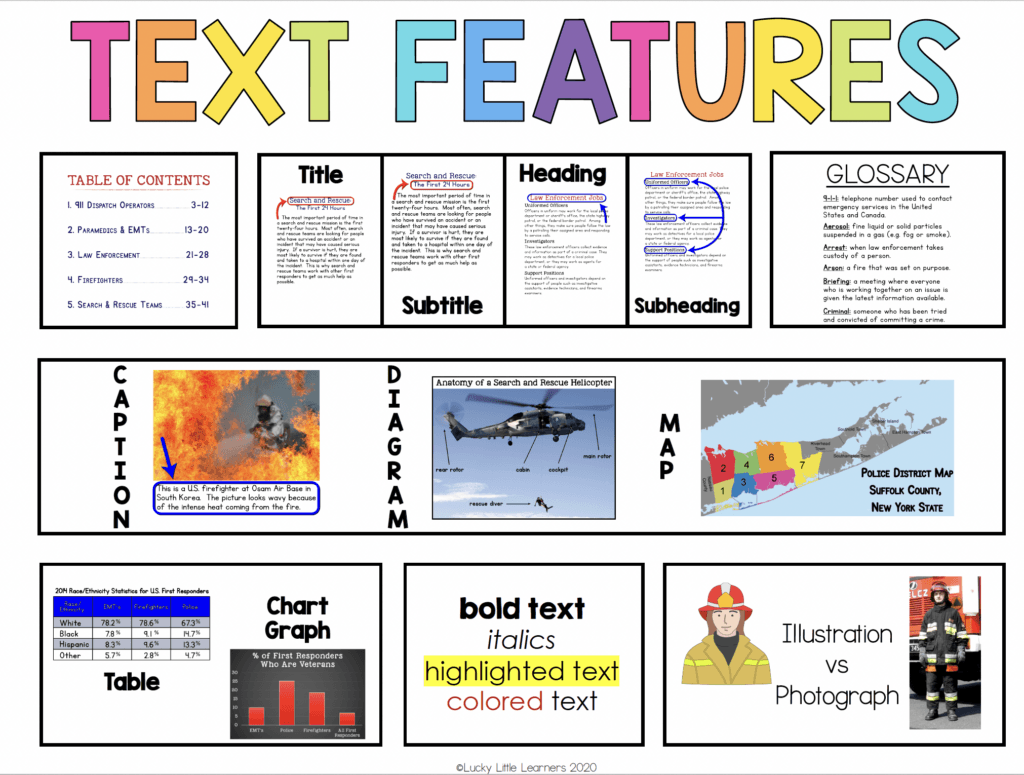
26) What text feature would best support the information found in paragraph 4 of "People of the Blue-Green Waters?" (RI 3.7)
a) a picture
b) a subtitle
c) a diagram
d) a map
a) a picture
200
PAGE 112
11) What is the setting of the poem?
a) a quiet street on the edge of a town
b) a forest in the middle of the winter
c) the backyard of a house in the country
d) a wood with two roads in it
c) the backyard of a house in the country
300
PAGE 106
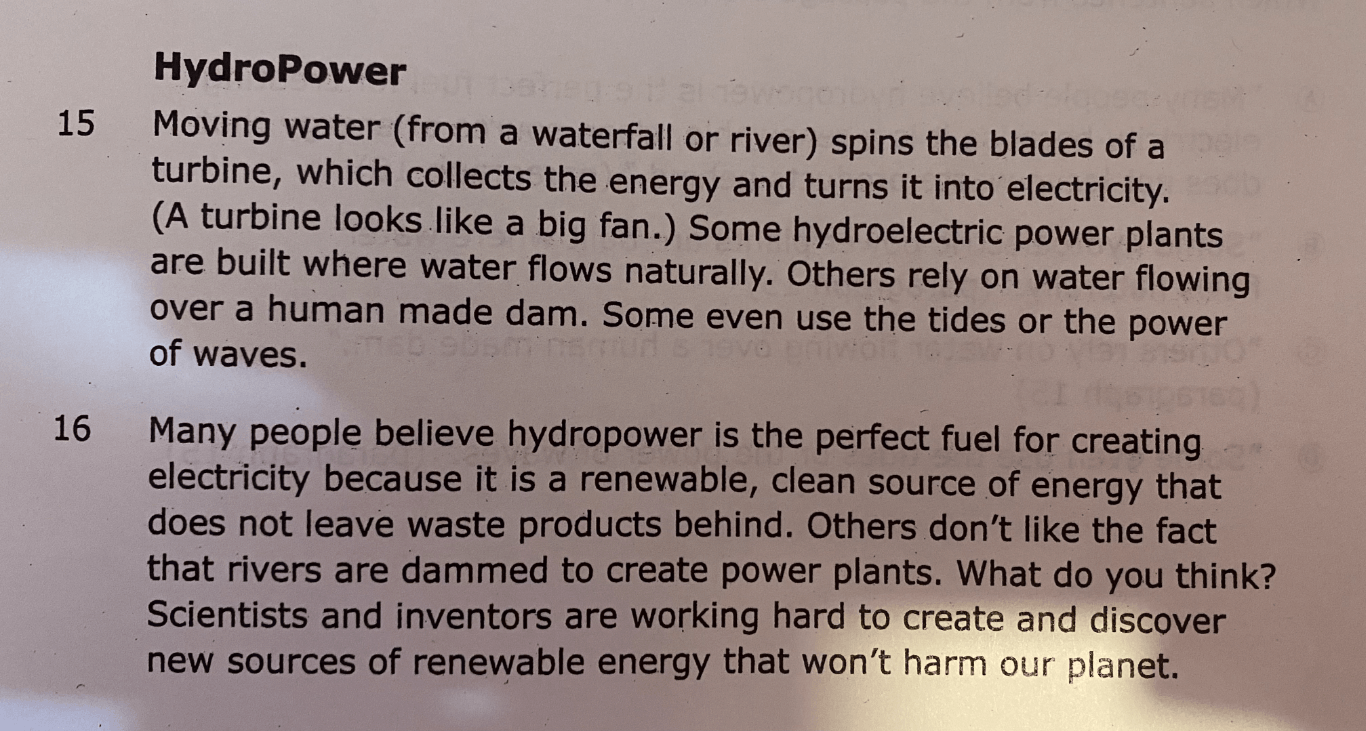
1) According to the passage, what was one reason many people liked hydropower more and any other renewable energy? (RI 1.1)
a) People could use this renewable energy and it does not leave waste behind.
b) People could use energy and it will eventually run out.
c) People could only use energy to travel to warm places.
d) People could travel at the time that was best for them.
a) People could use this renewable energy and it does not leave waste behind.
300
PAGE 108
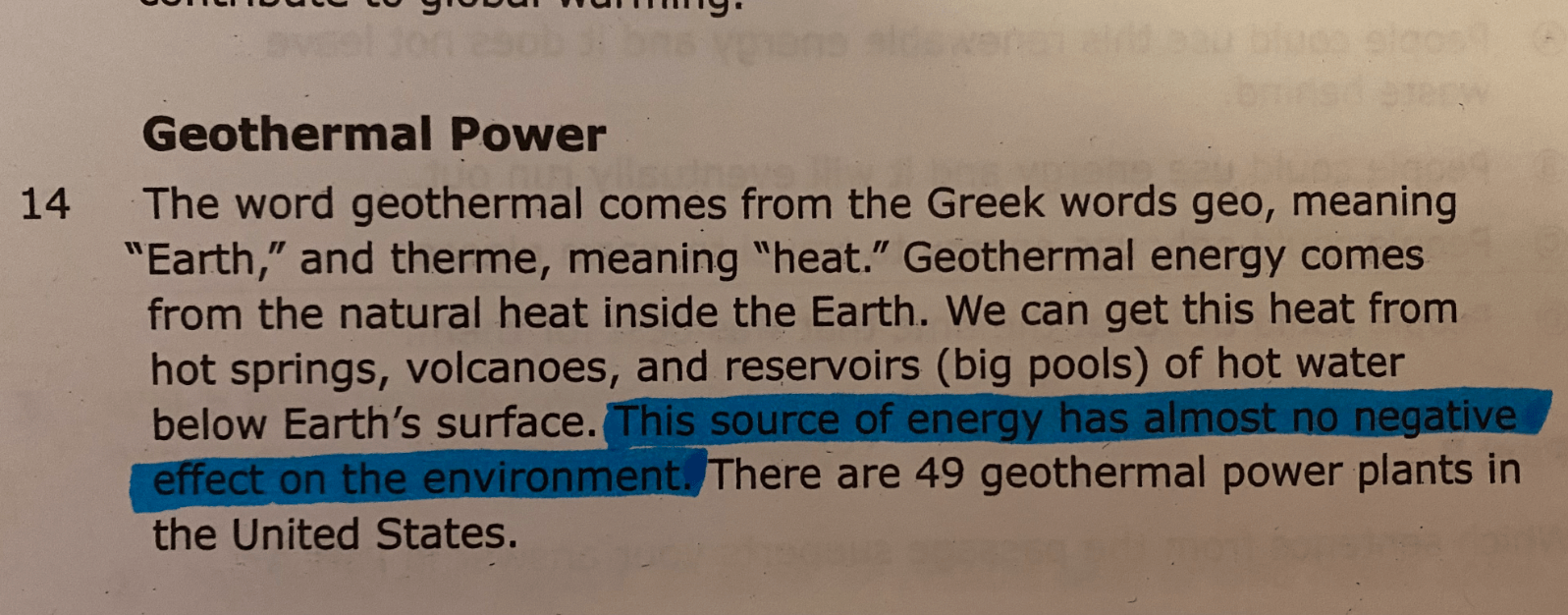
4) Does the option describe renewable or nonrenewable energy in the passage? (RI 1.1)
Geothermal Power
a) Renewable
b) Nonrenewable
a) Renewable
300
PAGE 121
18) How does the point of view in "How the Havaupai Came to Be" affect the reader's understanding of the passage? (RL 2.6)
a) Because of the passage's third person narrator, the reader does not understand how either Tochapa or Hokomata feels about the events in the passage.
b) Because of the passage's third person narrator, the reader can understand how both Tochapa or Hokomata feel about the events in the passage.
c) Because of the passage's first-person narrator, the reader only understands how Tochapa feels about the events in the passage.
d) Because of the passage's first-person narrator, the reader only understands how Hokomata feels about the events in the passage.
b) Because of the passage's third person narrator, the reader can understand how both Tochapa or Hokomata feel about the events in the passage.
300
PAGE 127
28) Read the sentence from paragraph 1 of "People of the Blue-Green Waters."
"It is also one of the only places where the mail is delivered by mule."
What does this sentence tell the reader about the Supai Village? (RI 1.1)
a) The Supai Village was remote.
b) The Supai Village was local.
c) The Supai Village was close.
d) The Supai Village was relevant.
a) The Supai Village was remote.
300
PAGE 114
14) Read stanza 3 of the poem. The poem uses an example of what type of figurative language?
a) metaphor
b) hyperbole
c) onomatopoeia
d) personification
d) personification
400
PAGE 107
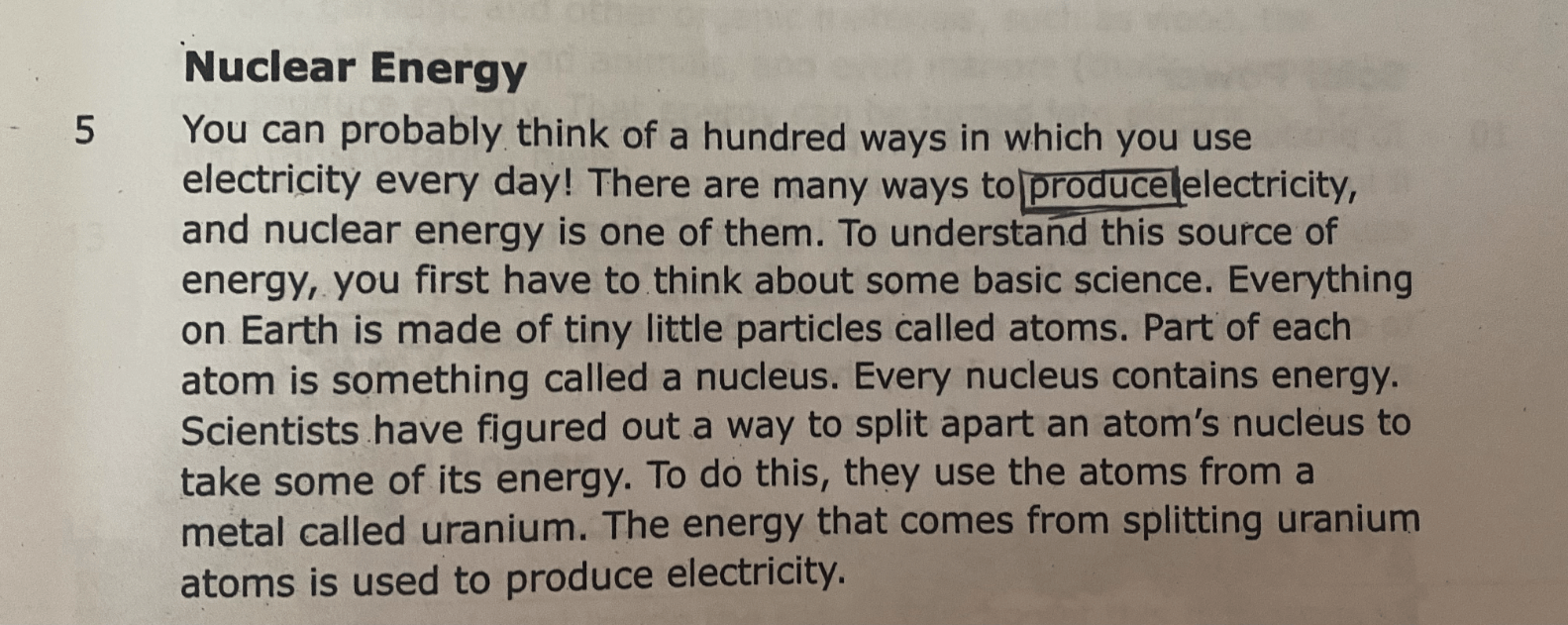
2) The Latin root pro means "in place of." Based on this information, what is the meaning of the word produce as it is used in paragraph 5? (RI 2.4)
a) something very clear
b) something that can be replaced
c) something usually forgotten
d) something people cannot replace
b) something that can be replaced.
400
PAGE 109
6) Which detail from the passage best supports the idea that energy is the ability to work? (RI 3.8)
a) "Making and using some sources of energy can hurt life on our planet." (paragraph 2)
b) "Making and using others does little or no harm" (paragraph 2)
c) "It's important to know the difference." (paragraph 2)
d) "It takes energy to set cars in motion, to cool refrigerators, and to run factories." (paragraph 1)
Think about which answer is showing things working...
d) "It takes energy to set cars in motion, to cool refrigerators, and to run factories." (paragraph 1)
400
PAGE 120
15) Which sentence from "How the Havasuapi Came to Be" shows an example of how Tochapa had determination? (RL 1.3)
a) "So he can cut down a great ponion tree and hollowed out the trunk to make a boat for Pu-keh-eh to keep her safe as the water rose and flooded earth." (paragraph 2)
b) "Pu-keh-eh who he hoped would become the mother of all living things and the grandmother of the future tribes of people." (paragraph 1)
c) "Tochapa the Good knew he had to save this precious daughter..." (paragraph 2)
d) "Tochapa closed up the end of the tree and sat down to await the destruction of the world." (paragraph 3)
a) "So he can cut down a great ponion tree and hollowed out the trunk to make a boat for Pu-keh-eh to keep her safe as the water rose and flooded earth." (paragraph 2)
400
PAGE 128
29) Read this sentence from paragraph 3 of "People of the Blue Green Waters."
"At the top of the Grand Canyon, the desert is harsh, dry, and uninhabitable as a moonscape."
What word has a similar meaning to the world uninhabitable as it is used in the sentence? (RI 2.4)
a) desolate
b) livable
c) safe
d) domesticated
a) desolate
400
PAGE 113
13) Read line 12 of the poem. What is the synonym of posthole the way it is used in the poem?
a) opening
b) solid
c) closure
d) pile
a) opening
500
PAGE 108
5) Read this sentence from the passage.
"Moving water spins the blades of a turbine, which collects energy and turns it into electricity."
What is the meaning of the word turbine in this sentence? Choose two answers. (RI 2.4)
a) a machine for producing continuous energy
b) a generator (converts energy to power) to use for a machine
c) a machine to keep the environment safe
d) a machine that produces pollution
e) a generator (converts energy to power) to use to keep the environment safe.
a) a machine for producing continuous energy
b) a generator (converts energy to power) to use for a machine
500
PAGE 109
7) Based on paragraph 6, which detail shows how dangerous nuclear energy can be?
a) Today, there is a lot of uranium on Earth.
b) But once we use up all that uranium, there won't be anymore.
c) There is another problem with nuclear energy: The process of splitting the atoms produces dangerous waste.
d) That waste must be stored safely away from humans for thousands of years.
e) Fossil fuels are oil, natural gas, and coal. These fuels were formed from the rotting bodies of plants and animals that lived millions of years ago.
c) There is another problem with nuclear energy: The process of splitting the atoms produces dangerous waste.
500
PAGE 122
20) How does the introduction help express the meaning of "How the Havasupai Came to Be" to the reader? (RL 1.1)
"According to their creation story, the Havasupai Indians originated from the Grand Canyon, in the deep gorge they live in today. as the Havasupai tell the story..."
a) It helps the reader understand that this is an origin story.
b) It helps the reader imagine how Hokomata wanted to drown the world.
c) It helps the reader appreciate the careful way Tochapa makes the boat for Hokomata.
d) It helps the reader understand why Hokomata is so evil when he covered Earth with a great flood.
a) It helps the reader understand that this is an origin story.
500
PAGE 127
27) Read this paragraph from "People of the Blue-Green Waters"
"The village, which is their ancestral home has been continuously occupied for about a thousand years."
What is the meaning of the word ancestral as it is used in the passage? Select two choices.
a) born with
b) current
c) introductory
d) inherited
e) ascending
a) born with
AND
d) inherited
500
PAGE 111
8) What theme is best supported by the poem? (RL 1.2)
a) giving up hope
b) making a difficult choice
c) enjoying the present moment
d) having the courage to fight for something you believe in
c) enjoying the present moment