Evolution Vocab
Evolution
Natural Selection Vocab
Natural Selection
Interpreting Diagrams & Charts
Practice Questions
100
Chart showing the order that specific organisms have evolved from a common ancestor.
Cladogram (phylogenetic tree)
100
What is artificial selection?
Selective breeding for specific traits. (Human-controlled/directed)
100
Describe natural selection.
the adaptations that produce the highest fitness will become more prominent in the population
100
What would cause one animal to have higher fitness than another?
Having more offspring.
100
Which animal is more closely related to the gray wolf? The dog or the coyote?
Dog
100
The roughly 30 species of silverswords that can be found in Hawaii developed from a single common ancestor.

The success of individual plant species is most likely the result of which process?
A. genetic drift
B. natural selection
C. genetic resistance
D. selective breeding
B. natural selection
200
Define homologous structure.
Similar structures in organisms that share a common ancestor.
200
The wings of a bird and a moth are examples of what types of structures?
Analogous Structures
200
Define biological fitness.
The ability of an organism to survive and reproduce in its environment.
200
What is it called when there is a change in allele frequency due to random occurrences?
Genetic Drift
200

Which animals do not have amniote eggs?
Amphibians, fish, and sharks
200
The graph indicates the changes over time in a particular trait in a population of shrew.

Which statement best explains what occurred after 10 years?
A. A mutation in the shrew population made the trait more common.
B. Inheritance of the trait slowed as the population of shrews decreased.
C. The shrew population began breeding with another shrew population.
D. An environmental change favored the trait for selection within the population.
D. An environmental change favored the trait for selection within the population.
300
Define analogous structure.
Similar structures that have the same function, but organisms do NOT share a common ancestor. These structures have evolved independently
300
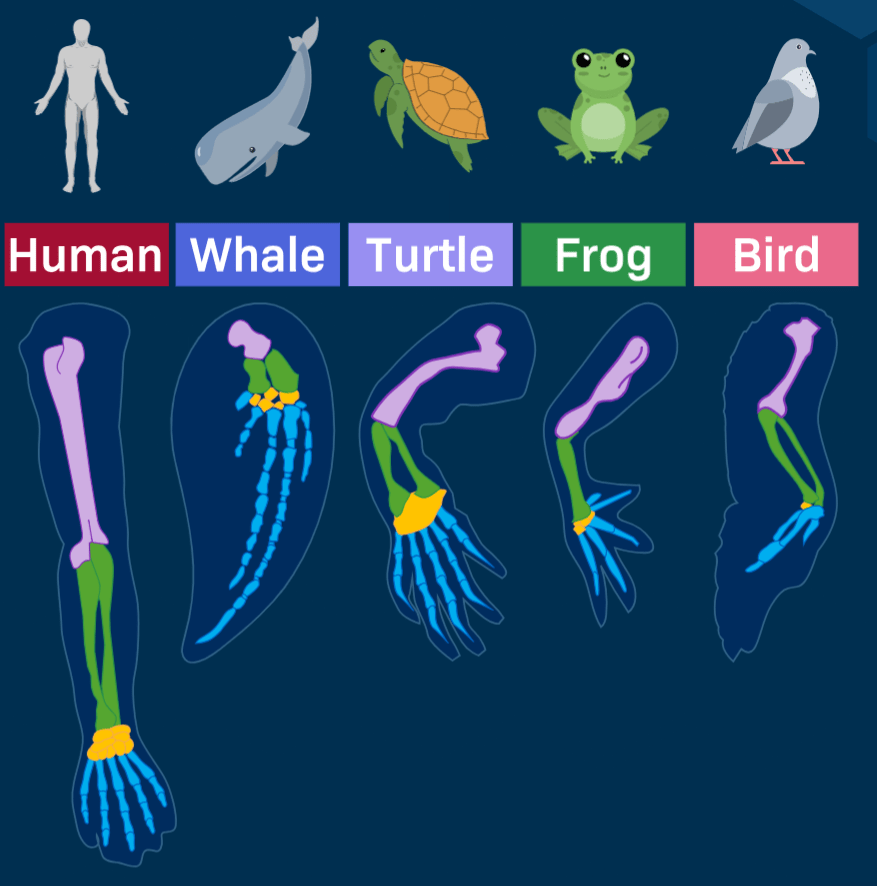
What information can be determined by this diagram?
All of these species have homologous features, so they must share a common ancestor.
300
Define adaptation.
a heritable characteristic that increases an organism’s fitness (can be physical or behavioral)
300
What populations that are not experiencing natural selection have
Genetic Equilibrium
300
Using anatomical data, scientists have shown that humans are most closely related to gorillas. Recent technological advances have allowed scientists to use amino acid sequences to determine evolutionary relationships. To examine the relationships of primates further, scientists compared the amino acid sequence for insulin in several primates.
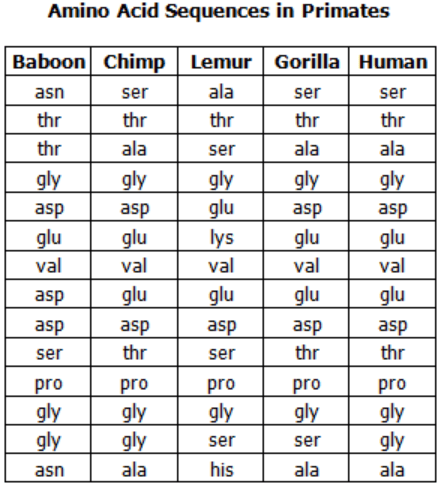 Based on the data, which species is the closest living primate relative to humans?
Chimpanzees
300
The table lists some ways that plants have adapted to survive in a desert biome.
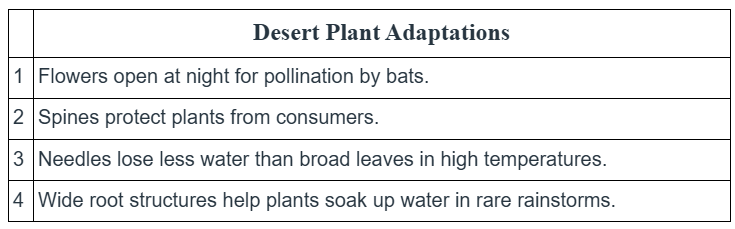
Which statements describe adaptations to biotic factors in a plant’s desert biome? (Choose all that apply.)
A. Statement 1
B. Statement 2
C. Statement 3
D. Statement 4
A & B: Statements 1 and 2
400
What are structures that have lost their original function, because that organism no longer needs them? Provide one example.
Vestigial structures.
Examples: pelvic bones in whales, tailbone in humans, non-functional wings in flightless birds, etc.
400
The pelvis and femur bones of a whale are examples
of which type of structure?
Vestigial Structures
400
What is a gene pool?
all the different alleles present in a population
400
Describe two examples of reproductive barriers (reproductive isolation).
Pre-zygotic:
Geographic Isolation (physical barrier)
Temporal Isolation (time)
Behavioral Isolation
- Gamete & Mechanical Isolation
Post-zygotic:
Hybrid inviability
Hybrid sterility
400
Researchers studied four species of birds on a small island. They hypothesized that birds with larger beaks eat larger seeds. They collected as many birds as they could find of each species, measured their beaks, and graphed the data.

Then the researchers searched for the types of seeds that the birds ate.
Which seeds would you expect each of the species to eat?
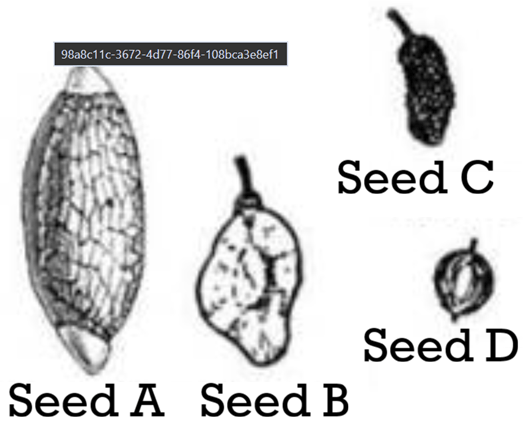
Species W and X would eat Seeds C and D.
Species Y and Z would eat Seeds A and B.
400
The flowchart shows the early steps in the formation of life on Earth.

How should missing steps X and Y be labeled in the flowchart?
A. X: appearance of single-celled autotrophs; Y: appearance of single-celled heterotrophs
B. X: appearance of single-celled heterotrophs; Y: appearance of single-celled autotrophs
C. X: appearance of multi-celled heterotrophs; Y: appearance of multi-celled autotrophs
D. X: appearance of multi-celled autotrophs; Y: appearance of multi-celled heterotrophs
B. X: appearance of single-celled heterotrophs; Y: appearance of single-celled autotrophs
500
Describe gradualism and punctuated equilibrium.
Gradualism: Small changes accumulate to form big changes.
Punctuated Equilibrium: Rates of change accelerate over short periods in small, peripheral populations and then stabilize for long periods in large, central populations.
500
What type of population is more resilient to climate change: a genetically diverse or genetically similar population? Explain your answer.
A genetically diverse population is more resilient because it has greater variation which increases the chances that some phenotypic variant will be able to survive changes in the environment.
500
What is an allele frequency?
percentage of an allele within the population
500
List 3 sources of genetic variation
Mutation/ Translocation, Crossing Over, Independent Assortment, Sexual Reproduction, Immigration
500
The data table shows environmental changes and the changes in the leaves on one tree over time.
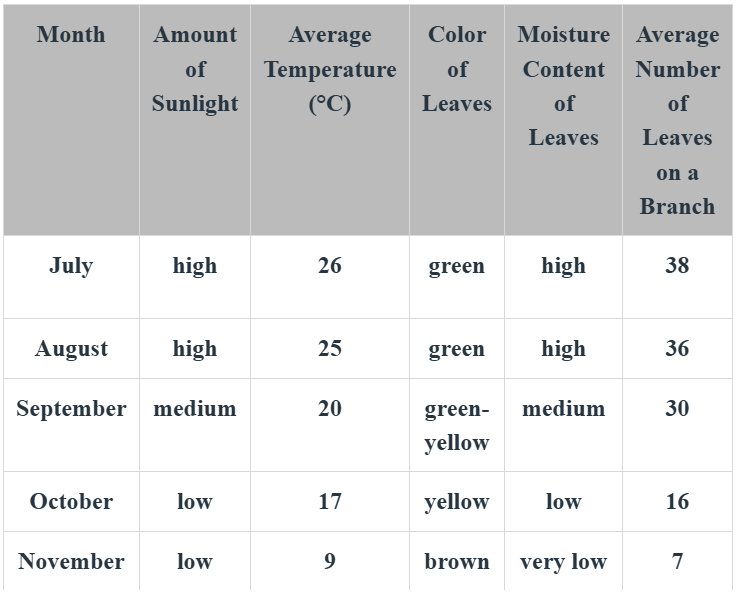
Which environmental factor helps cause the changes in the color of the leaves?
Decrease in the amount of sunlight
500
The Tiktaalik roseae fossil was recently discovered. This fossil is of a fish that lived approximately 370 million years ago. It had scales like fish. Unlike other fish fossils, this fossil has fins with jointed wrists similar to the wrist of a crocodile.

What is the evolutionary significance of jointed wrists on this fish?
A. Improved ability to hunt deep ocean fish.
B. Improved ability to obtain oxygen.
C. Improved ability to mate with others.
D. Improved ability to maneuver onto land.
D. Improved ability to maneuver onto land.
Note: Tiktaalik is a transitional species between marine and land animals.