Vocab
Interpreting Data
Types of Evidence
Cause, Event, Effect
Factors of Natural Selection
100
A group of interacting individuals of the same species in the same area.
A: Species
B:Community
C: Population
D: Group
C: Population
100
What conclusion can we draw from this graph?
A:Normal wingshape provides a reproductive advantage
B: Normal wingshape does not provide a reproductive advantage
C: The normal wing is an adaptation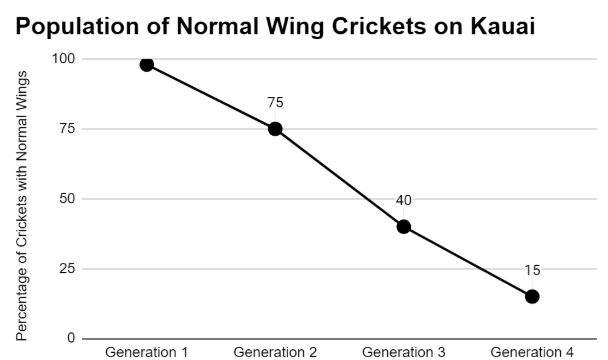
B: Normal wingshape does NOT provide a reproductive advantage
(because the number of crickets with normal wings are decreasing over time, meaning they are dying faster than they are reproducing)
100
Is the following type of evidence quantitative or qualitative?
Percent parasitized
Quantitative
Numbers
100
What would the best cause for this scenario be?
A) Reproductive Advantage
B) The parasites were killing male crickets
C) A DNA mutation
D) A disease
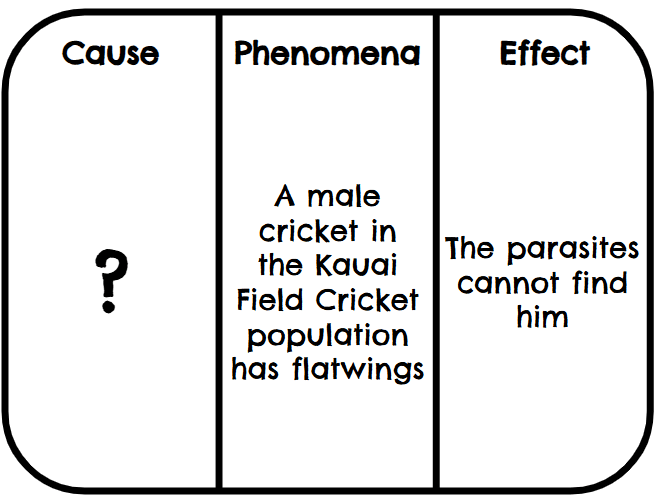
C) A mutation
The mutation causes the first cricket to develop flatwings instead of normal wings
100
In a population of labradors, some had brown fur, some had black fur, and some had yellow fur. Which factor of natural selection is being described?
Genetic Variation
200
A process by which a population becomes better suited for its environment.
A: Reproductive Advantage
B: Adaptation
C. Variation
D: Species
B: Adaptation
200
What conclusion can we draw from the table?
A: The parasite rate increased after the flatwing mutation.
B: Flatwing mutation provided a reproductive advantage.
C: The parasite level remained the same.
D: Normal wingshape provides a reproductive advantage.
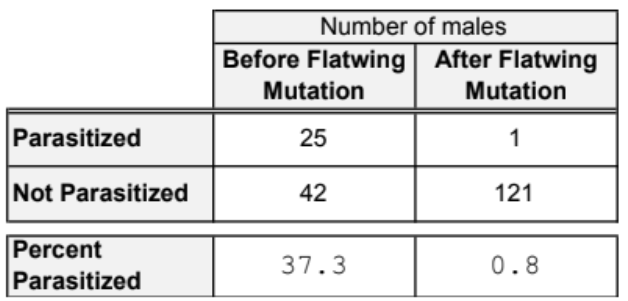
B: The flatwing mutation provided a reproductive advantage
Less than 1% of the males after the flatwing mutation had parasites sprayed on them (which kills them) meaning the mutation makes it easier for the crickets to survive and reproduce.
200
Is the following type of evidence quantitative or qualitative?
Fur Color
Qualitative
(Description or characteristic)
200
What would the best phenomena (visible event) be?
A) A mouse develops black fur
B) A mouse develops tan fur
C) A mouse develops gray fur
D) A mouse develops webbed feet
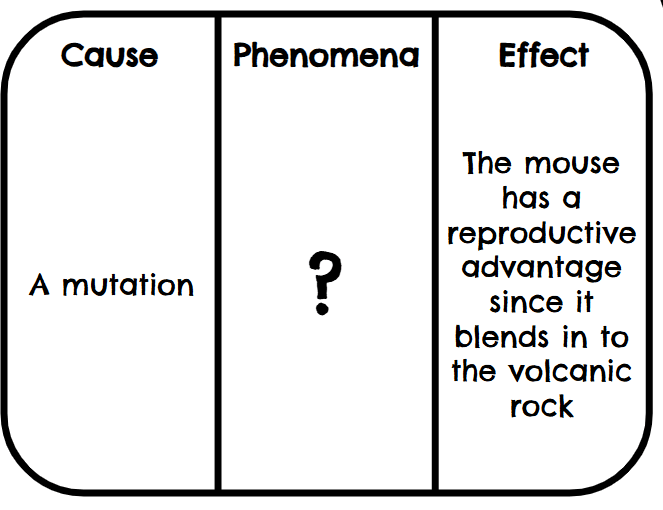
A) a mouse develops black fur
The black fur is what gives the outcome of a reproductive advantage in volcanic rock
200
Having polydactyly for your fingers is a trait that can be passed on from parents to offspring. Which factor of natural selection is being described?
Heritability
300
Those who are better suited for their environment survive and produce offspring.
A: Reproductive Advantage
B: Adaptation
C: Variation
D: Species
A: Reproductive Advantage
300
What conclusion can we draw from this data table showing the percent of population with brown and white fur from 2015-2019?
A) Brown fur became the adaptation
B) White fur became the adaptation
C) The brown fur became the variation
D) The white fur became the variation
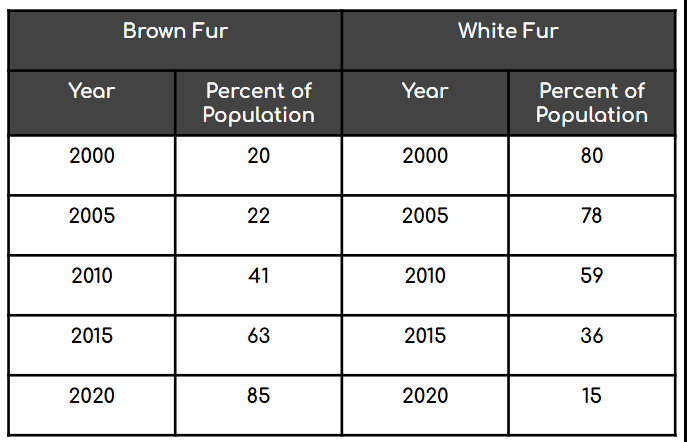
A) Brown fur became the adaptation
Adaptations are the traits that make it easiest to survive in the environment - so their percentage in a population tends to increase over time as it becomes easier to survive and reproduce
300
Is the following type of evidence quantitative or qualitative?
Distance Traveled
Quantitative
(number)
300
What would the most likely effect be for this scenario?
A) Both bunnies survive
B) Only the white bunnies survive
C) Only the brown bunnies survive
D) Neither has a reproductive advantage
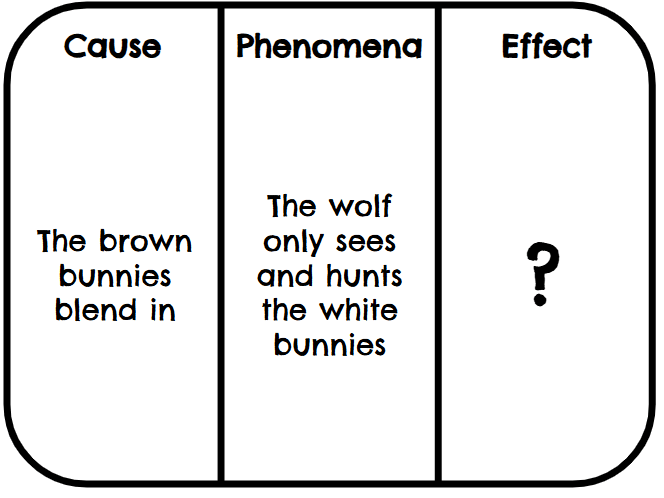
C) Only the brown bunnies survive
The brown bunnies blend in, so they are less likely to be eaten. The white bunnies stand out and are easily seen, and are more likely to die as prey.
300
In an environment with only tall trees, long necked giraffes have an easier time getting food over their fellow short necked giraffes. Long necked giraffes survive and reproduce more successfully than the short neck giraffes. Which factor of natural selection is being described?
Reproductive Advantage
400
What is our definition of species?
A: Groups of animals that share traits in common with one another
B: Groups of organisms that are located near one another on a phylogenetic tree
C: Creatures that have changed over time to be best suited for their environment
D: A group of organisms with similar characteristics that are able to exchange genetic information (interbreed).
D: A group of organisms with similar characteristics that are able to exchange genetic information (interbreed).
400
What conclusions can we draw from this table tracking pigeon wingspan over time?
A) The average height of pigeons is decreasing
B) The average distance is decreasing
C) The average lifespan is decreasing
D) The average wingspan is decreasing
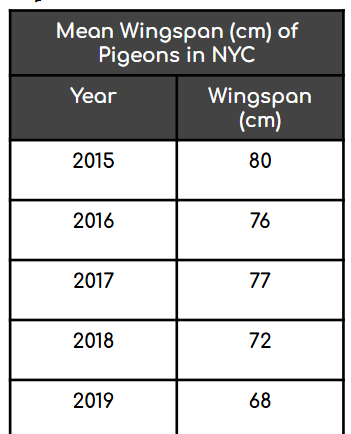
D) The average wingspan is decreasing
400
Is the following type of evidence quantitative or qualitative?
Different fur pigmentation
Qualitative
(description or characteristic)
400
Identify the best cause for the following scenario.
A) The green beetles blend in
B) The purple beetles blend in
C) There is no reproductive advantage
D) A DNA mutation occurs
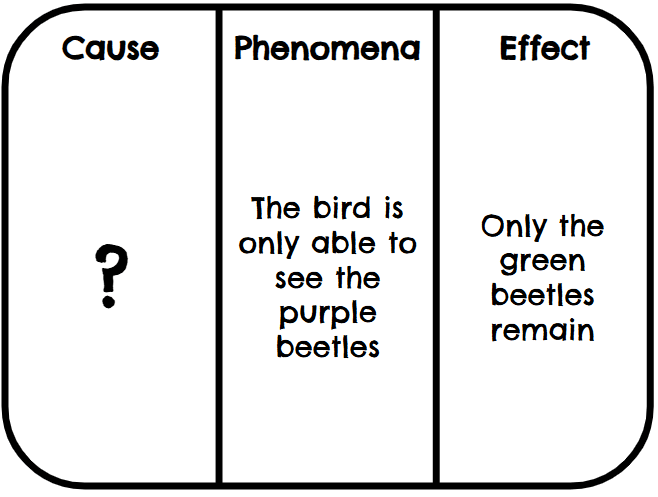
A) The green beetles blend in
400
List the 3 factors of Natural Selection.
Genetic Variation
Heritability
Reproductive Advantage
500
Write the definition of variation.
The variety of different gene combinations that exist within a population.
Pigeon Example: Feather color (brown, blue, white)
500
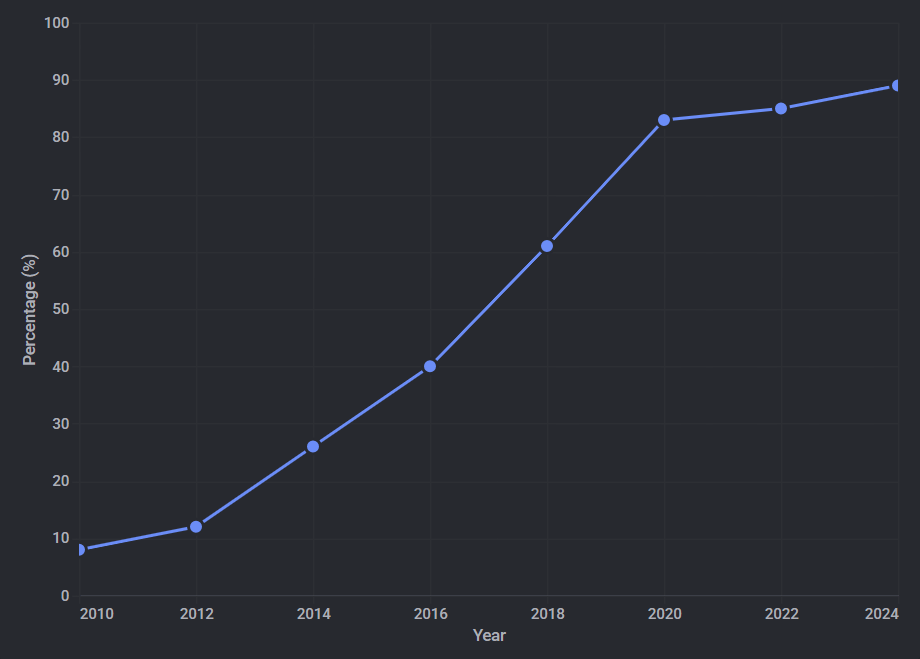
Create a graph representing the following data, and write down a brief conclusion we can draw from the graph.
Green beetle percentage in a population
2010: 8%
2012: 12%
2014: 26%
2016: 40%
2018: 61%
2020: 83%
2022: 85%
2024: 89%
Your graph should look like the one below, and include a title of "Percentage of Green Beetles in the Population over Time"
500
Is the following type of evidence quantitative or qualitative?
Qualitative
(description or characteristic)
500
What would be the most likely phenomena (event) for this cause and effect?
A) The only food availabe was soft seeds
B) The only food available had hard seeds
C) There was a wide variety of food available
D) There was no food available
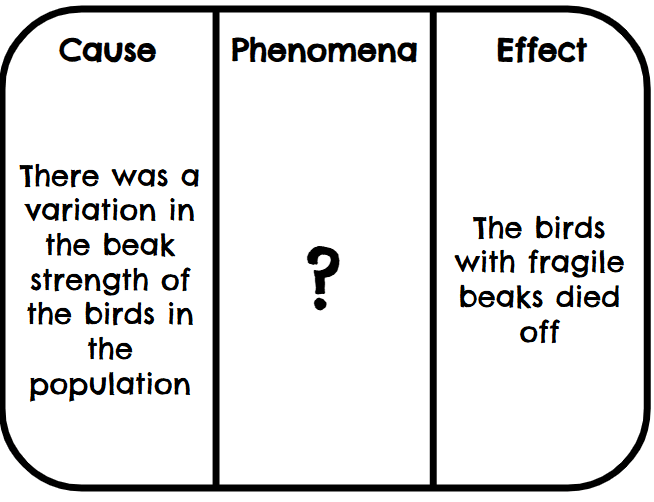
B) The only food available was hard shell seeds
This event allows us to see that in a population with a variety of beak strengths, fragile beak birds who cannot break the hard shelled seeds would starve and die off
500
Identify the population, adaptation, and genetic variation in the following scenario.
Rock pocket mice in the southwestern USA have two different fur colors - tan and black. After a sandstorm covers the environment with light colored sand, the black mice are easily spotted by predators and start to die off.
Population: Rock pocket mice in Southwestern USA
Genetic Variation: Tan and Black fur
Adaptation: Tan fur