Nerve Failures
D-eye-agnostics
Paw-pourri
Think Fast! (Reflexes)
Appl-eye-d Anatomy
100
This tool is the only one that can reliably diagnose retinal detachment, especially if a fundic exam is not possible.
What is an ocular ultrasound?
100
This structure allows for conjugate eye movement.
What is the medial longitudinal fasciulus?
200
A patient with dorsolateral strabismus has a failure of this muscle, innervated by this cranial nerve.
What is the dorsal oblique, innervated by CNIV (Trochlear Nerve)?
200
These two categories of animals do NOT have a consensual pupillary light reflex
What are birds and fish?
200
While in a surgical plane of anesthesia, a patient does not have a palpebral reflex. Name the two nerves that are not responding due to anesthesia.
What are CNV (Trigeminal) and CNVII (Facial)?
300
A patient with a cortical blindness will have negative results on these two tests.
What are tracking and maze tests?
300
The pupillary constrictor muscle has these types of receptors.
What are muscarinic receptors?
300
Name the THREE nerves responsible for the menace response.
What are:
CNII (Optic Nerve; to process movement)
CNVI (Abducens; retractor bulbi)
CNVII (Facial; to blink)
300
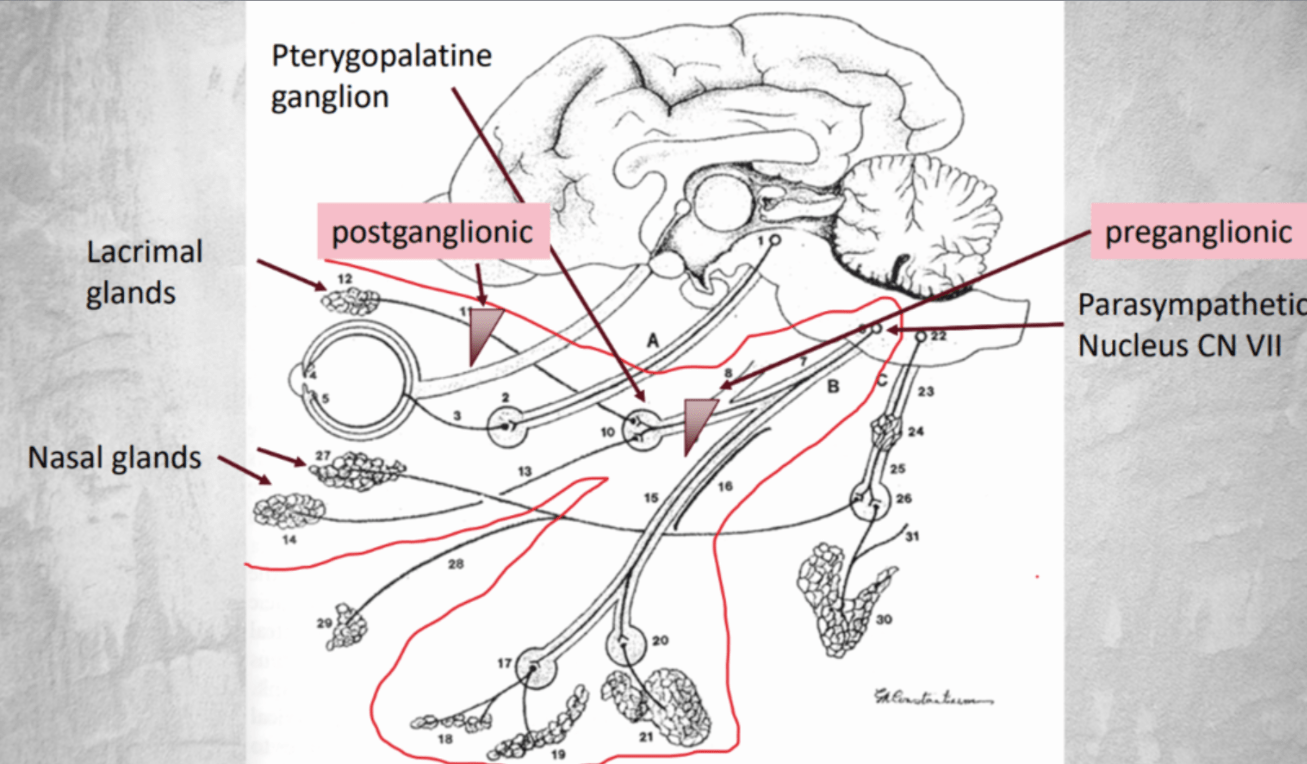
A dog comes in with a right dry eye and dry nostril. As an amazing veterinarian, you suspect or diagnose this disease (with location of lesion!)
What is
Preganglionic Neurogenic keratoconjunctivitis sicca
400
A patient whose direct pupillary light reflex is absent while the consensual pupillary light reflex is present has a defect in this nerve.
What is CNIII (Oculomotor)?
400
A dog that was diagnosed with a pituitary tumor is now unable to move their eyes. You diagnose this issue, and know that these 4 nerves can be affected.
What is cavernous sinus syndrome?
Cranial nerves 3, 4, 5, and 6
500
Name three medications discussed to test for diseases and what each one is trying to diagnose.
What are:
1% Phenylephrine- Horner's Syndrome
1% Pilocarpine- Dysautonomia
Atropine- Uveitis
(Will also accept Tropicamide for dilating the pupil)