Bone to be Wild
Muscle Hustle
Action Jackson
Joint Venture
Directional Dysfunction
Origin Story
100
Commonly referred to as the "sit bones"
Ischial Tuberosity
100
These muscles make up the Erector Spinae group
Iliocostalis, Longissimus, Spinalis
100
The left side of this trunk muscle is used when I am driving and try reach something in my back seat.
External Oblique
100
The synovial joints allow this movement classification.
Diarthrotic
100
While standing, your cervical vertebrae are located _____ to your lumbar vertebrae.
Superior
100
Proximal, medial, stable
Origins
200
Prominent ridge of the ilium
Iliac Crest
200
Given the origin of pubic symphisis and pubic crest, name this muscle's insertion.
Cartilage of ribs 5–7 and xiphoid process
200
Fixes the last rib during forced inhalation and exhalation
Quadratus Lumborum
200
The arm has these types of synovial joints
Hinge, Saddle, Condyloid/Ellipsoid, Pivot, Ball and Socket, and Gliding
200
Which plane separates the left and right side of the body
Sagittal
200
The muscle with the origin of the anterior surface of the sacrum has this insertion point
Superior aspect of the greater trochanter
300
Hole in a bone for other structures to pass through
Foramen
300
Has an insertion at the pes anserinus tendon
Gracilis
300
This adductor flexes the hip and does not attach to the linea aspera.
Pectineus
300
This joint allows dorsiflexion and plantarflexion
Talocrural joint (ankle)
300
When your client is laying prone on the table, you have access to the ______ side of their body if they were split by the coronal plane
Posterior
300
What is the origin of this muscle?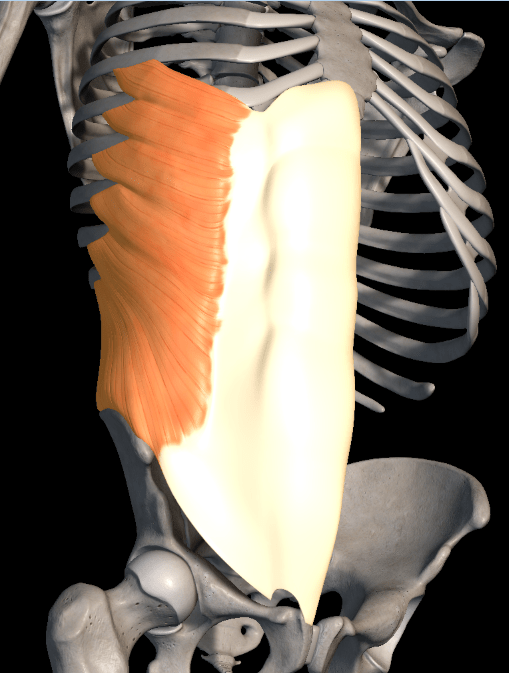
External surfaces of ribs 5–12
400
Three structural classifications of joints
Fibrous, Cartilaginous, Synovial
400
This muscle that originates at the interosseous membrane everts the foot instead of inverting it.
Extensor digitorum longus
400
Name of the muscle you'd work on if your client has a limited range of motion when flexing their wrist
Extensor digitorum (remember that ROM issues target the antagonist of the movement)
400
These are the ranges of motion found in the vertebral column
Flexion, extension, lateral flexion (L/R), and rotation (L/R)
400
While adducting your hip, your foot is moving in this direction.
Medially
400
The origin of the muscle that everts the foot and assists in plantar flexing the talocrural joint
Head of fibula; proximal two-thirds of lateral fibula
500
The total number of individual vertebrae in the cervical, thoracic, and lumbar regions combined
24 (Cervical - 7, Thoracic - 12, Lumbar - 5)
500
This muscle inserts at the iliotibial tract and is not on the secret menu at Starbucks.
Tensor Fasciae Latae
500
Which adductors are excluded if a movement requires hip flexion?
Gracilis
500
Synanthrotic movement is associated with what type of joint?
Fibrous
500
When working with varicose veins, massage strokes should be directed in this direction, relative to the affected area
Proximally
500
This muscle flexes the hip, flexes the trunk, and tilts the pelvis anteriorly
Iliopsoas