Communication- Vocab
Communication- Technique
MISC 😈
World Religions
Culturally Competent Care
100
What is therapeutic communication?
An intentional, professional interaction focused on the patient's emotional, psychological, and physical well-being.
100
What therapeutic communication technique involves repeating the patient's main idea in slightly different words to encourage the patient to continue talking?
Restating, this shows the patient that the nurse is actively listening.
100
A nurse is explaining a new medication to a patient. After explaining the instructions, the nurse asks, “Can you tell me in your own words how you will take this medication at home?”
What is the nurse primarily attempting to evaluate?
A. The patient's ability to memorize medical terminology
B. Whether the patient received and understood the message
C. Whether the patient agrees with the treatment plan
D. The patient's willingness to follow the nurse's instructions
B. Whether the patient received and understood the message
Communication is a two-way process that requires feedback to determine whether the message was understood.
100
Which monotheistic religion is centered around the teachings of Jesus Christ and includes traditions such as Catholicism, Protestantism, and Eastern Orthodoxy?
Christianity
100
What is culturally competent care?
Providing care that respects and responds to a patient's cultural beliefs, values, practices, communication needs, and individual preferences while maintaining safe, effective nursing care.
200
What is the difference between verbal and nonverbal communication?
Verbal communication involves the use of spoken or written words, while nonverbal communication conveys meaning through behaviors such as posture, facial expressions, gestures, eye contact, and tone.
200
What therapeutic communication technique involves directing the conversation back to an important topic when the patient begins discussing unrelated information?
Focusing, this allows the nurse to recenter and focus the patient in a therapeutically sound manner to allow for adequate interview.
200
A nurse is interviewing an older adult patient who frequently asks the nurse to repeat questions. Which action should the nurse take first?
A. Speak louder and repeat the question immediately
B. Ask the patient's family member to answer the questions
C. Face the patient and speak slowly and clearly
D. Assume the patient has a cognitive impairment
C. Face the patient and speak slowly and clearly
Appropriate communication with older adults includes facing the patient, speaking slowly and clearly, and allowing additional processing time.
200
Which monotheistic religion is traditionally associated with the Torah, the Sabbath (Shabbat), and dietary laws such as kosher?
Judaism
200
What is cultural humility, and how does it differ from simply learning about different cultures?
Cultural humility involves recognizing that the nurse cannot know everything about another person's culture, remaining open to learning from the patient, and examining one's own biases and assumptions.
300
Define emotional intelligence (EI) in the context of nursing communication.
The ability to recognize and regulate one's own emotions while also recognizing and responding appropriately to the emotions of others.
300
A patient says, “I don't understand what the doctor told me about my surgery.” The nurse responds, “Which part of the explanation was unclear to you?”
What therapeutic communication technique is the nurse using?
Clarification. The nurse is asking the patient to provide more specific information about what they do not understand.
300
A patient becomes angry and says, “Nobody here listens to me!”
Which response by the nurse would most interfere with effective communication?
A. “Tell me what has been frustrating you.”
B. “It sounds like you feel that your concerns haven't been heard.”
C. “Dr. Smith is very competent and has been taking excellent care of you.”
D. “I'd like to understand what concerns you have.”
C. “Dr. Smith is very competent and has been taking excellent care of you.”
A defensive response shifts attention away from the patient's concern and protects another healthcare professional rather than addressing the patient's experience.
300
Which monotheistic religion observes five daily prayers (Salah), practices fasting during Ramadan, and considers the Qur'an its sacred text?
Islam
300
A patient has limited English proficiency and is having difficulty understanding the nurse's explanation of a procedure.
What is the nurse's best action to promote culturally competent care?
Use a qualified medical interpreter to facilitate communication and ensure the patient understands the information.
The goal is accurate communication and patient understanding, rather than relying on assumptions or inadequate communication methods.
400
What does self-concept mean, and how can it influence communication between a nurse and patient?
Self-concept is how a person views themselves. It can influence how confidently a patient expresses themselves and how they receive messages; for example, low self-esteem may cause a patient to be more withdrawn or sensitive to tone.
400
A patient tells the nurse, “I don't know if I should have this procedure. My husband thinks I should, but I'm not sure.” The nurse responds, “What concerns do you have about having the procedure?”
What therapeutic communication technique is being used?
Exploring. The nurse encourages the patient to discuss their concerns more fully rather than giving advice or making the decision for them.
400
A patient who does not speak English fluently is preparing for a procedure. The patient's adult daughter says, “Don't worry, I'll translate everything for my mother.”
What is the nurse's best action?
Use a qualified medical interpreter
Nurses should obtain a qualified medical interpreter when there is a language barrier and not rely on family members for interpretation.
400
Which religion/philosophy teaches the Four Noble Truths and the Eightfold Path as part of the path toward liberation from suffering?
Buddhism
400
A patient refuses a recommended treatment because they believe their illness has a spiritual meaning. The nurse believes the patient's interpretation is incorrect.
What is the nurse's most appropriate response?
Respect the patient's beliefs, explore how those beliefs affect their healthcare decisions, provide accurate information about the treatment, and support the patient's informed decisions without judgment.
Illness can be interpreted as a test, punishment, or spiritual journey, and those beliefs can affect treatment acceptance.
500
Come to the board and draw the communication process:
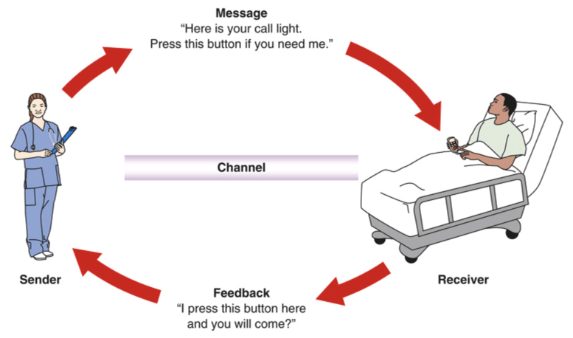
500
A patient tells the nurse, “My doctor keeps telling me everything is going to be fine, but I don't feel fine. I'm scared.”
“You sound frightened about what is happening. Tell me more about what concerns you.”
This acknowledges the patient's feelings and encourages further expression rather than providing false reassurance.
500
A nurse is evaluating whether culturally responsive care was successful. Which finding is most meaningful?
A. The patient followed the hospital's routine without complaint
B. The nurse successfully completed all planned interventions
C. The patient expressed feeling heard, respected, and supported
D. The patient's practices became more consistent with hospital expectations
C. The patient expressed feeling heard, respected, and supported
Culturally competent evaluation focuses on the patient's emotional, spiritual, and physical needs and whether mutual trust and understanding were established, not whether the patient conforms to the nurse's cultural standards.
500
A nurse is caring for a patient who identifies as Muslim. The nurse assumes the patient will want all care to be modified according to Islamic practices.
What should the nurse do instead?
Ask the patient about their individual religious beliefs and practices and determine which, if any, are important to incorporate into their care.
500
A patient from the same cultural background appears hesitant to discuss their health concerns. The nurse assumes the patient is simply “noncompliant” and being difficult. She begins giving repeated instructions.
What should the nurse consider before labeling the patient as noncompliant?
Assess whether cultural beliefs, communication differences, health literacy, language barriers, family expectations, traditional health practices, or other factors may be affecting the patient's understanding or willingness to participate in care.
The nurse should assess before judging and work with the patient to identify barriers and develop an individualized plan of care, regardless of her personal understanding and experience of cultural practices.
600
A patient's verbal statement indicates that they are “fine,” but their facial expression, posture, and tone suggest distress. What communication concept should the nurse recognize, and what should the nurse do?
The nurse should recognize a mismatch between verbal and nonverbal communication. The nurse should not assume the patient is fine; instead, they should use clarification and further assessment to explore what the patient is actually experiencing.
600
A patient awaiting surgery says, “I don't want to think about it. Let's talk about something else. Did you see the weather today?”
The nurse recognizes that the patient may be avoiding discussion of their anxiety.
What is the most therapeutic response by the nurse?
“We can talk about the weather, but I also noticed you've seemed worried about your surgery. Would you like to talk about what is concerning you?”
The nurse acknowledges the patient's attempt to change the subject while gently exploring the underlying concern. The response avoids forcing the patient to discuss the surgery while still providing an opportunity to express feelings.
600
A nurse is assessing a patient who speaks limited English. The patient's spouse answers every question for the patient and says, “She doesn't understand English very well, so just talk to me.”
What should the nurse do first?
Say to the spouse “We appreciate your help, but we need to use a qualified medical interpreter to ensure that your wife receives accurate information, understands her care, and can make informed decisions for herself.”
600
A nurse is caring for a patient whose religious and cultural practices differ significantly from the nurse's own beliefs. The nurse believes one of the patient's practices is unnecessary and initially feels uncomfortable accommodating it.
What is the nurse's most appropriate action?
Recognize and manage their own bias, ask the patient about the meaning and importance of the practice, and determine how it can safely be incorporated into the plan of care.
The nurse's personal beliefs should not determine the patient's care. Culturally competent nursing requires the nurse to recognize personal bias and respect the patient's individual beliefs and practices.
600
A patient uses a traditional herbal remedy at home and tells the nurse, “I want to continue taking it while I'm in the hospital.” The nurse has never heard of the remedy and immediately tells the patient to stop taking it.
What should the nurse have done instead?
Ask the patient about the remedy, including what it is used for and how it is taken, assess for potential safety concerns or interactions, and collaborate with the healthcare team before determining whether it can safely be continued.
700
A patient becomes increasingly frustrated while discussing their diagnosis. The nurse notices that they are becoming frustrated as well, but recognizes their own emotional response and intentionally remains calm and supportive while addressing the patient's concerns.
Emotional intelligence (EI) — the nurse recognizes and manages their own emotions while remaining attentive to the patient's emotional state.
700
“I haven't told anyone this, but sometimes I wish I could just go to sleep and not wake up. My family would probably be better off without me.”
The nurse pauses and maintains a calm presence.
What is the nurse's best response?
“It sounds like you're feeling that your family would be better off without you. Can you tell me more about what you've been thinking?”
The response acknowledges the patient's emotional experience and encourages further expression without judgment, reassurance, or changing the subject. Given the patient's statement, the nurse should also proceed with an appropriate suicide-risk assessment rather than dismissing the comment.
700
A patient tells the nurse, “I understand what you're saying, but I don't agree with the treatment because of my spiritual beliefs.”
Which response by the nurse is best?
“Can you tell me more about how your beliefs affect your decision?”
700
A patient tells the nurse, “My religion is very important to me, but I don't follow all of the traditional practices associated with it.”
What should the nurse recognize?
Religious affiliation does not necessarily determine an individual's personal beliefs or practices. The nurse should assess the patient's individual preferences rather than making assumptions based on their religious identity.
700
A patient with limited English proficiency repeatedly nods while the nurse explains the treatment plan. The nurse assumes the patient understands because they are nodding.
What should the nurse do?
Use a qualified interpreter and verify the patient's understanding rather than assuming that nodding indicates comprehension.