Abdomen/GI
Breast
Genitourinary
Older Adult
Miscellaneous
100
A nurse is assessing a client who reports noticing bright red blood on the toilet paper after a bowel movement. The client also reports itching and discomfort around the anus. Which condition should the nurse suspect as the most likely cause of these findings?
A. Anal fissure
B. Rectal prolapse
C. Upper GI bleed
D. Hemorrhoids
D. Hemorrhoids
Rationale:
-Hemorrhoids are swollen veins in the rectum, which is a common (abnormal) problem. They typically cause bright red blood in the rectum and may cause rectal pain or itching.
-Anal fissures are extremely painful and may cause bleeding but are not likely to cause itching.
-Rectal prolapse is the protrusion of the rectal tissue through the anus.
-An upper GI bleed is more likely to be associated with black, tarry stool. Bright red blood indicates a bleed in the colon/rectum, whereas dark blood indicates a bleed higher up in the GI tract.
100
The nurse is preparing to complete a breast assessment. Which of the following breast findings should the nurse recognize as expected?
A. Tenderness 1 week before menstrual cycle
B. Red, hot rash
C. New or sudden nipple inversion
D. Dimpling
A. Tenderness 1 week before menstrual cycle
Rationale:
-Breast tenderness before and during menstrual cycle is a normal, expected finding. Breasts have the least amount of tenderness about 7-9 days after the menstrual cycle, which is why self-breast exams are recommended at that time.
-Signs of inflammation, rashes, lumps, dimpling, nipple discharge, or new changes in the nipples are unexpected, abnormal findings and may be concerning for breast cancer.
100
A nurse is assessing a client who reports noticing a single, painless ulcer on the genital area. Which sexually transmitted infection (STI) should the nurse suspect based on these findings?
A. Genital herpes
B. Syphilis
C. Chlamydia
D. Gonorrhea
B. Syphilis
Rationale:
-In the primary (early) stage of syphilis, a painless sore ("chancre") may be found on the genitals where syphilis was contracted.
-Genital herpes causes PAINFUL red vesicles.
-Chlamydia & gonorrhea may cause dysuria and/or genital discharge.
100
The nurse is caring for an older adult client who was just admitted to the medical-surgical unit. Which of the following should the nurse recognize as an abnormal finding in the older adult?
A. Smaller liver borders
B. Accumulation of fat around the abdomen
C. Increased saliva & peristalsis
D. Weak abdominal muscles
C. Increased saliva & peristalsis
Rationale:
Older adults have an increased amount of subcutaneous fat around the abdomen, but a decreased amount of overall body fat. Other physiological changes that occur as we age include weaker muscles, smaller liver borders, decreased peristalsis, and decreased production of digestive enzymes, saliva, and tears.
100
The nurse is performing a physical assessment of an older adult client. Which finding is most likely associated with age-related muscle weakness?
A. Muscle hypertrophy
B. Increased motility
C. Increased coordination
D. Muscle atrophy
D. Muscle atrophy
Rationale:
Muscle atrophy, or muscle wasting, may occur as a result of muscle weakness or decreased muscle use. The muscle mass decreases or shrinks, which you can visibly see.
Muscle hypertrophy (growth) would not be seen in the older adult.
Motility and coordination would decrease as a result of muscle weakness.
200
A nurse is auscultating the abdomen of a client who reports abdominal discomfort. After listening in all four quadrants, the nurse does not hear any bowel sounds. How long should bowel sounds be auscultated before they are confirmed to be absent?
A. 30 seconds
B. 1 minute
C. 2 minutes
D. 3-5 minutes
D. 3-5 minutes
Rationale:
Bowel sounds cannot be deemed "absent" unless you auscultate for 3-5 minutes and do not hear any sounds within that time period.
200
What is this finding called?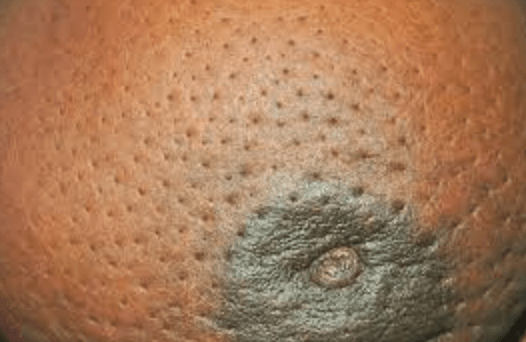
Peau D'Orange
Rationale:
This is referred to as P'eau D'Orange because the breast has an "orange peel" appearance. This is very concerning because it may be a sign of breast cancer.
200
Which of the following is true regarding this rash?
A. This is a priority finding that must be treated immediately
B. This is a manifestation of an STI
C. This is a normal finding
D. The patient should be assessed for related symptoms & onset of rash
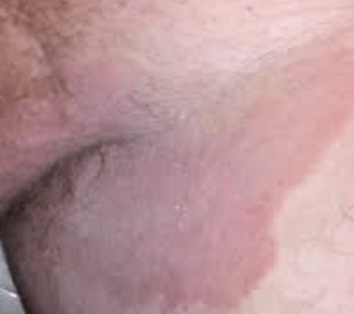
D. The patient should be assessed for related symptoms & onset of rash.
Rationale:
This is tinea cruris ("jock itch"). Tinea cruris is a common skin rash found near the groin in males. It is not a normal finding, so it should be assessed further using OLDCARTS. It is not an STI. It does not need to be treated immediately; the priority action given this information is to assess further.
200
Which of the following findings in the older adult would be unexpected?
A. Difficulty hearing high-frequency sounds
B. Decreased visual acuity, including peripheral vision
C. Decreased sense of taste
D. Increased expansion & vital capacity of the lungs
D. Increased expansion & vital capacity of the lungs
As we age, our sensory function decreases.
Our muscles become weaker and our thorax becomes less mobile. Our lungs become rigid and harder to inflate, and the vital capacity decreases. This may lead to pneumonia.
200
You are taking care of a 75 y/o patient who just had a stroke and now has limited mobility. Which of the following complications of immobility should you monitor for when taking care of a 75 y/o post-stroke patient?
A. Unilateral upper extremity weakness
B. Non-blanchable redness on sacrum
C. Difficulty speaking
D. Unilateral facial droop
B. Non-blanchable redness on sacrum
Rationale:
-Unilateral upper extremity weakness, difficulty speaking, and unilateral facial droop are symptoms of the stroke itself.
-Complications of immobility may include pneumonia, muscle weakness, contractures, DVT, pressure injuries, etc. Non-blanchable redness on the sacrum is a stage 1 pressure injury, which is a complication of immobility.
300
Which abnormal abdominal finding is depicted in this photo?
A. Obesity
B. Ascites
C. Diastasis recti
D. Scaphoid contour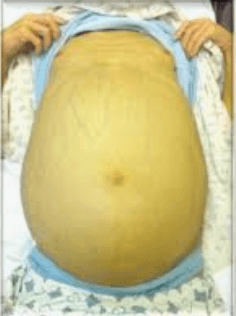
B. Ascites
Rationale:
-Ascites is a manifestation of liver disease, characterized by abdominal distention due to buildup of fluid. It may be accompanied by jaundice as seen in the picture.
-A scaphoid contour is concave (often seen when a patient is malnourished).
-Obesity would not cause jaundice, & subcutaneous fat would be noted in the chest as well.
300
Which of the following techniques should NOT be used when assessing the breast?
A. Inspecting the breasts while standing in front of a mirror
B. Palpating the breast with the palm of your hand
C. Gently squeezing the nipple
D. Using three finger pads to palpate with light, medium, & firm pressure
B. Palpating the breast with the palm of your hand
Rationale:
For both clinical breast exams and self breast-exams, the breasts should be inspected while standing in different positions, and the entire breast tissue (including the axillae) should be palpated using three finger pads, alternating between light, medium, and firm pressure. This will help identify any abnormal tissue, lumps, or masses. You will not be able to identify very many masses if you use the palm of your hand, so the palm should not be used. The nipple should be gently squeezed to assess for discharge.
300
Which organ is the red arrow pointing to?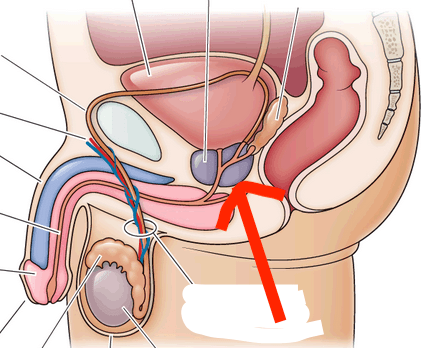
Prostate
Rationale:
The prostate is a walnut-shaped organ that wraps around the urethra in males. An enlarged prostate (benign prostatic hypertrophy/BPH) is a very common condition in older men and causes urinary symptoms such as urinary retention or nocturia (increased urinary frequency at night).
300
The nurse is assessing an 82-year-old client who has had several episodes of diarrhea over the past 2 days. Which assessment finding is most concerning for dehydration in this older adult?
A. White coating on the tongue with localized irritation
B. Dry mucous membranes, urine output 20cc/hr, and cracked lips
C. Pallor, fatigue, and lightheadedness
D. Wrinkled skin with tenting on the hand and liver spots
B. Dehydration
Dry mucous membranes, cracked lips, and decreased urine output are concerning for dehydration, particularly in an older adult who has experienced prolonged diarrhea. Urine output of 20 mL/hr is below the expected minimum of approximately 30 mL/hr for an adult. White coating on the tongue with localized irritation suggests thrush (candidiasis). Pallor, fatigue, and lightheadedness may indicate anemia. Wrinkled skin with tenting on the hand and liver spots are expected findings in the older adult.
300
A nurse is assessing an older adult client during a clinic visit. Which of the following findings should the nurse recognize as expected with aging?
A. Difficulty swallowing liquids
B. Crackles in the lung bases bilaterally
C. Slight decrease in height over time
D. Urinary retention
C. Slight decrease in height over time
Rationale: A slight decrease in height over time is expected as we age due to decreasing bone density.
Difficulty swallowing liquids is a priority concern due to risk for aspiration, and it may be a sign of stroke. Crackles in the lung bases may be a sign of pneumonia or heart failure. Urinary retention may be a sign of BPH or neurological dysfunction.
400
Which region is the uterus located?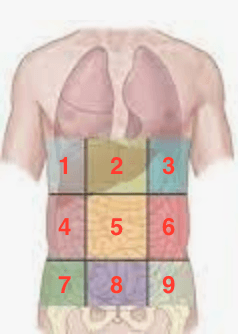
A. Region 2 - Epigastric
B. Region 7 - Right iliac
C. Region 5 - Umbilical
D. Region 8 - Hypogastric/suprapubic
#8 (Hypogastric/Suprapubic)
The bladder is also found in this region.
400
During an assessment of the breast, which finding is considered unexpected?
A. Nipple elasticity
B. Asymmetrical breasts
C. Inverted nipples
D. Lump under areola
D. Lump under areola
Rationale:
*Assume all findings are chronic unless stated otherwise**
Nipple elasticity, asymmetrical breasts, and inverted nipples are all normal findings as long as they are not NEW. A lump found anywhere in the breast or axilla is abnormal and concerning.
400
Upon assessment, the nurse notes tenderness at the costovertebral angle (CVA). Which organ is most likely involved as a source of the client's symptoms?
A. Kidney
B. Bladder
C. Liver
D. Prostate
A. Kidney
Rationale:
CVA tenderness is assessed by placing your non-dominant hand on the patient's back at the costovertebral angle and striking it with your dominant hand. This is indirect percussion directly over the kidneys, so pain or tenderness may indicate inflammation of the kidneys.
400
Which of the following is most accurate regarding osteoporosis?
A. Osteoporosis is a spinal deformity.
B. Osteoporosis occurs due to formation of new, weaker bones.
C. Osteoporosis is an increase in the bone matrix.
D. Osteoporosis occurs due to gradual bone density loss.
D. Osteoporosis occurs due to gradual bone density loss.
Rationale:
Osteoporosis occurs due to a gradual loss of bone density, and older adults are at increased risk for this. Loss of bone density in the vertebrae leads to loss of height, which is a normal age-related finding.
Osteoporosis is not a spinal deformity, but people with osteoporosis are more likely to have kyphosis (exaggerated curvature of the thoracic spine).
400
A nurse is assessing a client and auscultates a bruit over the abdominal aorta. Which of the following health history findings are most important for the nurse to further investigate? (Select all that apply.)
A. History of hypertension
B. History of peripheral artery disease
C. Recent weight gain of 5 pounds in one week
D. History of smoking
E. Family history of abdominal aortic aneurysm
F. Occasional constipation
A. History of hypertension
B. History of peripheral artery disease
D. History of smoking
E. Family history of abdominal aortic aneurysm
Rationale:
- A. History of hypertension — Correct. Hypertension increases risk for vascular damage and aneurysm formation.
- B. History of peripheral artery disease — Correct. Indicates systemic atherosclerosis, which is associated with bruits.
- C. Recent weight gain — Incorrect. More related to fluid balance or cardiac issues, not directly linked to abdominal bruits.
- D. History of smoking — Correct. Major risk factor for atherosclerosis and abdominal aortic aneurysm.
- E. Family history of abdominal aortic aneurysm — Correct. Suggests genetic predisposition.
- F. Occasional constipation — Incorrect. Not related to vascular abnormalities causing bruits.
500
The nurse is conducting an abdominal assessment on a client in the emergency department. Which of the following should the nurse recognize as normal findings? Select all that apply.
A. Umbilicus midline
B. Bowel sounds every 60 seconds
C. Rounded contour
D. Hemorrhoids
E. 30 bowel sounds per minute
A. Umbilicus midline
C. Rounded contour
E. 30 bowel sounds per minute
Rationale:
-The umbilicus should be midline with no masses, discoloration, or protrusions. 5-34 bowel sounds should be heard per minute, so bowel sounds that are heard every 60 seconds would be considered hypoactive.
-Normal contours include flat or rounded (scaphoid and protuberant/distended are abnormal).
-Hemorrhoids are not a normal finding.
500
The nurse is caring for a client who recently had a mastectomy. Which of the following is true regarding post-mastectomy care? Select all that apply.
A. You cannot get breast cancer since you've had a mastectomy
B. Patients still need self-breast exams & clinical breast exams
C. When performing self-breast exams, you should start assessing the post-mastectomy side first
D. We cannot take blood pressures or insert IVs into the right arm if the patient had a right mastectomy
E. The chances of getting breast cancer are reduced after having a mastectomy
B. Patients still need self-breast exams & clinical breast exams
D. We cannot take blood pressures or insert IVs into the right arm if the patient had a right mastectomy
E. The chances of getting breast cancer are reduced after having a mastectomy
Rationale:
-The chances of getting breast cancer are significantly reduced after having a mastectomy, but it is still possible to develop breast cancer. Therefore, patients still need self-breast exams & clinical breast exams.
-We cannot take blood pressures or insert IVs into the arm of the same side as the mastectomy.
-When performing self-breast exams, the patient should start by assessing the unaffected side and then assess the post-mastectomy side.
500
The public health nurse is teaching clients about testicular self-exams. Which of the following should the nurse include in the teaching? Select all that apply.
A. They should be performed monthly
B. They should be performed after getting out of a cold shower
C. Testicles should be palpated for lumps using thumb & two fingers
D. They are only necessary if someone has a family history of testicular cancer
E. They should be performed while in a warm shower
A. They should be performed monthly
C. Testicles should be palpated for lumps using thumb & two fingers
E. They should be performed while in a warm shower
Rationale:
-Testicular self-exams should be performed monthly to assess for signs of testicular cancer, regardless of family history. Testicular cancer is common in adolescent men, and the most common sign of testicular cancer is a painless lump in one testicle.
-To perform a testicular self-exam, the thumb and two fingers should be used to palpate for lumps. This should be done in a warm shower.
500
Which of the following changes are expected in the older adult? Select all that apply.
A. Lungs become rigid and harder to inflate
B. Increased elastin production & subcutaneous fat
C. Wrinkles, liver spots, and thin, dry skin
D. Increased body temperature
E. Increased blood pressure
A. Lungs become rigid and harder to inflate
C. Wrinkles, liver spots, and thin, dry skin
E. Increased blood pressure
Rationale:
As we age, our reflexes (including cough reflex) and sensory functions (sight, hearing, smell, taste, touch) decrease.
All of our muscles become weaker, our organ function decreases, and digestion (peristalsis) slows because we produce less bodily fluids. Our appetite and thirst response decrease.
We lose subcutaneous fat, which decreases our body temperature because we have less insulation. We also produce less elastin, and our skin becomes thin, dry, and wrinkly. We may develop liver spots, which is a normal finding.
Our organs, valves, and vessels become rigid, and less flexible/compliant, which decreases their ability to expand & contract properly. As a result, our blood pressure increases and we are more predisposed to pneumonia.
500
You are assessing a patient who is having difficulty emptying their bladder. Which of the following should be assessed at this time to gather more data about the chief complaint? Select all that apply.
A. The patient's last bowel movement
B. Burning with urination (dysuria)
C. Frequency of urination
D. Allergies
E. Characteristics of urine
B. Burning with urination (dysuria)
C. Frequency of urination
E. Characteristics of urine
Rationale:
All of the following are relevant symptoms to assess except for last bowel movement and allergies. Although these may be assessed in the health history, they are not components of OLDCARTS so they do not need to be assessed at this time.