Black Ch. 6 (Legal Issues in Nursing)
Black Ch. 7 (Ethical Issues in Nursing)
Black Ch. 15 (Political Activism in Nursing)
Black Ch. 16 (Nursing's Evolution & Future)
100
True or False: In North Carolina, nurses must report suicidal ideation in an adult patient to external authorities immediately.
Answer: False. Rationale: Suicidal ideation in an ADULT is NOT mandatorily reported to external authorities in North Carolina.
What you DO for suicidal adults:
- Handle internally with psychiatric consultation
- Implement safety precautions
- Follow facility protocols for suicide risk assessment
- May require involuntary commitment if criteria met, but this is handled through clinical/legal channels, not external reporting
100
True or False: If a nurse personally disagrees with a patient's healthcare decision, the nurse can refuse to care for that patient.
Answer: False
Rationale: Professional ethics override personal ethics. Nurses must provide care regardless of personal beliefs about the patient's decisions.
100
True or False: In a "closed shop" workplace, union membership is optional for nurses.
False: In a closed shop workplace, union membership is required, not optional.
100
True or False: Nursing is largely united as one profession with little division, and functions as one clear, effective voice in healthcare policy and advocacy.
False. Rationale: Nursing is not a fully unified profession and is divided by factors such as differences in education levels, practice settings, and political perspectives. These divisions, along with low organizational membership (e.g., fewer than 10% of RNs belong to the ANA), can weaken nursing’s collective voice in healthcare policy and advocacy.
200
________ ________ ________ protects nurses who provide emergency care off-duty at accident scenes.
Good Samaritan Law.
Rationale: The Good Samaritan Law protects nurses when they provide emergency care off-duty at accident scenes or emergencies.
What it covers:
- Emergency care provided at accident scenes
- Off-duty emergency situations
- Care given in good faith to help someone in need
What it protects you from:
- Legal liability for minor errors made during emergency care
- Lawsuits for unintentional harm when acting as a Good Samaritan
Important limitations:
- You must be acting in good faith
- Care must be within reasonable scope of your training
- Does NOT protect gross negligence or reckless behavior
- Does NOT apply when you're on duty or in your workplace
200
________ ________ occurs when a nurse knows the right thing to do but feels powerless to act due to institutional constraints, unsafe staffing, or limited resources.
Answer: moral distress
200
___________ is defined as power that is not legitimated through official channels but comes from expertise, relationships, or persuasion.
Influence.
200
Workplace __________ includes behaviors such as distracting actions, poor manners, taunting, intimidation, bullying, and aggression that compromise professional relationships.
Incivility
300
Which situation allows disclosure of patient information WITHOUT patient consent under HIPAA?
A. Patient's employer calls asking when the employee will return to work
B. Patient's adult daughter (not listed as emergency contact) requests test results
C. Reporting suspected elder abuse to appropriate authorities
D. News media requests information about a high-profile patient
C. Reporting suspected elder abuse to appropriate authorities.
Rationale: HIPAA allows disclosure WITHOUT patient consent for:
- Child/elder abuse
- Gunshot wounds
- Communicable diseases
- Threats to third parties (duty to warn)
300
A nurse is caring for a Jehovah's Witness patient who has signed an advance directive refusing blood products under any circumstances. The patient becomes unconscious due to severe hemorrhage, and the family demands that the patient receive a transfusion to save their life. Using ethical principles, what should guide the nurse's response?
A. Beneficence: do what is best for the patient by administering blood to save their life
B. Autonomy: honor the patient's documented wishes refusing blood products
C. Justice: treat this patient the same as any other patient in similar circumstances
D. Nonmaleficence: avoid harm by preventing family distress and giving the transfusion
B.
Rationale: Autonomy and respect for patient self-determination require honoring the advance directive, which represents the patient's informed decision made while competent. The advance directive exists precisely for situations when the patient cannot communicate. While beneficence suggests saving life, professional ethics require respecting autonomous decisions even when they conflict with medical recommendations or family wishes.
300
A registered nurse wants to influence legislation regarding safe nurse staffing ratios. Which action best demonstrates the nurse functioning as a nurse activist?
A. Voting in local and national elections
B. Maintaining current knowledge about healthcare issues
C. Writing letters to legislators and providing testimony at public hearings
D. Participating in community health fairs
C.
Rationale: Writing letters to legislators and providing testimony represents nurse activist behavior, which involves taking a more active role in response to issues affecting professional practice. Options A and B describe nurse citizen activities - basic civic participation that brings a healthcare perspective to voting and community involvement. Option D, while valuable, is more aligned with community service than political activism. Nurse activists specifically engage in lobbying, contacting officials, and providing testimony to influence policy decisions, representing a higher level of political engagement than basic citizenship activities.
300
A nurse is concerned about negative portrayals of nursing in the media. Which organization specifically monitors and addresses nursing's image in media?
A. American Nurses Association (ANA)
B. Truth About Nursing
C. National League for Nursing (NLN)
D. International Council of Nurses (ICN)
Correct Answer: B. Truth About Nursing
Truth About Nursing is a nonprofit organization specifically dedicated to monitoring and improving the portrayal of nurses in media, entertainment, and advertising. They actively track both positive and negative depictions of nursing in television, film, news, and other media outlets, and work to challenge inaccurate or demeaning portrayals.
400
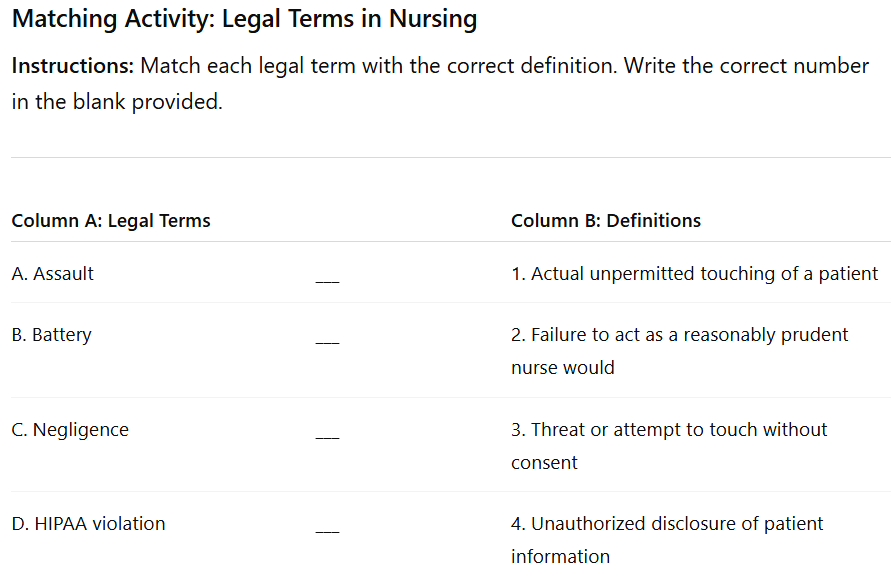
- A = 3
- B = 1
- C = 2
- D = 4
400
A nurse is caring for two patients who both need the last available ICU bed. One patient is a 35-year-old mother of three who was in a car accident. The other patient is an 82-year-old with multiple comorbidities who has pneumonia. The hospital must decide who receives the ICU bed.
Which ethical principle is most at play in this situation, and why?
Answer: Justice
Rationale: Justice requires fairness in the allocation of scarce resources. The situation involves deciding how to fairly distribute a limited resource (the ICU bed) between two patients with different needs and circumstances. This raises questions about how to treat equals equally and unequals appropriately.
400
What are 3 benefits of nurses maintaining membership in professional organizations beyond just networking opportunities?
1. Collective Voice & Advocacy for Policy Change
- Professional organizations like ANA lobby legislators on behalf of nurses
- They work to influence health policy at local, state, and national levels
- Example: Oncology Nursing Society (ONS) successfully advocated for the Lymphedema Treatment Act (2022), which improved patient access to compression garments
- Individual nurses have limited influence, but organizations amplify our voice to create real policy change
2. Continuing Education & Certification Opportunities
- Access to professional development courses and resources
- Certification programs specific to your specialty area
- Staying current on evidence-based practice and professional standards
- Helps you maintain licensure requirements and advance your career
3. Leadership Skill Development
- Opportunities to serve in organizational roles (committees, boards, elected positions)
- Practice shared governance and learn organizational skills
- Develops your capacity to lead change in healthcare
- Prepares you for transformational opportunities in the profession
400
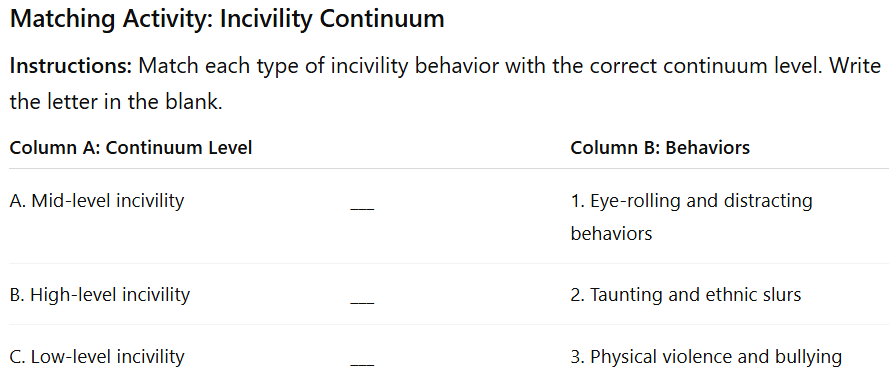
A – 2 (Mid-level incivility → Taunting and ethnic slurs)
B – 3 (High-level incivility → Physical violence and bullying)
C – 1 (Low-level incivility → Eye-rolling and distracting behaviors)
500
List the 4 elements that must ALL be present for malpractice to occur.
1. Duty
- The nurse assumed responsibility for patient care
- A nurse-patient relationship existed
2. Breach (of duty)
- The nurse failed to meet the standard of care
- This can happen by commission (doing something wrong) OR omission (failing to do something required)
3. Causation
- The breach of duty directly caused the injury
- The harm wouldn't have occurred otherwise
4. Injury (Damages)
- Actual harm occurred to the patient
- Physical, emotional, or financial damage resulted
If ANY element is missing, there is NO malpractice.
500
List and define the 6 basic ethical principles covered in the chapter.
1. Autonomy
Right to self-determination; patients make their own decisions
2. Beneficence
Do good; actively promote patient welfare
3. Nonmaleficence
Do no harm; avoid causing injury
4. Justice
Be fair; treat equals equally and allocate resources fairly
5. Fidelity
Keep promises; be faithful and loyal
6. Veracity
Tell truth; be honest in all communications
500
List 2 ways that politics affects your daily practice as a nurse at the national, state, or local level.
National Level
- Federal Medicare/Medicaid reimbursement policies - These determine which services are covered, how much hospitals get paid, and ultimately affect staffing budgets, available resources, and the types of care you can provide to patients.
- OSHA regulations and workplace safety standards - Federal policies dictate requirements for PPE availability, needlestick safety devices, and hazardous material handling that directly impact your safety every shift.
State Level
- Nursing Practice Acts and scope of practice - Your state board of nursing defines what tasks you can legally perform, whether you need physician supervision for certain procedures, and licensure requirements including continuing education mandates.
- Nurse-to-patient ratio laws - Some states (like California) have legally mandated staffing ratios that determine your workload, while others don't, directly affecting how many patients you're assigned and your ability to provide safe care.
Local Level
- Hospital policies on mandatory overtime and scheduling - Local facility policies (often influenced by union contracts or lack thereof) determine whether you can be forced to work double shifts or extra days.
- Workplace safety protocols and incident reporting - Your specific hospital's policies on handling workplace violence, reporting unsafe conditions, and available security measures affect your daily safety and working conditions.
500
List 3 ways nurses can actively care for the nursing profession.
1. Join and Actively Participate in Professional Organizations
- Become a member of ANA and/or specialty nursing organizations
- Don't just pay dues - actually participate in committees, attend conventions, volunteer for initiatives
- Use your membership to advocate for policy changes that strengthen nursing
2. Protect Nursing's Image in Media and Public Perception
- Monitor and challenge negative or inaccurate portrayals of nurses in media
- Contact organizations that use sexualized "naughty nurse" stereotypes or show physicians doing nursing work
- Applaud and support accurate representations of nursing
- Use resources like The Truth About Nursing (www.truthaboutnursing.org) to advocate for better representation
- Ensure the public understands the true complexity and importance of nursing work
3. Promote Civility in the Workplace
- Refuse to perpetuate or tolerate incivility, bullying, or "eating our young"
- Model professional behavior and respectful communication
- Speak up when witnessing horizontal violence or workplace abuse
- Mentor new nurses with kindness and support
- Create a positive workplace culture that attracts and retains nurses
- Maximize your education and encourage others to advance their degrees
- Demand safe work environments for all nurses (advocate for staffing ratios, safety equipment, OSHA protections)
- Work toward unity across educational levels and practice settings—division weakens the profession