Factoring Polynomials of Degree 3
Polynomial and Power Functions
Division and Rational Zeros
Applications
Direct and Inverse Variation
Piecewise Functions
Applications and Regression Modeling
100
Factor the expression:
x3+5x2
x2(x+5)
100
Identify the degree, leading coefficient, zeros, and end behavior of the function without the use of technology.
f(x)=3/2(x-2)
Degree: 1
Leading Coefficient: 3/2
Zeros: 2
End Behavior:
As x goes to negative infinity, f(x) goes to negative infinity.
As x goes to positive infinity, f(x) goes to positive infinity.
100
Use the Rational Zeros Theorem to make a list of possible rational zeros for the polynomial function.
f(x)=3x^6-27x^3+8x^2-12
+-12, +-6, +-4, +-3, +-2, +-4/3, +-1, +-2/3
100
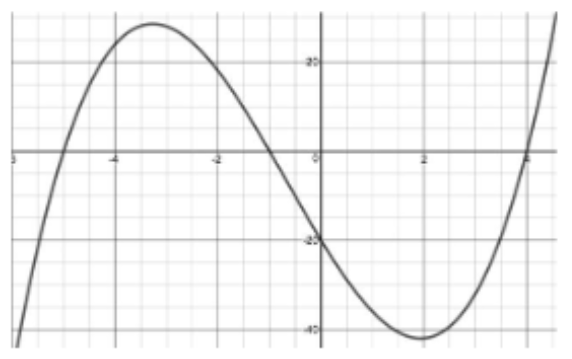
Find the real and complex roots of the polynomial function and sketch the graph (without a calculator).
f(x)=x^3+2x^2-19x-20
𝑥 = −5, −1, 4
100
Assume 𝑦 varies inversely with 𝑥. Find the constant of proportionality and the function.
𝑦 = 50 when 𝑥 = 100
k=5000
y=5000/x
100
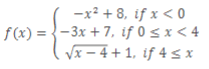
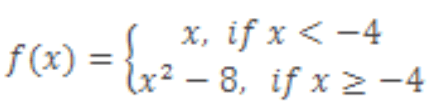
Sketch a graph of the following piecewise functions. Then evaluate f(-3):
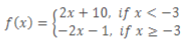
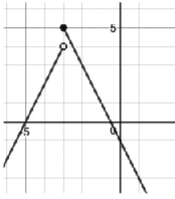
f(-3)=5
100
In your own words, describe what the correlation coefficient 𝑟 represents, and what it is used for. Are there any relationships that do not use 𝑟?
If the correlation coefficient 𝑟 is close to 1, then there is a strong relationship between the two variables with a positive slope. If the correlation coefficient 𝑟 is close to 0, then there is very little relationship between the two variables. If the
correlation coefficient 𝑟 is close to -1, then there is a strong relationship between the two variables with a negative slope.
200
Factor the expression:
r3-4r2+6r-24
(r2+6)(r-4)
200
Without using technology, state the degree of the polynomial along with the multiplicity of each root in the polynomial.
v(t)=-t(t+2)^2(t-3)
Degree 4; mult 2 at 𝑡 = −2; mult 1 at 𝑡 = 0; mult 1 at 𝑡 = 3
200
Use long division or synthetic division to find the quotient (you should not have a remainder).
(9x^4-3x^3-20x^2+24x+32)div(3x+4)
3x^3-5x^2+8
200
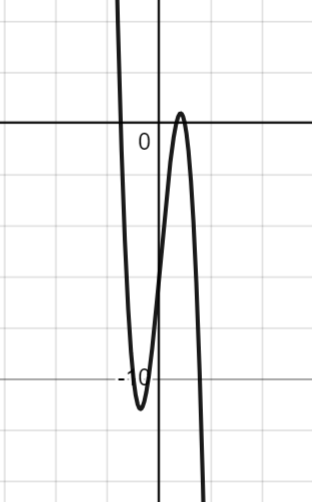
Find the real and complex roots of the polynomial function and sketch the graph (without a calculator)
g(x)=-6x^3+x^2+11x-6
x=1,(5+-isqrt119)/-12
200
Assume 𝑦 varies directly with 𝑥. Find the constant of proportionality and the function.
𝑦 = 0.5 when 𝑥 = 4
k=1/8
y=1/8x
200
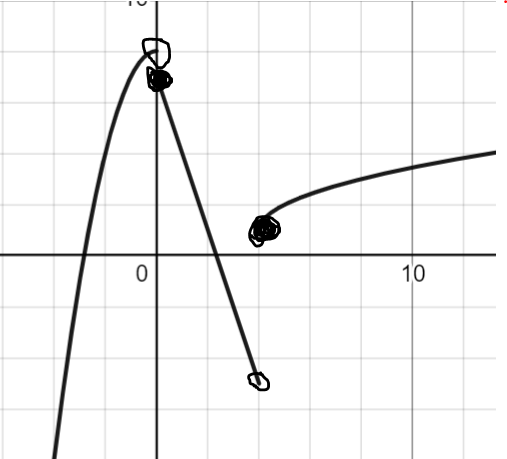
Sketch a graph of the following piecewise functions. Then evaluate f(1).
f(1)=4
200
The following table is a random sample looking at the average GPA of students, and the number of times they have been absent. Make a scatter plot of the data and use linear regression to write a function that models the data. Also, state the correlation
coefficient for this linear regression and whether you believe your model is a good fit for the data.
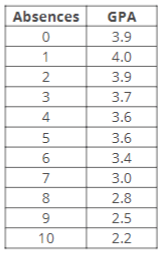
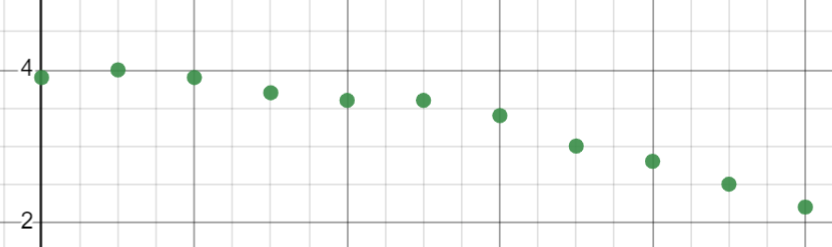
r=-0.9562, this is a pretty strong model
y=-0.18x+4.21
300
Factor the expression:
27x3-64y3
(3x-4y)(9x2+12xy+16y2)
300
Describe the graphical symmetry of the function, if any.
f(x)=-3x^2+1
Symmetry across the y-axis
300
Use long division or synthetic division to find the quotient (you should have a remainder).
(2x^3-10x^2+16x-5)div(x-6)
2x^2+2x+28+163/(x-6)
300
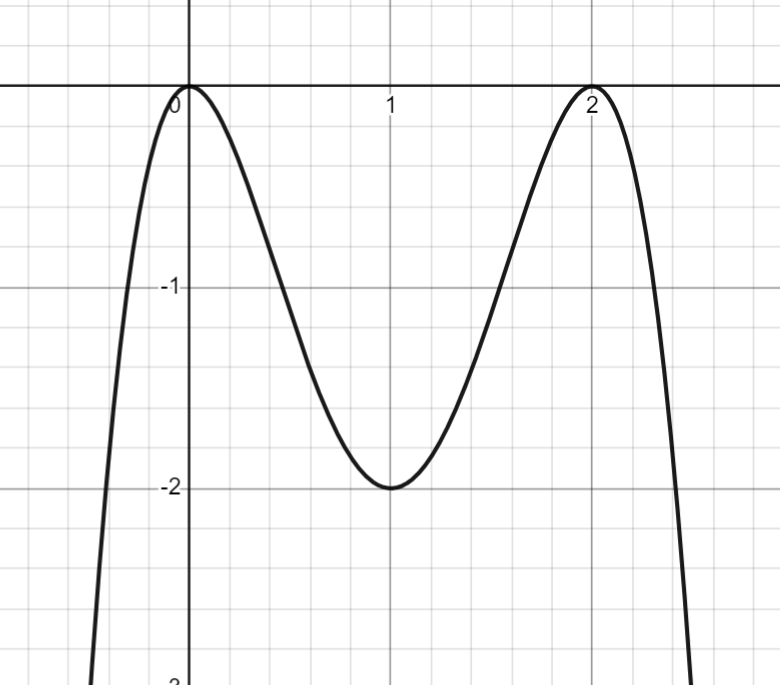
Find the real and complex roots of the polynomial function and sketch the graph (without a calculator)
h(x)=-2z^4+8z^3-8z^2
z=0,2
300
Assume 𝑦 varies directly with 𝑥. Find the constant of proportionality and the function.
𝑦 = 10 when 𝑥 = 3
k=10/3
y=10/3x
300
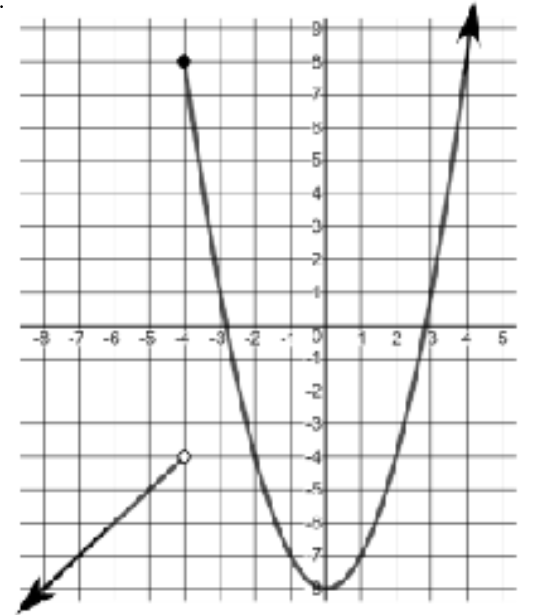
Write the corresponding piecewise function for the graph below.
300
The table below shows world population size from different points in history. Create a function to model this data. What type of model best fits the data? What would the expected world population be in 2017? Research and compare your prediction with the known value.
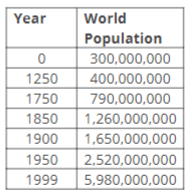
Exponential function is the best function for population growth.
𝑃(𝑡) = 204873911.4(1.0113964)t , 𝑟 = .785
𝑃(2017) = 2.038 × 10⁹ , which is not a good estimation knowing that the true world population in 1999 was 5.98 × 10⁹
400
Factor the expression:
x3-3x2-10x
x(x-5)(x+2)
400
p(x)=ax^2-bx^3
The degree is:
The leading term is: positive or negative
Thus, the graph from below that best represents the end behavior is:
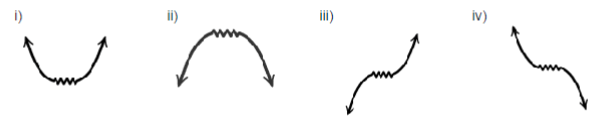
Degree: 3
Leading term: negative
Graph: iv 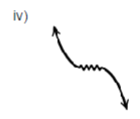
400
Find all the zeros of the polynomial, then completely factor it over the real and complex numbers.
f(x)=9x^3+5x+2
x=-1/3,(1+-isqrt23)/6
f(x)=(x+1/3)(9x^2-3x+6) or
f(x)=(3x+1)(3x^2-x+2)
400
Factor the following polynomial functions.
v(t)=8t^3-2t^2-17t-7
2(2x+1)(x+1)(4x-7)
400
Find the inverse or direct variation function for each graph.
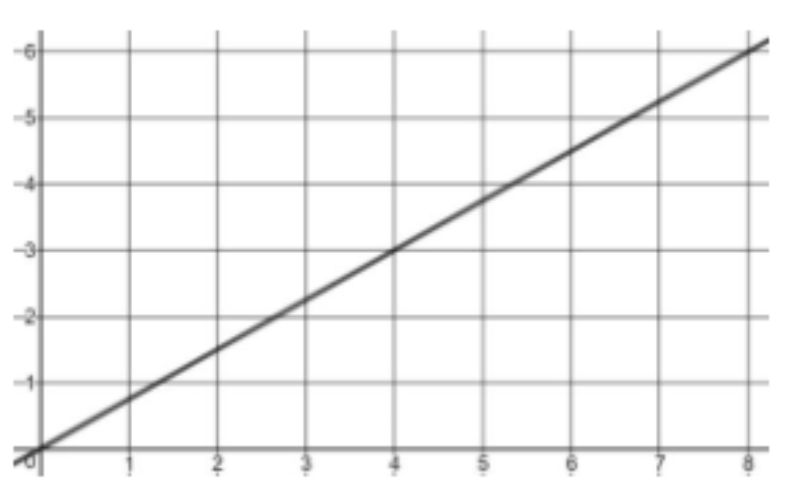
k=3/4
400
Write the corresponding piecewise function for the graph below.
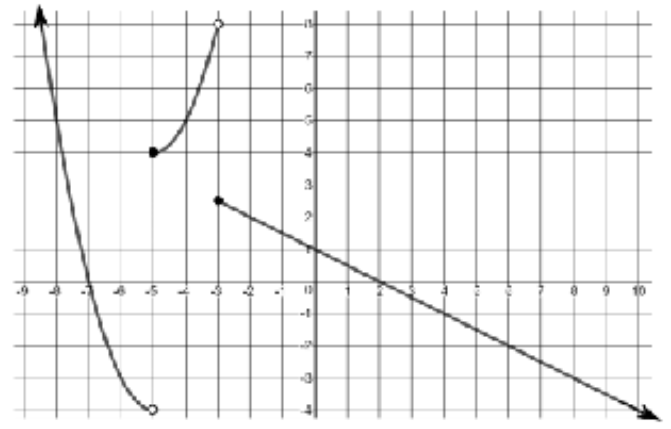
(x+5)^2-4, if x<-5
(x+5)^2+4, if -5<=x<-3
-1/2x+1, if x>=-3
400
The advertising budget of a restaurant is about 3% of their revenue. The yearly advertising budget of Adelaide’s Restaurant from 2000 to 2015 is shown below. Make a scatter plot and create a function to model the data. Which type of model did you choose, and why was it the best choice?
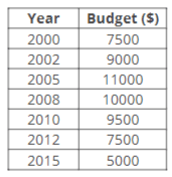
y=-74.722x^2+299817x-0.000000030074
The quadratic model was the best choice.
500
Factor the expression:
k3-3k2-28k
k(k-7)(k+4)
500
Predict the difference of the graphs without using technology.
y=(x-2)^2 vs. y=(x-2)^4
The 4th degree polynomial will increase faster. Therefore, it will appear skinnier and steeper than the quadratic function. Around the root 𝑥 = 2, the 4th degree polynomial will “flatten more” than the quadratic.
500
Use long division and synthetic division to find the quotient (you should not have a remainder).
(-3x^3+7x^2+27x-28)div(x-4)
-3x^2-5x+7
500
Factor the following polynomial functions.
f(x)=x^3+4x^2-3x-18
f(x)=(x-2)(x+3)^2
500
Assume 𝑦 varies inversely with 𝑥. Find the constant of proportionality and the function.
𝑦 = 3 when 𝑥 = 11
k=33
y=33/x
500
For the first 40 hours Kayla works per week, she gets paid $12/hr. For each hour over 40 worked, she gets paid $18/hr. Write a piecewise function to represent her total pay with respect to the number of hours worked. How much will she make for working 50 hours?

500
Hye Ryung is the president of the local chapter of the American Medical Students Association (AMSA). She is organizing local outreach and informational meetings. At her first meeting there are five people present (including herself). Every month after
that her group grows by 5 people.
a. How many members are in the group after 6 months?
b. The logistics of hosting and feeding her group at meetings was more complicated than expected. The cost of feeding 5 people at her first meeting was $30, for 10 people it was $35, for 15 it was $45, and after 6 months all of the costs had added up to $100. Write a function to model the cost with the number of people attending meetings.
a. 30
b.
y=0.087x^2-0.251x+28.992