Students as Learners
Describing Instructional Processes
Assessment
Professional Development, Leadership, and Community
-agogy
100
Name at least 4 of the tiers in Maslow's Hierarchy of needs.
What are:
100
Describe an example of "scope" in an educational context.
What is referring to the topics and areas of development within a curriculum? What is included and not included in the curriculum?
100
This type of assessment occurs at the end of the learning process as a final evaluation of skills and knowledge the student should have.
What is a summative assessment?
100
Name 3 (of 10) professional development practices and resources.
Professional literature, Professional associations, Workshops, Conferences, Learning communities, Graduate courses, Independent research, Internships, Mentors, Study groups
100
This is what the method and practice of teaching adult learners is called.
What is andragogy?
200
Name 3 (of 13) exceptionalities a student may have in order to receive a free public education with accommodations under IDEA.
What are:
Autism, Deaf-blindness, Deafness, Developmental delay, Emotional disturbance, Hearing impairment, Intellectual disability, Multiple disabilities, Orthopedic impairment, Other health impairment, Specific learning disability, Speech or language impairment, Traumatic brain injury, Visual impairment (including blindness)
200
Describe examples of active listening.
What are:
Attending to the speaker, Restating key points, Asking questions, Interpreting information, Providing supportive feedback, and Being respectful
200
This percentage of scores is within one standard deviation of the mean in a normal distribution.
What is 68%?
200
Name that school position!
This position is a school employee who works under the supervision of teachers or other professional practitioners. Their jobs are instructional in nature and they provide other direct services to children and youth and their families.
What is a paraeducator?
(OK, paraprofessional is acceptable!)
200
Name two differences between adult learners and child learners.
Adults are typically self-directed learners who are motivated to learn because they want to, not because they have to. They also have a wealth of experience that can be used as a resource for learning.
Children are passive learners who need to be told what to learn. It is also focused on the transmission of knowledge, rather than the development of skills and abilities.
300
Lev Vygotsky is particularly known for constructing these kinds of zones of development (Name one)
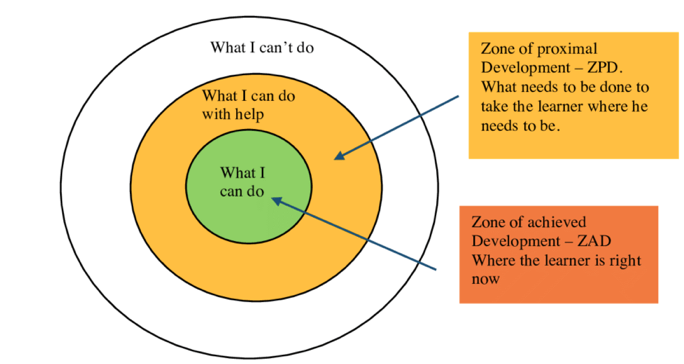 What is the zone of proximal/achieved development?
300
Describe an example of explicit teaching.
Explicit instruction is a way to teach in a direct, structured way.
Similar to following a recipe. Classroom examples include multiplication tables, vocabulary lists, and penmanship practice.
300
As opposed to an Analytic assessment, which involves assessing different aspects of student performance, such as mechanics, grammar, style, organization, and voice in student writing. This type of assessment means making an overall assessment, considering all criteria simultaneously.
What is a holistic assessment?
300
This is the first step in what a teacher is required by law to do if they suspect a child is being abused or neglected.
Call the Indiana Department of Child Services' Child Abuse and Neglect Hotline.
1-800-800-5556
300
The full name of the "pedagogy exam" (not just the number!)
The Principles of Learning and Teaching Test: Grades 7-12
Praxis 5624
400
Dogs love this! This form of learning pairs an automatic, conditioned response with specific stimuli.
What is classical conditioning?
400
Describe how "scaffolding" works in education.
Scaffolding refers to removing support structures to make students more independent gradually.
400
This type of standardized test measures what students have learned, but rather than focusing on specific subject matter learned in school (e.g. math, science, English or social studies), the test items focus on verbal, quantitative, problem-solving abilities that are learned in school or in the general culture.
Examples of this type of standardized test includes the SAT and ACT Reasoning Test.
What is an aptitude test?
400
Name that school position!
This position works with both students and teachers to facilitate access to information in a wide variety of formats. They also instruct students and teachers how to acquire, evaluate, and use information and the technology needed in this process.
What is a librarian?
400
This "gogy" focuses on helping adults and young people to learn by facilitating and technologically enabling learner-centered autonomous and collaborative learning in a virtual environment
What is Cybergogy?http://edutechwiki.unige.ch/en/Cybergogy
500
These describe patterns of thinking and behavior that people use to interpret the world.
According to Piaget, these are divided into 4 parts: Person, Social, Event, and Self.
According to Kelly, these refer to how a database is structured.
What is a schema?
500
Provide an example of reciprocal determinism as a social learning theory.
What is a theory points out why social stimuli can exasperate a certain other factor of behavior? For example, if a child acts out because they don't like school, then the teacher reprimands them for it, then the child will likely act out even more.
There are 3 factors to consider, behavioral, personal, and environmental.
500
FERPA regulations allow student records disclosure without consent under which conditions?
FERPA allows schools to disclose those records, without consent, to the following parties or under the following conditions (34 CFR § 99.31):
- School officials with legitimate educational interest;
- Other schools to which a student is transferring;
- Specified officials for audit or evaluation purposes;
- Appropriate parties in connection with financial aid to a student;
- Organizations conducting certain studies for or on behalf of the school;
- Accrediting organizations;
- To comply with a judicial order or lawfully issued subpoena;
- Appropriate officials in cases of health and safety emergencies; and
- State and local authorities, within a juvenile justice system, pursuant to specific State law.
Even then, they can only disclose "directory information"
500
In this developmental teaching stage, an educator has developed professionally and is successful in the classroom, but has yet to become a leader and go-to expert in the school?
(Hint: think of Mathspace task proficiency levels)
What is a proficient?
500
This "gogy" is the name of facilitating self-directed learning (as opposed to pedagogy and andragogy)
What is Heutagogy?