Phases of the Moon
Eclipses
Seasons
Seasons II
Wild Card
100
How many days are there in a lunar cycle or lunar month?
28-30 days.
100
What three celestial bodies (planets, moons, stars) need to align for an eclipse to happen?
Sun, Moon, Earth
100
What causes the different seasons?
Earth's tilt on its axis.
100
If it is Spring in the Northern Hemisphere, what season is it in the Southern Hemisphere?
It is Autumn
100
How many phases are there in the Lunar Cycle?
8
200
The phase of the moon when the side facing Earth is completely dark and invisible.
New Moon
200
The moon phase required for a solar eclipse to happen.
New Moon
200
The Earth ________ around the Sun every ________ days.
a) revolves b) 365
200
If you live in Australian what differences might you expect with their Christmas traditions? Why?
Go to the beach, have picnics, go swimming, Santa wears board shorts and surfs. Christmas is in summer in Australia
200
Which hemisphere experiences winter in December, January, and February?
The Northern Hemisphere.
300
The celestial body that the moon revolves around.
The Earth
300
The dark, inner portion of the Moon's shadow where a total solar eclipse is visible.
The Umbra
300
If the Northern Hemisphere is tilted away from the sun will experience this season.
Winter
300
What does rotation mean in Space Science?
Rotation is when an object spins on its own axis or centre.
300
The moon phase required for a lunar eclipse to happen.
Full Moon
400
Describe the difference in the phases that are waxing and waning.
Waxing: Growing (from the right)
Waning: Shrinking (to the left)
400
Draw a diagram of a Solar eclipse.
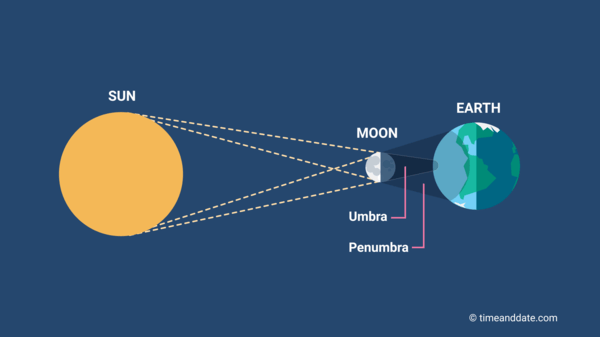
400
During summer in the Northern Hemisphere, the North Pole is pointed in this direction relative to the Sun.
Away from the Sun
400
If Earth had no tilt on its axis, what would happen to our seasons?
There would be no seasons; temperatures would stay mostly the same year-round.
400
The lighter, outer part of a shadow that causes a partial lunar eclipse.
Penumbra
500
Explain why only one side of the Moon is visible from Earth.
The Moon rotates on its axis at the same rate that the Moon orbits the Earth.
500
The four types of solar eclipses.
Total, partial, annular, and hybrid
500
The poles are not pointed towards or away from the Sun. What two seasons are happening on Earth in the Northern and Southern Hemispheres?
Spring and Fall
500
If the North Pole is experiencing 24 hours of daylight (the "midnight sun"), what is happening at the South Pole?
It is experiencing 24 hours of darkness (polar night).
500
The reason we only ever see one side (the "near side") of the moon from Earth.
Synchronous motion (the moon's rotation time on its axis matches its orbital time around Earth)