Vector Addition
Kinematics Equations
Dynamics
Graphs (Final Jeopardy)
100
Imagine an object is moving back and forth in a straight line. If the object moves 5 meters in the positive direction over 3 seconds, followed by moving 7 meters in the negative direction over 5 seconds,
what is its final position (away from origin)
X = -2 m
100
An object is traveling at a constant velocity of 15 m/s when it experiences a constant acceleration of 3.5 m/s 2 for a time of 11 s. What will its velocity be after that acceleration?
53.5 m/s
100
A 0.40 kg toy car moves at constant acceleration of 2.3 m/s 2 . Determine the net applied force that is responsible for that acceleration.
0.92 N
100
How does this data describe about the movement (velocity) of this toy car? 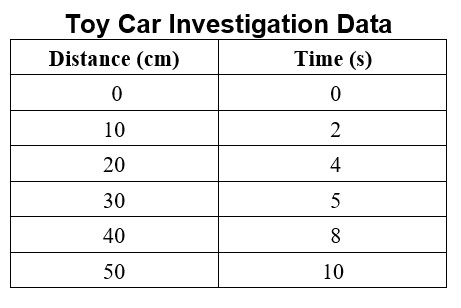
The velocity is constant
200
Imagine an object is moving back and forth in a straight line. If the object moves 5 meters in the positive direction over 3 seconds, followed by moving 7 meters in the negative direction over 5 seconds.
What is the total distance traveled?
12 m
200
If an object accelerates from rest, what will its velocity be after 2.1 s if it has a constant acceleration of 9.8 m/s 2 ?
21.6 m/s2
200
If a net horizontal force of 175 N is applied to a bike whose mass is 43 kg what acceleration is produced?
4.07 m/s2
200
What is the total displacement of this object?
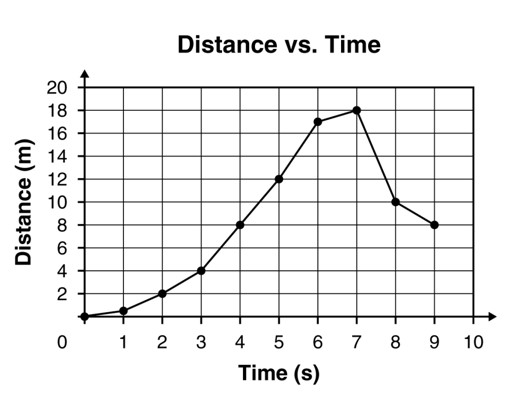
8 meters
300
Imagine an object is moving back and forth in a straight line. If the object moves 4 meters in the positive direction over 3 seconds, followed by moving 12 meters in the negative direction over 5 seconds,
What is its average velocity?
-1 m/s
300
An object, moving with constant acceleration and zero initial velocity, travels 48 m in 5.2 s.
What is the magnitude of its acceleration?
3.6 m/s2
300
A crane lifts a load at a constant speed. Draw a free-body diagram for the load and compare the
magnitudes and directions of the all forces.
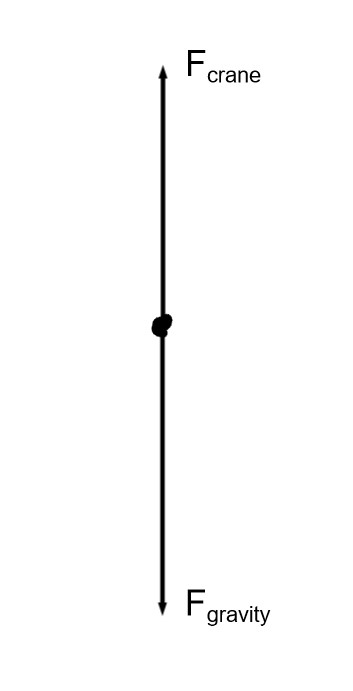
300
At what time interval is this object moving at a constant velocity? 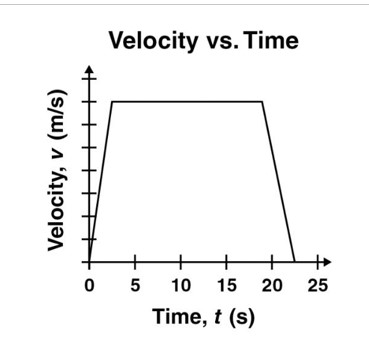
From 2.5 s - 22.5 s
400
An object starts at a point An object starts at a point +25 m goes 40 m toward +X direction in 5 s then suddenly changes its direction to the opposite and covers 50 m in 10 seconds.
What is its total displacement?
-10 m from 0
400
An object accelerates from rest with a constant acceleration of 7.5 m/s2 . How fast will it be traveling after it goes 21 m?
17.7 m/s2
400
A student pushes on an object with a force of 6 Newtons and the object does not move. What force does the object exert on the student’s hands?
Which law is this phenomena explained by?
6 N , Newton's 3rd Law
500
From a starting point, a balloon drifts 3 m in the positive direction in 10 s; then the wind suddenly changes and the balloon flies 5 m in the negative direction in the next 5 s.
What is the average velocity of the balloon?
(Total displacement / total time)
-0.13 m/s
500
A car slams on its brakes creating an acceleration of -3.2 m/s 2 . It comes to rest after traveling a distance of 210 m. What was its velocity before it began to accelerate?
36.7 m/s
500
A 150 kg motorcycle starts from rest and accelerates at a constant rate along a distance of 350m. The applied force is 250 N and the coefficient of kinetic friction is 0.03.
Find the force of friction on the bike
44 N