Graphing a quadratic inequality
Polynomial Function I
Polynomial Function II
Functional Models
100
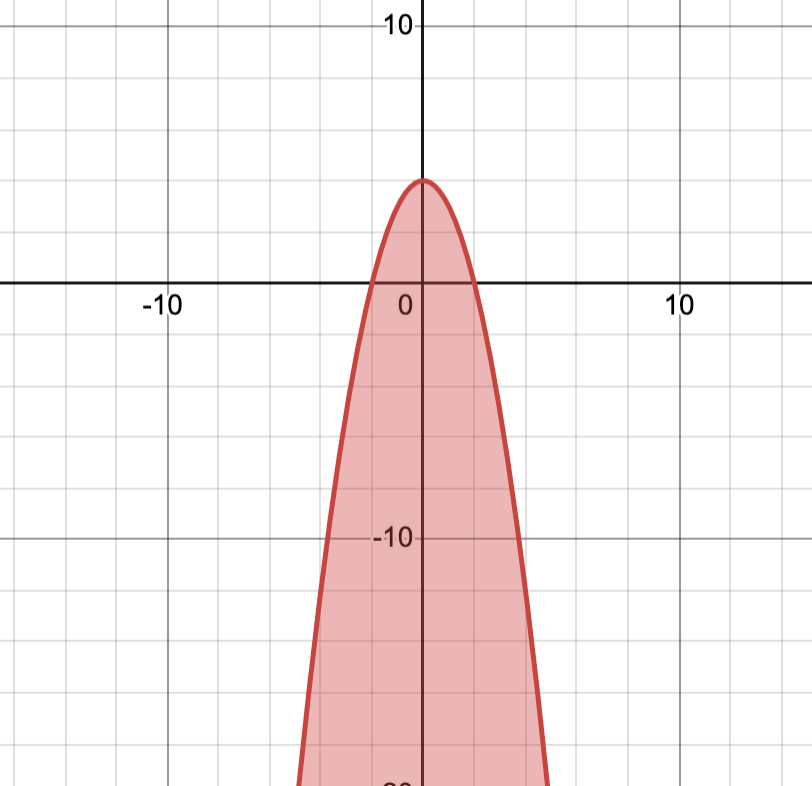
Define the shading (below/above the curve) and type of line (dashed/continuous) the following inequality:y≤- x2+4 will have.
This is its graph:
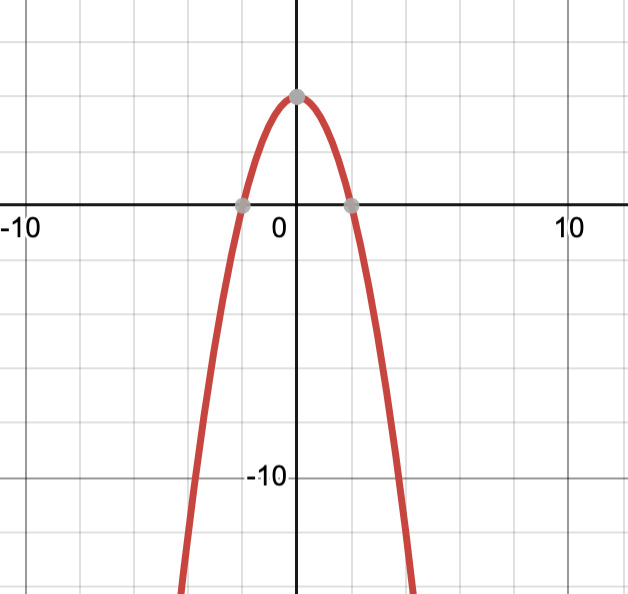
•Below the curve (inside)
•Continuous line
100
Find the end behavior for the following equation:
f(x)=-9x4+2x+9x3-3x5
•rises to the left and falls to the right
100
Use the Factor Theorem to determine whether x-1 is a factor of P(x)=-2x3+3x2-4x-5
P(1) = -8
So: x-1 is not a factor of P(x)
100
The length of a rectangle is 3in longer than its width. If the perimeter of the rectangle is 26in , find its area.
40in2
200
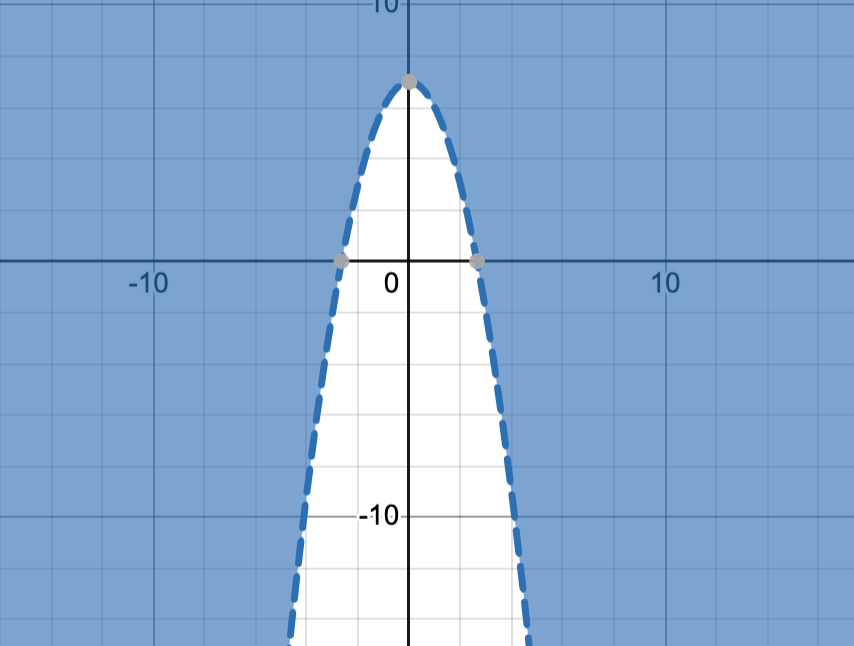
Define the shading (below/above the curve) and type of line (dashed/continuous) the following inequality: y> -x2 +7 will have.
This is its graph:
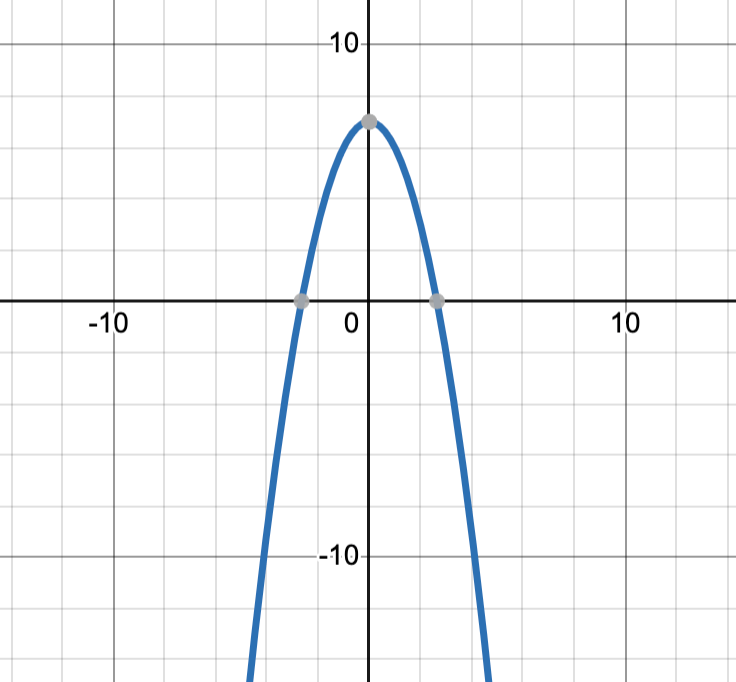
•Above the curve (outside)
•Dashed line
200
Find the end behavior for the following equation:
f(x)=4(x-3)2(x+2)2
•rises to the left and rises to the right
200
Use the rational zeros theorem (p/q) to list all the possible zeros:
h(x) = 4x3-7x2-8x+1
±1, ±1/2, ±1/4
200
The perimeter of a rectangle is 50.4m, and its diagonal length is 18m . Find its length and width.
Lenght: 14.4m
Width: 10.8m
300
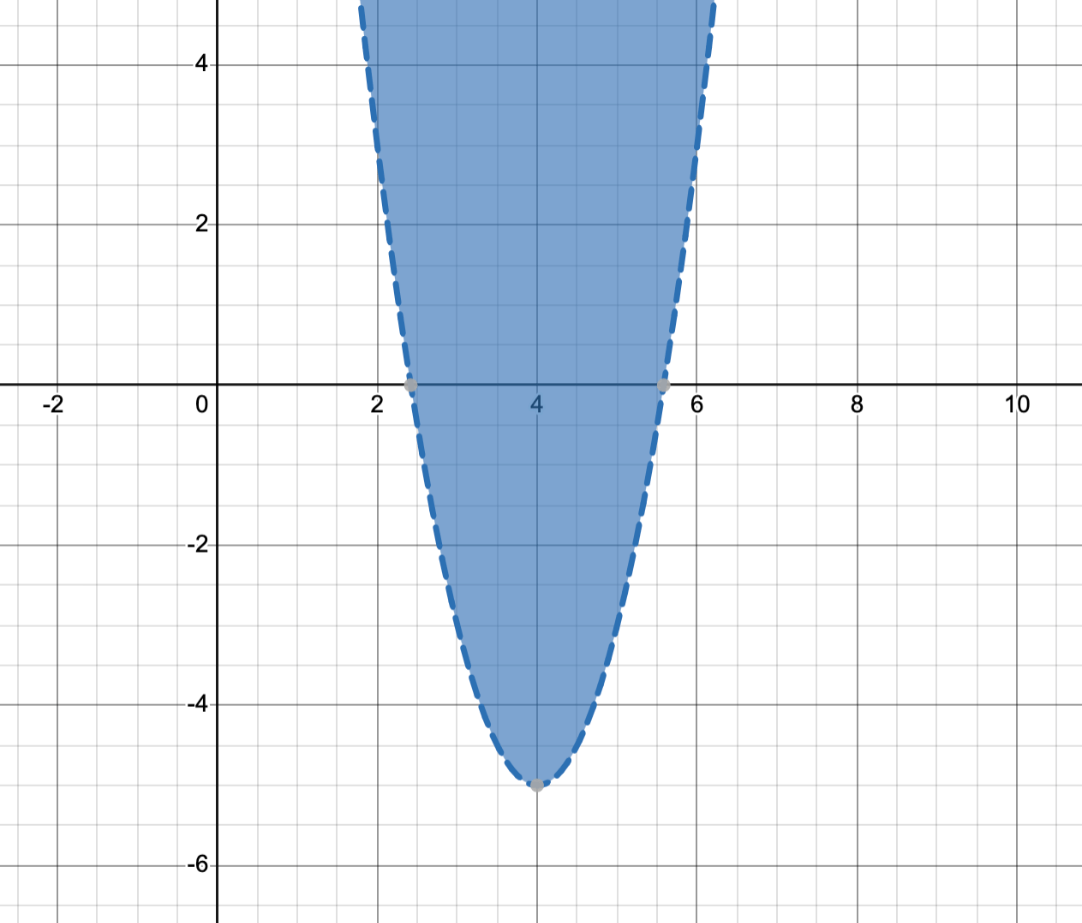
Define the shading (below/above the curve) and type of line (dashed/continuous). The following inequality:y>2x2-16x+27 will have.
This is its graph:
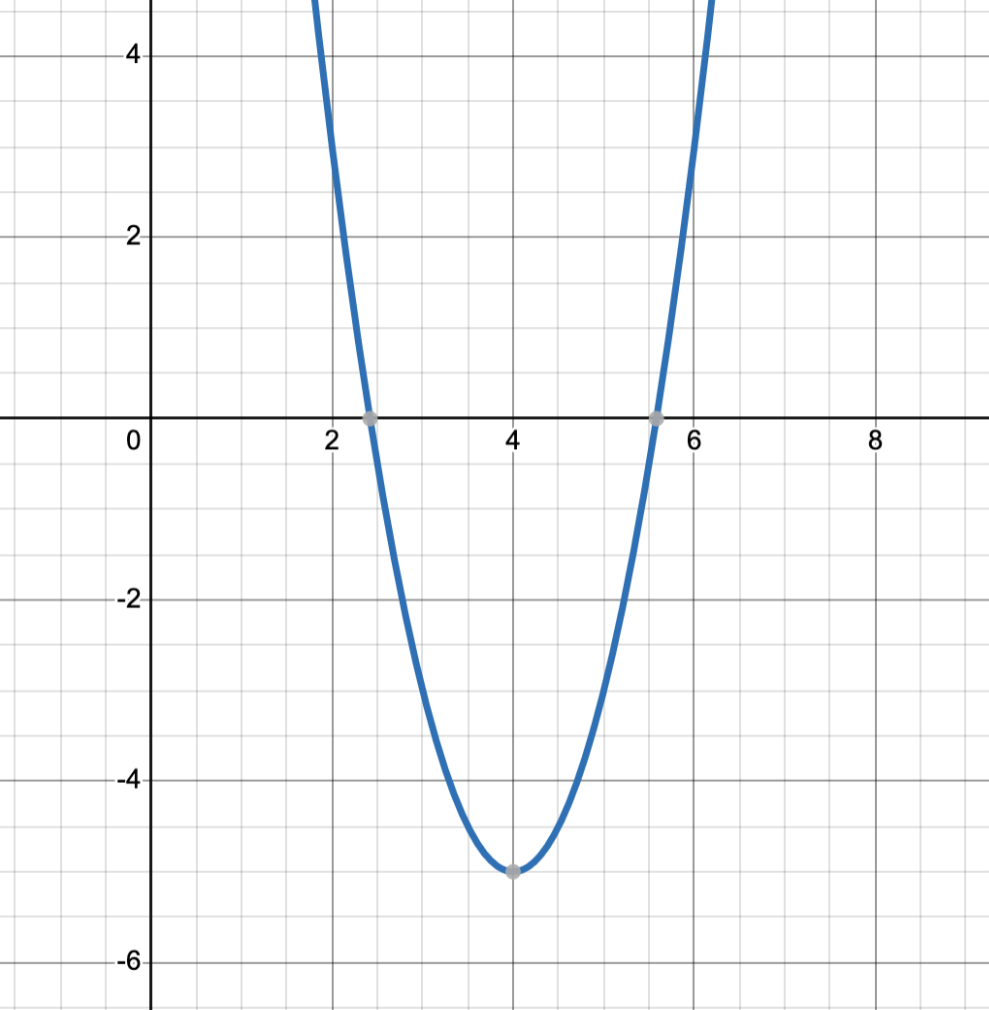
•Above the curve (inside)
•Dashed line
300
Find all the real zeros of the function:
f(x)=-5x(x2-1)(x2+36)
zeros: 0, 1, -1
(you can't get sq root of -36)300
Use synthetic division to find the quotient and remainder when:
-x3-7x2+9 is divided by x+7
-x2+(9/x+7)
300
The perimeter of a rectangle is 23.2cm, and its area is 31.08cm2. Find its length and width.
Length: 7.4cm
Width: 4.2cm
400
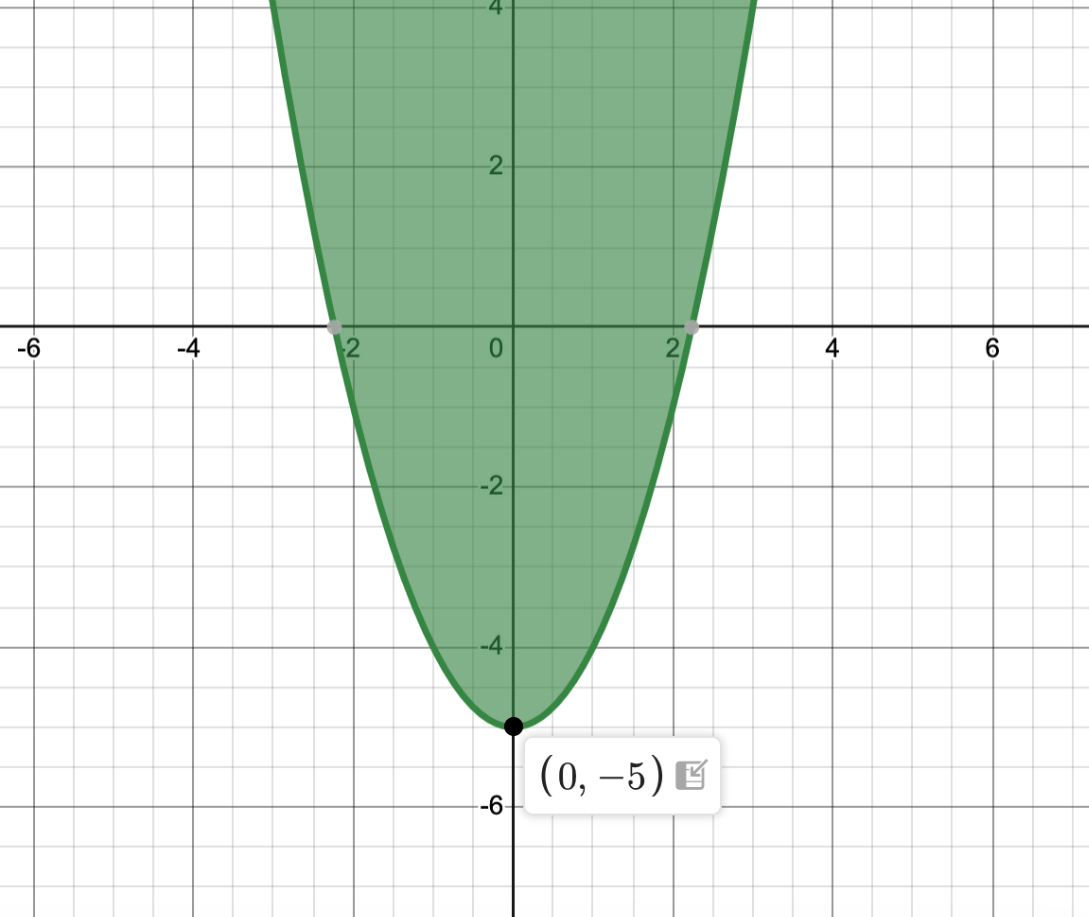
Find the vertex and define: the concavity (upward/downward), shading (below/above the curve) and type of line (dashed/continuous) for the following inequality:
y≥x2-5
•vertex: (0,-5)
•opens upward
•continuous line
•shading above the curve (inside)
400
Find all y-intercepts and x-intercepts of the following function:
f(x) = x3+5x2-4x-20y-int: -20
x-int: -5,-2,2
400
Use the rational zeros theorem (p/q) to list all the possible zeros:
g(x) = 9x3-6x2-5x-9+9x4
±1,±3, ±9,±1/3,±1/9
400
A model rocket is launched with an initial upward velocity of 235 ft/s. The rocket's height h (in feet)
after t seconds is given by the following
h=235t-16t2
Find all values of t for which the rocket's height is 151 feet. Round your answer(s) to the nearest hundredth.
t=0.67 seconds or t = 14.01 seconds
500
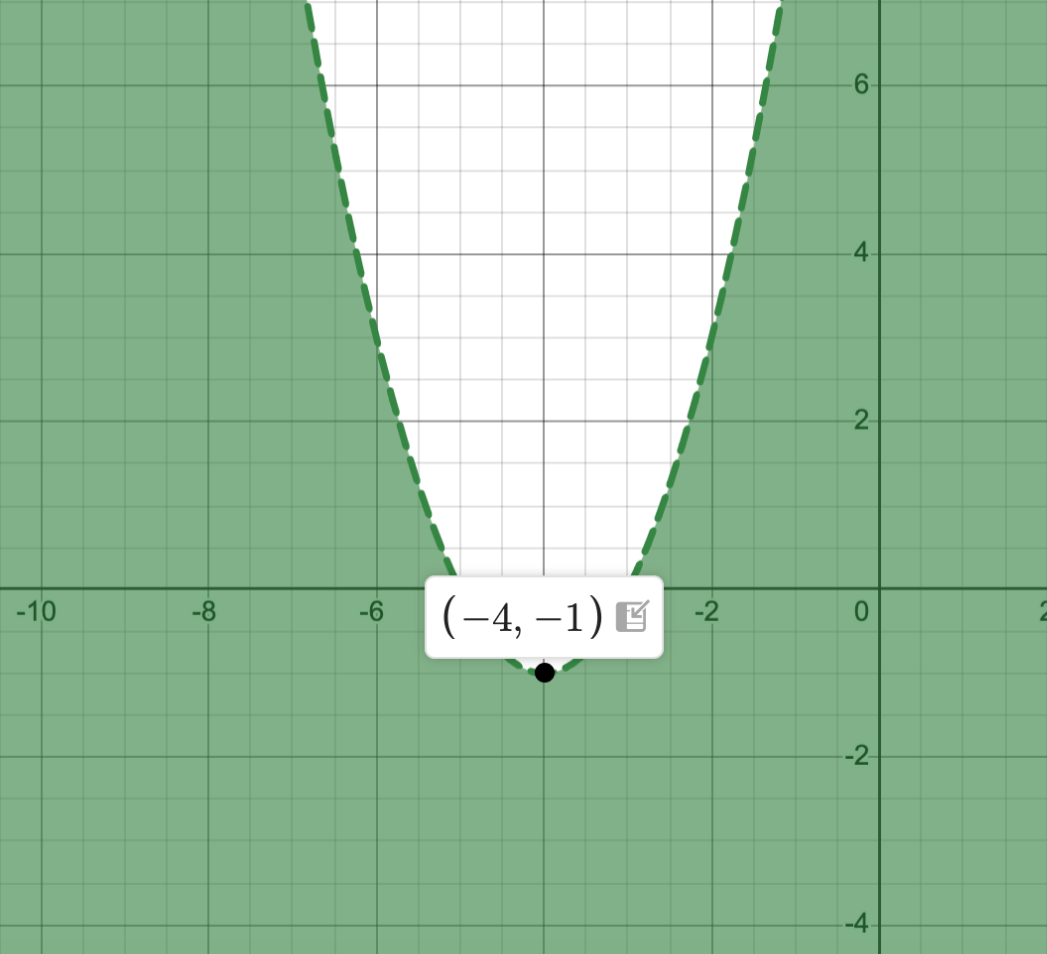
Find the vertex and define the shading (below/above the curve) and type of line (dashed/continuous) for the following inequality:
y<x2+8x+15
•vertex: (-4,-1)
•opens upward
•dashed line
•shading below the curve (outside)
500
Find the zeros and multiplicities of the following function:
f(x) = -x2(x-2)2(x+1)
State if each zero crosses or touches/bounces the x-axis.
Zeros: -1, 0, 2
crosses the x-axis: -1
touches/bounces the x-axis: 0,2
500
For the polynomial below, -2 is a zero:
h(x) =x3+8x2+14x+4
Express h(x) as a product of linear factors.h(x) = (x+2)(x-(-3+√7))(x-(-3-√7))
500
A ball is thrown vertically upward. After t seconds, its height h (in feet) is given by the function h(t)= 40t-16t2 . After how long will it reach its maximum height? Do not round your answer.
1.25 seconds