Operations
Long Division
Synthetic Division
Factoring
Graphing
100
(3x-4)+(2x+3)
5x-1
100
(8x^3+33x^2-29x-70)/(8x+9)
x^2+3x-7-7/(8x+9)
100
If you are dividing by x+9, what number would we use for the synthetic division method?
-9
100
Factor by X-Box:
f(x)=3x^2+11x+6
(3x+2)(x+3)
100
Describe the End Behavior:
f(x)=x^3-7x^2+11x-3
Falls to the left. Rises to the right.
200
(2x^2-3x+4)-(3x^2+2x-5)
-x^2-5x+9
200
(4x^3+29x^2+53x+18)/(4x+9)
x^2+5x+2
200
(2x^3-2x^2-32x-40)/(x-5)
2x^2+8x+8
200
Factor by X-Box:
f(x)=x^3+7x^2+12x
x(x+3)(x+4)
200
Describe the End Behavior:
f(x)=-3x^2+2
Falls to the left. Falls to the right.
300
(5x^2-5-6x^4)+(4-3x^2+4x^4)
-2x^4+2x^2-1
300
(10x^3-73x^2+14x+51)/(10x+7)
x^2-8x+7+2/(10x+7)
300
(x^3+10x^2+24x+1)/(x+3)
x^2+7x+3-8/(x+3)
300
Factor using Cube Formulas:
f(x)=x^3-8
(x-2)(x^2+2x+4)
300
How many zeroes does a polynomial have?
The same amount as its degree.
400
(8a^3-6a^4+4a^2)-(2a^2-4a^4-3a^3)
-2a^4+11a^3+2a^2
400
(36x^4-96x^3+33x^2+93x-69)/(6x-9)
6x^3-7x^2-5x+8+1/(2x-3)
400
How do we know when synthetic division can be used?
We are dividing by something that looks like 1x+# or 1x-#
400
Factor by Grouping:
f(x)=x^3-3x^2-4x+12
(x-3)(x-2)(x+2)
400
What is the max amount of times a polynomial can change directions?
Its degree minus 1
500
(4x^4-3x^3+2x-4)-(-2x^4+2x^3-4x^2+1)
6x^4-5x^3+4x^2+2x-5
500
(9x^4-10x^3+45x-42)/(9x-10)
x^3+5+8/(9x-10)
500
What is the value of f(-4)?
f(x)=x^4-3x^3-22x^2+19x-11
f(-4)=9
500
f(x)=3x^5-5x^4+6x^3-10x^2
x^2(3x-5)(x^2+2)
500
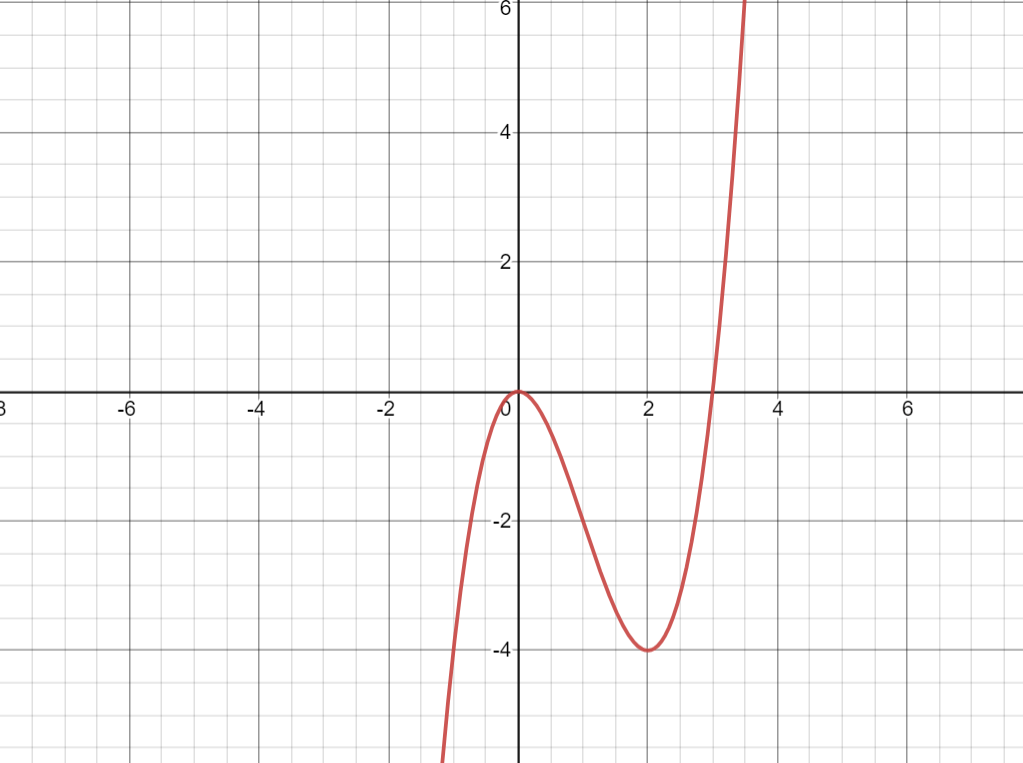
Graph the function:
f(x)=x^3-3x^2