Precipitation Reactions
Molarity
Redox Reactions
Acids & Bases
Breaking Bad
100
What is a precipitate? Which state of matter is it in? Is it soluble in water?
Precipitates are solid, insoluble (i.e. not soluble) products of a chemical reaction.

100
What is the formula for molarity?
Molarity (M) = moles solute ÷ liters solution
100
Oxidation is a (gain / loss) of electrons, and therefore a (gain / loss) of charge.
Reduction is a (gain / loss) of electrons, and therefore a (gain / loss) of charge.
Oxidation is a loss of electrons, and therefore a gain of charge.
Reduction is a gain of electrons, and therefore a loss of charge.
100
How many times more acidic is a substance with a pH of 2 versus a pH of 4.
100
The pH scale is logarithmic, not linear.
100
This highly-conductive element is commonly found in wires. (When asked this same question, Jesse Pinkman says that wires are made of the element "wire".)
Copper (Cu)
200
What products are formed when magnesium cyanide (Mg(CN)2) reacts with aluminum oxide (Al2O3)?
Magnesium oxide (MgO) and aluminum cyanide (Al(CN)3)
200
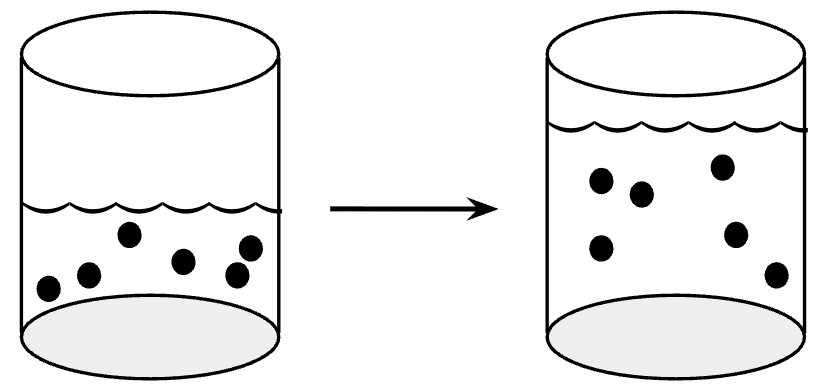
A beaker is half full with saltwater. If deionized water (i.e. not saltwater) is added to the beaker, does the molarity of the saltwater increase, decrease, or stay the same? Why?
Molarity decreases, because the concentration of salt is diluted over a larger volume of water.
200
2 CuSO4 + 4 KI → 2 CuI + I2 + 2 K2SO4
In the redox reaction above, which species is oxidized? Which species is reduced?
Describe the transfer of electrons in this reaction.
Iodine (I) is oxidized: its oxidation state increases from -1 to 0.
Copper (Cu) is reduced: its oxidation state decreases from +2 to +1.
1 electron is transferred from I to Cu.
200
Define the terms acid and base according to the Arrhenius model
When dissolved in water, acids supply H+ ions and bases supply OH- ions.
200
96.3% of the human body is made up of which four elements? (Walter White names these elements in a Season 1 flashback.)
Oxygen (65%), carbon (18.5%), hydrogen (9.5%), and nitrogen (3.3%)
300
When aqueous solutions of lead nitrate (Pb(NO3)2) and potassium iodide (KI) are mixed, what is the precipitate, if any? (Hint: Use a solubility table.)
Lead iodide (PbI)
300
How many moles of hydrochloric acid (HCl) are in a 0.35 L solution of 12 M HCl?
M = mol / L
12 M = x mol / 0.35 L
x = 12 * 0.35
x = 4.2 mol
300
What is the oxidation number of sulfur (S) in RaSO4?
+6
300
A solution has an H+ concentration of 1 x 10⁻³. What is the pH of this solution?
pH = 3
300
Walter White lectures Jesse Pinkman for using the wrong lab equipment. ("Did you learn nothing from my chemistry class?") Which pieces of glassware is Walter holding in the image below?
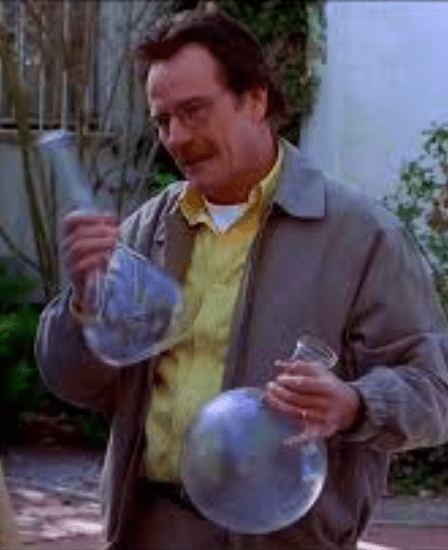
Boiling flask (left hand)
Volumetric flask (right hand)
400
Potassium chromate (K2CrO4) and calcium chloride (CaCl2), both aqueous, react. What is the net ionic equation? What are the spectator ions?
Net ionic equation: CrO42− + Ca2+ → CaCrO4
Spectator ions: K+ and Cl−
400
5 grams of sodium hydroxide (NaOH) are dissolved in 250 mL of solution. What is the molarity of the NaOH?
0.5 M
400
Is the reaction between hydrochloric acid (HCl) and sodium hydroxide (NaOH) a redox reaction? Why or why not?
No. By definition, a redox reaction involves a transfer of electrons. No elements have a change in their oxidation states before vs. after the reaction; therefore, no electrons were transferred:

400
A 2.0 L solution has an OH- concentration of 1 x 10⁻⁹. How many moles of H+ are present in this solution?
2 * 10-5 mol H+
400
Walter White tells Jesse Pinkman to pour hydrochloric acid (HCl), a strong acid, into a plastic bin, made of polypropylene plastic. (Jesse doesn't listen to this advice, and accidentally burns a hole through his ceiling.) Why does doesn't HCl dissolve polypropylene?
Hydrochloric acid is polar (due to high electronegativity difference between H and Cl). Polypropylene is nonpolar. "Like dissolves like"; therefore, HCl does not dissolve polypropylene.