Parallelograms
Rectangles
Rhombi
Squares
Trapezoids and Kites
100
What must be true about the sides of a quadrilateral to be a parallelogram?
Opposite sides must be parallel (and/or congruent)
100
True or false: Every rectangle is also a parallelogram.
True! Rectangles meet all the requirements to be a parallelogram.
100
Rhombi share all features of a parallelogram in addition to having which unique feature about their sides?
All sides are equal length (congruent).
100
True or false: squares have all the properties of parallelograms, rectangles, and rhombi.
True!
100
What feature is true of trapezoids that is NOT true of kites?
Trapezoids have at least one pair of parallel sides; in a kite, no sides are parallel.
200
Given quadrilateral ABCD, how would you know if it is a parallelogram based on its diagonals?
If they bisect each other, then it is a parallelogram.
200
What feature is true about the diagonals of rectangles in addition to bisecting each other?
Diagonals of a rectangle are congruent.
200
What feature is true about the diagonals of a rhombus in addition to bisecting each other?
Diagonals are perpendicular.
200
If quadrilateral ABCD is a square, what relationship exists amongst its diagonals?
They are perpendicular bisectors of each other.
200
Complete the sentence: In a kite, diagonals are...
perpendicular
300
What coordinate geometry tool could you use to verify the existence of a parallelogram based on opposite parallel sides - and what evidence would be needed?
1) The slope formula would need to be used - to show that opposite sides have equal slope and thus are parallel. OR
2) The midpoint formula would need to be used - to show that diagonals share a midpoint and thus bisect each other.
300
Name the two coordinate geometry tools that could be used to verify the existence of a rectangle AND state what evidence you would need from them.
1) Slope Formula - used to show two segments meeting at a vertex are perpendicular by showing opposite reciprocal slopes
2) Distance formula - used to show the diagonals are equal length and thus congruent by definition
300
What coordinate geometry tool(s) would need to be used to verify a quadrilateral is a rhombus - and what evidence would need to be shown?
Slope formula can be used both (a) to show its first a parallelogram and then (b) to show the diagonals are perpendicular (opposite reciprocal slopes)
300
Name two coordinate geometry methods you could use to classify a quadrilateral as a square based on the coordinates of its vertices.
Any combination of:
1) Use the Slope Formula to show that all four sides and/or diagonals are perpendicular
2) Use the Distance Formula to show all four sides are equal in length
3) Use the Midpoint formula to show the diagonals bisect each other
300
In order to prove a figure in the coordinate plane is an isosceles trapezoid, what pieces of evidence would need to be shown?
1) One pair of opposite sides are parallel
2) The other pair of opposite sides are not parallel, but ARE congruent
400
Given the figure below, find the values of y and z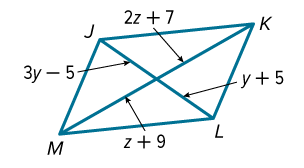 .
.
y = 5; z = 2
400
Find the lengths of the diagonals for the image shown below, given XW = 3 and WZ = 4.
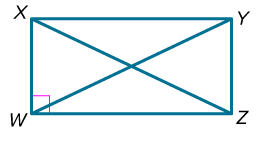
YW = XZ = 5 units
400
Assume quadrilateral ABCD is a rhombus. If AD = 2x+4 and CD=4x-4, find the value of x.
x = 4
400
The area of square ABCD is 26 square units and the area of triangle EBF is 20 square units. if EB is perpendicular to BF, and AE = 2, find CF.
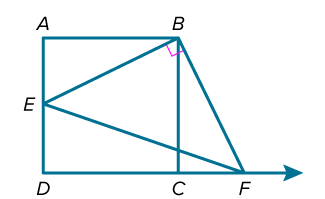
CF = 4 units
400
Given that WXYZ is a kite, if m∠WXY=(13x+24)°,m∠WXY=(13x+24)°,
m∠WZY =35°,m∠WZY =35°, and
m∠ZYX=(13x+14)°, find m∠ZWX.
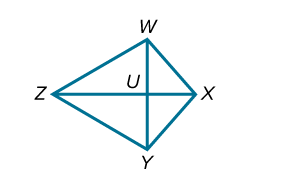
105 degrees
500
Given quadrilateral ABCD with vertices A(-1,4), B(4,5), C(2,0), and D(-3,-1), determine if quadrilateral ABCD is a parallelogram based on specific evidence.
Quadrilateral ABCD is a parallelogram;
Can be verified in different ways:
- Showing parallel sides by Slope Formula
- Showing diagonals bisect by Midpoint Formula
500
Given Quadrilateral WXYZ with vertices W(-2,1), X(4,2), Y(3.5, 5) and Z(-2.5, 4), determine if quadrilateral WXYZ can be classified as a rectangle.
Quadrilateral WXYZ is a rectangle.
Two options to show:
1) Calculate slopes of each side, show that sides meeting at a vertex are perpendicular
2) Calculate midpoints and lengths of diagonals, show they bisect each other and are congruent.
500
Given quadrilateral ABCD with vertices A(1,2), B(3,1), C(2,-1) and D(-1,0), determine if the quadrilateral is a rhombus based on specific evidence.
ABCD is not a rhombus; while it CAN be shown to be a parallelogram, its diagonals are not perpendicular.
500
Determine if the points below generate a square.
A(2, −4), B(−6, −8), C(−10, 2), D(−2, 6)
ABCD is not a square (but it IS a rectangle!)
500
Given quadrilateral RSTU with vertices R(−3, −3), S(5, 1), T(10, −2), and U(−4, −9), provide evidence to show whether it is or is not a trapezoid.
RSTU is a trapezoid; RS is parallel to TU, but RT is not parallel to SU.