Vocab
Angle Pairs
Find the Missing Angle
Transversal angles
Transformations
100
What type of transformation always leaves the shape congruent to the original shape?
Rigid motion or Rigid Transformation
100
Sum of complementary angles
90 Degrees
100
Angles A and B are Complementary angles. Angle A measures 28 degrees. Angle B measures ___.
62 degrees
100
A line that crosses two or more other lines in a plane?
traversal line
100
The point (2, 5) is translated using the rule:
(x + 3, y - 1)
What is the new coordinate for the new positition?
(5, 4)
200
What is the name of an angle that measures 180 degrees?
straight
200
Sum of supplementary angles
180 Degrees
200
What is the measurement of angle x?
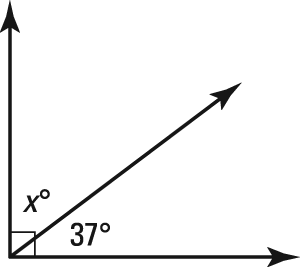
53 degrees?
200
The type of lines that NEVER intersect
Parallel Lines
200
A triangle undergoes the transformation using the rule (-x , y)
What transformation has occurred?
Reflection across the y axis.
300
Write give an example of a pair of supplementary angles (WITH actual numbers!)
Many examples!
100 and 80
170 and 10
90 and 90
and many more!
300
Angles on the same side of a transversal are called
Consecutive angles
300
Solve for x
14x+2 = 13x+9
x = 7
300
The pair of blue angles in this image are congruent, known as:
Corresponding Angles
300
Write the algebra rule that summarizes the transformation: 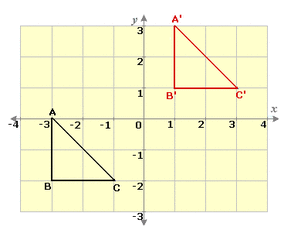
(x,y) --> (x+4, y+3)
400
If an angle measures 34 degrees, what type of angle is it?
acute
400
Angles that are next to each other
Adjacent Angles
400
Write the equation to solve for x

28o + xo + 73o = 180o
xo = 79o
400
The two angles below are known as:
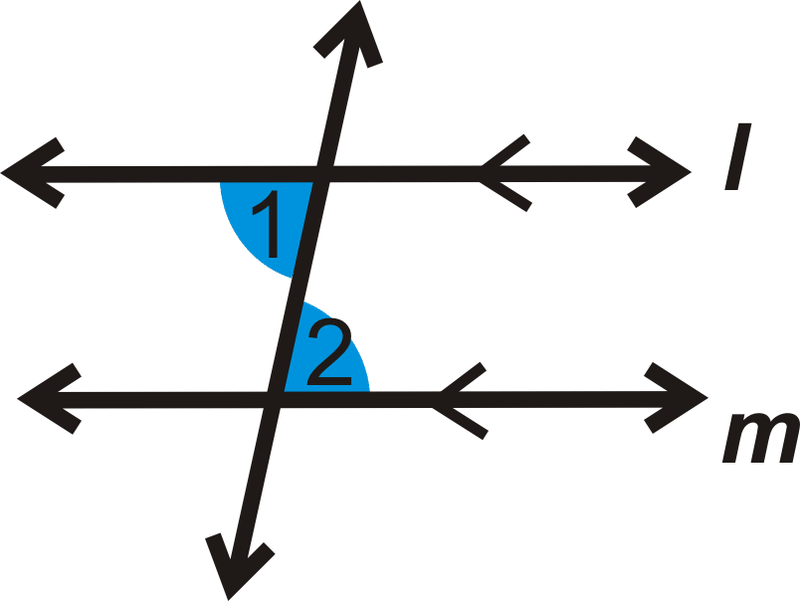
Alternate Interior angles
400
The coordinate (-1, 6) is transformed by a series of transformations:
1) Reflected across the x-axis
2) Translated up 4 units.
What is the new coordinate position?
(-1, -2)
500
Complementary angles add up to _____
90 Degrees
500
Vertically opposite angles are always __________
Congruent (the same)
500
Two angles are supplementary.
Angle <A = 4x + 20
Angle <B = x + 60
What is the measure of angle A?
x = 20
<A = 4(20)+20 = 100
500
Name three pairs of supplementary angles in this diagram.
Many! Any consecutive angles, any linear pairs, or any more that Stover approves :)
500
The coordinate (-5, 10) is transformed by two transformations, and the result is (5, 6).
What are two possible transformations that could result in this new coordinate?
Many options!
One possible answer: reflect across the y-axis, translate down 4