Graphing
Grab bag
Displacement Vs Time Graph
Distance/Displacement
Velocity
100
The variable that goes on the Y-Axis
What is the dependent variable?
100
A magnitude is another way to say this:
What is a number, or an amount of something. Basically, just some amount of something AS LONG AS THERE IS NO INFORMATION ABOUT DIRECTION.
100
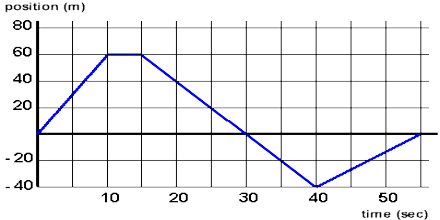 The average velocity between 20 and 55 seconds
What is -1.14 m/s
average velocity depends on displacement divided by time. The displacement cares about distance from start to finish, INCLUDING direction. SO, the starting displacement at 20 seconds is 40m. The ending displacement at 55 seconds is 0m. This gives 0m-40m = -40m (since it is going downhill, or from 40 to 0 m) The time is 55-20 seconds, or 35 seconds. Finally, take the displacement (40m) then divide by total time (35 seconds). -40m/35s = -1.14m/s
100
A value where only magnitude, but not direction, matters.
What is scalar?
100
bob traveled 15 meters East. Then, he went 6 meters South. The whole thing took him 20 seconds. His average velocity is this.
What is 0.81 m/s Southeast?
the velocity equation is V=displacement/time.
Since displacement cares about distance from start to finish AS THE CROW FLIES, note that 15m East and 6m South are at right angles. To get the displacement, you'd have to put those two numbers into pythagorean theorem. When you've got the length of that displacement, you'd have to divide it by time (20 seconds in this problem)
200
The variable that is changed by the scientist in an experiment
What is the independent variable?
200
LOLcat rides Lionking's skateboard to visit the friendly hyena family. If he skated at 15 m/s and took 80 seconds to get there, how far away are the friendly animals?
what is 1200 m?
V=displacement/time. Solving for displacement gives: d=V*t
200
The displacement at 35 seconds
What is -20 m
This question is just asking where the displacement is at 35 seconds, so just check the Y-axis when the time is at 35 seconds, remembering the sign.
200
The change in position
What is displacement?
200
The velocity formula is V=displacement/time. This is the new formula when if you have to solve for time:
What is displacement over velocity, or displacement divided by velocity?
300
On a displacement vs. time graph, the SLOPE of a line tells us this.
How fast something is going. The steeper the slope, the faster the thing is going.
Speed cares about the absolute value of slope since speed or distance don't care about direction, but velocity on the other hand DOES care about direction. For example, a velocity could have a very fast NEGATIVE velocity if the graph had a steep negative slope.
300
bob traveled 15 meters East. Then, he went 6 meters South. The whole thing took him 20 seconds. His average speed is this.
What is 1.05 m/s
the formula for speed is S=distance/time. The distance is the TOTAL of all steps traveled regardless of direction. This gives distance=15m+6m=21m. Then, divide that by the time to get average speed: 21m/20sec=1.05 m/s
300
The displacement at 20 seconds.
What is 40 m?
again, this is just checking where the displacement is (measured on the Y-axis) when the time is 20 seconds. No formula required for this one.
300
Mr. Knorr walked 30 meters East, realized he went too far so he turned around and went 10 meters West, and then calculated his displacement, which he found to be...
What is 20 meters East?
Displacement cares only about the distance from start to finish AS THE CROW FLIES. If you were to mark this path, you'd see that the 30m East counteracts the 10m West, so 20m is left, and it would be in the East direction
300
Given the choices speed and velocity, ______ is a scalar, and _______ is a vector.
What is speed is scalar and velocity is vector?
400
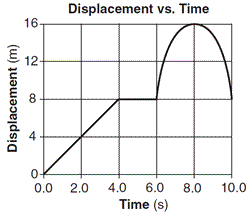 This is the average velocity from 6 to 8 seconds.
What is 4 m/s?
(displacement is the distance from start to finish *as the crow flies*. Since at 6 seconds it is at 8 meters displacement, then it is at 16 meters displacement at 8 seconds, the displacement is 8m. The time from 6 to 8 seconds is 2 seconds. Then, using the formula for velocity, you get V = 8m / 2 seconds = 4m/s)
400
The standard metric unit for velocity or speed is this:
What is meters per second (m/s)?
400
The instantaneous velocity at 45 seconds
What is 2.67 m/s
Instantaneous velocity is a measure of the slope AT THE SPOT that it is asking about. So at 45 seconds, the slope of THAT LINE is 45 seconds. It doesn't care about the line segments next to it, just the line and point that exists at the time it asks about
400
Lion King lost his marbles. While looking for them, he traveled 20 meters North, 10 meters East, 45 meters South, and then another 10 meters East. His distance traveled was this
What is 85 meters?
Distance only cares about ALL steps taken, regardless of direction or sign. Just add up each step taken. 20m+10m+10m+45m=85m
400
The total distance divided by the total time is this.
What is average speed.
500
This is the displacement from 2 seconds to 10 seconds.
What is 4 m?
the displacement is from start to finish as the crow flies, so from 2 seconds the displacement is 4m, but then by the time it gets to 10 seconds it has a displacement of 8m. The distance from that start point (4m) to the end point (8m) is your total displacement, or 8m - 4m= 4m
500
A vector has magnitude and direction. A scalar has this:
just magnitude
500
The instantaneous velocity at 30 seconds
What is -4 m/s
Instantaneous velocity is a measure of the slope AT THE SPOT that it is asking about. So at 30 seconds, the slope of THAT LINE is 30 seconds. It doesn't care about the line segments next to it, just the line and point that exists at the time it asks about
500
Mr. Knorr was looking for his tesla coil high and low. He looked in the cabinets 30 meters North, and then the other cupboards 10 meters East, and then went 30 meters South to his last set of cupboards. Then he realized he had recently put some supplies in the ceiling, so he climbed 15 meters up. His displacement was...
What is about 18 meters East & Up?
Displacement is from the start point to the ending point, AS THE CROW FLIES. TO do this: combine east and west directions together and separately combine north-south directions together, remembering that opposite directions (like north & south for example) must have one cancelling the other. This gives 30m North and 30m South cancelling out completely, and 10m East left over. Then, note the 10m East and then 15m up. Since they're at right angles to each other, combine them using the pythagorean theorem. This should give the remaining side's length, and then just figure out which direction it is pointing.
500
When looking at a displacement vs time graph, I can find the instantaneous velocity by finding this.
What is the slope of the line at that instant (or time)?