Translations
Reflections
Rotations
Rules
Symmetry & Compositions
100
The point A (−2, 1) is translated along the vector <−3,5>. The image is A′. Find the coordinates of A′.
(-5,6)
100
Find the coordinates of the point (−3, 5) after it is reflected across the line y = 3.
(-3, 1)
100
The triangle XYZ has vertices X (−2, 1), Y (−5, 3), and Z (−4, 5). After a 180° clockwise rotation of △XYZ about the origin, the result is △X′Y′Z′.
State the coordinates for X', Y', and Z'.
X' (2, -1)
Y' (5, -3)
Z' (4, -5)
100
Write the rule to describe the following reflection:
over the y-axis
(- x, y)
100
Give the smallest angle of rotation needed for the figure to appear unmoved.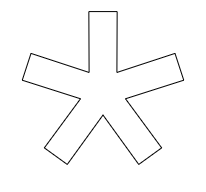
72o
200
The figure below has a point marked with a large dot. Translate the figure 7 units to the right and 6 units down. Give the coordinates of the marked point in the final figure.
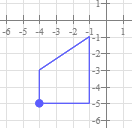
(3, - 11)
200
Find the coordinates of the point (6, 7) after it is reflected across the line x = 1.
(-4, 7)
200
Point A is graphed at (−6, 1). After a 270° counterclockwise rotation about the origin, what are the coordinates of A'?
(1, 6)
200
Write the rule to describe the following translation:
4 units to the right, 2 units down
(x + 4, y - 2)
200
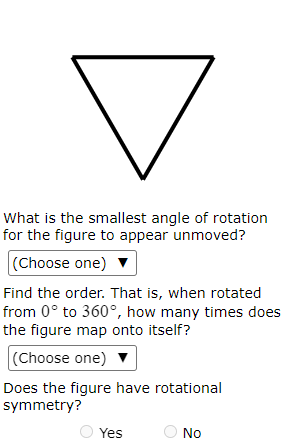
a) 120o
b) 3
c) Yes
300
In the coordinate plane, the point A (0, 1) is translated to the point A′ (−5, 2). Under the same translation, the points B (−2, 5) and C (−2, 3) are translated to B′ and C′, respectively.
What are the coordinates of B′ and C′?
B' (-7, 6)
C' (-7, 4)
300
The image of A (−8, −1) after a reflection across a line is A′ (−8, −5). Find the equation of the line of reflection.
y = −3
300
A circular dial has ten equally spaced points, as shown. Point A is on the top of the dial. Suppose that the dial is turned clockwise until point G is on top. How many degrees does the dial have to turn?
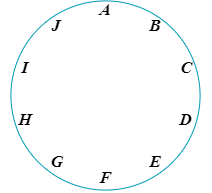
144o
300
Write the rule to describe the following rotation:
180o
(- x, - y)
300
Which sequence(s) of transformations will map Figure A onto Figure B exactly? 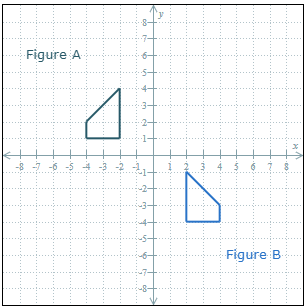
(Two correct answers)
- Translate Figure A down 5 units, and then reflect that result over the y-axis.
- Reflect Figure A over the y-axis, and then translate that result down 5 units.
400
State the coordinates for each point of the triangle a translation 2 units to the right and 3 units up. 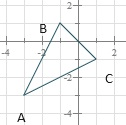
A' (- 1, 0)
B' (1, 4)
C' (3, 2)
400
Write the coordinates of A′, B′, and C′ which are the vertices of the reflected triangle.
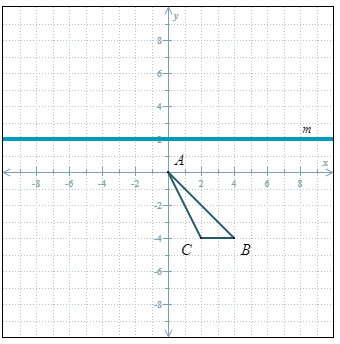
A' (0, 4)
B' (2, 6)
C' (4, 6)
400
Point A is graphed at (3, 4). After a 90°
counterclockwise rotation about the point (−1, −2), what is the location of A'?
(−3, 6)
400
Write the rule to describe the following rotation:
90o CCW
(- y, x)
400
Which sequence(s) of transformations will map Figure A onto Figure B exactly? 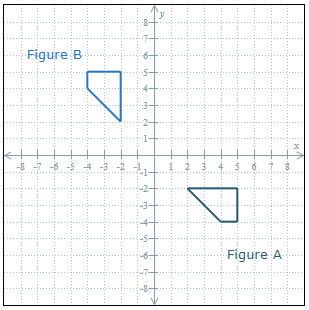
> Reflect Figure A over the y-axis, and then rotate that result clockwise 90° about the origin.
> Rotate that result clockwise 90° about the origin, and then reflect Figure A over the x-axis .
500
Write the rule for the translation shown:
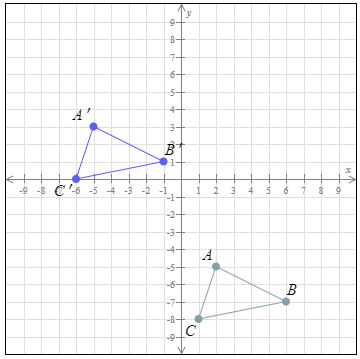
(x - 7, x + 8)
500
Write the rule for the reflection shown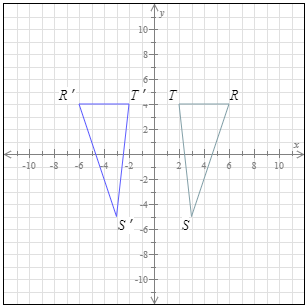
(- x, y)
500
Write the rule that describes the rotation: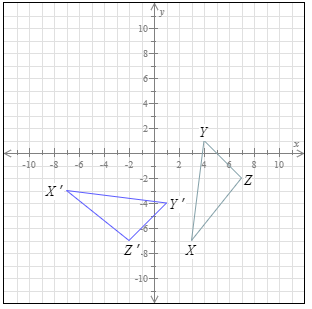
(y, - x)
500
Write the rule to describe the following rotation:
90o CW
(y, - x)
500
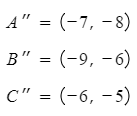
The triangle ABC has vertices A (−5,−2), B (−3,−4), and C (−2,−1). Its image after a translation along the vector <−3,−5> followed by a reflection across the line y=x is △A″B″C″.
State the coordinates of A″, B″, and C".