Evolution
Organic Compound
Cell Processes
Genetics
Ecology
Homeostasis and Body Systems
100
What is an Adaptation
An adaptation is something an organism has, or can do, that helps it to survive in its environment
100
What molecule, located in the nucleus, controls the production of proteins in a cell?
DNA
100
Which process makes ATP energy for a cell?
Cellular Respiration
100
How do we get the DNA that gives us our traits?
We inherit DNA from our parents
100
How are abiotic factors different from biotic factors?
Abiotic-non-living
Biotic- Living
100
Why is homeostasis important?
Because it keeps you healthy and balanced inside your body so that you can stay alive.
200
Why is genetic variation needed for natural selection to occur?
Genetic variation means that there will be a chance that some individuals within a population will have the adaptations they need when the environment changes, so those organisms will survive and the species won’t all die out.
200
Identify the subunits (building blocks) of
proteins
starch (in plants) or glycogen (in animals)
1. Amino Acids
2. Glucose
200
Identify the 3 parts of the cell that need to work together to synthesize proteins, including directing the production, bringing in the raw materials, and producing the proteins
Directing: nucleus
Bringing in the materials: cell membrane
Producing: ribosome
200
What affect will mutations in the DNA affect the organism that has those mutations? Describe the possible consequences of those mutations.
Mutations in DNA can cause incorrect proteins to be made that can’t do their jobs. This may change the traits of the organism.
200
Explain why an energy pyramid shows fewer consumers at the top, and more producers at the bottom.
Energy is used up by the organisms and lost as heat as you go up the trophic levels, so there are fewer organisms at the top than at the bottom of the energy pyramid.
200
How does your endocrine system make sure that your blood sugar levels stay the same, even if you eat a lot, or stop eating?
When you eat a lot, the pancreas makes insulin to decrease blood sugar levels; when you stop eating the pancreas makes glucagon to increase blood sugar levels, so that your sugar levels remain constant.
300
How does natural selection work?
There is a change in the environment, and some of the organisms in that environment will have the adaptation they need to survive, and they will reproduce and pass on that adaptation to their offspring, so there will be more of the organisms with the adaptation in the population.
300
Identify the inputs and outputs, including all matter and energy, in the processes of
Photosynthesis
Cellular respiration
Photosynthesis:
Inputs: sunlight, carbon dioxide, and water
Outputs: glucose and oxygen
Respiration:
Inputs: glucose and oxygen
Outputs: ATP, carbon dioxide, and water
300
Explain how the involvement of coding and non-coding genes in the process of differentiation during embryonic development results in the baby having different kinds of cells, tissues, and organs.
Control regions (non-coding DNA) turns coding genes on or off. Each kind of cell expresses different genes so each cell only makes the proteins it needs. For example, muscle cells only express muscle cell genes and make muscle cell proteins.
300
Explain how genes can change in frequency in response to changes in the environment, due to the process of natural selection.
Genes that provide an advantage to an organism by giving them an adaptation for survival, will increase in frequency in a population because the organisms that don’t have those genes are more likely to die and not be able to pass on their genes to their offspring.
300
Explain the role of decomposers in the cycling of matter in an ecosystem.
Decomposers break down waste and dead organisms and return the nutrients to the soil to be reused by plants.
300
Choose any two body systems and explain how they work together to enable your body to maintain homeostasis.
Examples:
1.The digestive system breaks down your food, and the circulatory system carries it to your cells
2.The respiratory system breathes in oxygen, and the circulatory system carries it around the body to the cells.
3.The circulatory system brings wastes to the excretory system, which filters out the waste and put it into your urine.
400
Give a specific example of how evolution changed the traits of a population. (You may use an example we learned about this year.)
Possible examples:
- Peppered moths
Antibiotic-resistant bacteria can’t be killed by antibiotics
400
All proteins are made of the same amino acids, but they all have different functions. There are different enzymes, receptors and hormones, and there are many other different types of proteins, each with its own specific function. Explain how that is possible.
They have different sequences of amino acids, which give them their specific shapes, which gives them their specific functions.
400
Explain how the process of diffusion allows only certain molecules to travel across cell membranes into and out of cells. In your response identify the kind of molecules that can cross these membranes, and why.
Molecules diffuse from high to low concentration. Only small molecules such as oxygen, carbon dioxide, water, glucose and amino acid molecules can go through membranes. (Oxygen, glucose and amino acids diffuse into a cell, carbon dioxide diffuses out.)
400
How can DNA provide evidence that two organisms are closely related and share a relatively recent common ancestor?
If they have similar sequences of the bases A, T, C, and G in their DNA, that will provide evidence that they inherited those sequences from a recent common ancestor and are closely related
400
Explain how the carrying capacity of an ecosystem limits the number of organisms that the ecosystem can support.
Factors such as space, food availability, sunlight, water, temperature and predators will limit how many of each kind of organism can live in the ecosystem.
400
Explain how a negative feedback mechanism works in general to enable you to maintain homeostasis.
(You don’t need to give a specific example)
A negative feedback mechanism is the brain sensing that there is an imbalance in the body and then making a change in the body to get it back to the set point.
500
Evaluate the following as evidence for evolution from a common ancestor:
Homologous structures
Comparing DNA base sequences
Comparing amino acid sequences in proteins
Homologous structures – they show that organisms inherited the structures from a common ancestor
Comparing DNA base sequences – if two organisms have similar base sequences, they are closely related
Comparing amino acid sequences in proteins – if organisms have similar sequences, they are more closely related
500
How do plants make amino acids, nucleic acids (DNA & RNA) and other organic compounds?
They use minerals from the soil such as nitrogen and phosphorus and rearrange the atoms in glucose molecules to synthesize amino acids, nucleic acids, and other organic compounds.
500
DAILY DOUBLE!!!
Explain how the processes that involve the cycling of carbon between biotic and abiotic factors in the ecosystem enable organisms to survive.
Photosynthesis in plants takes carbon dioxide from the atmosphere and uses it to make glucose. Animals eat the plants and get the glucose. Both plants and animals use the glucose to make energy, and produce carbon dioxide which goes into the atmosphere for plants to use
500
Transcribe and translate the following DNA sequence:
GGC TTC CTA CTT GGA CAA
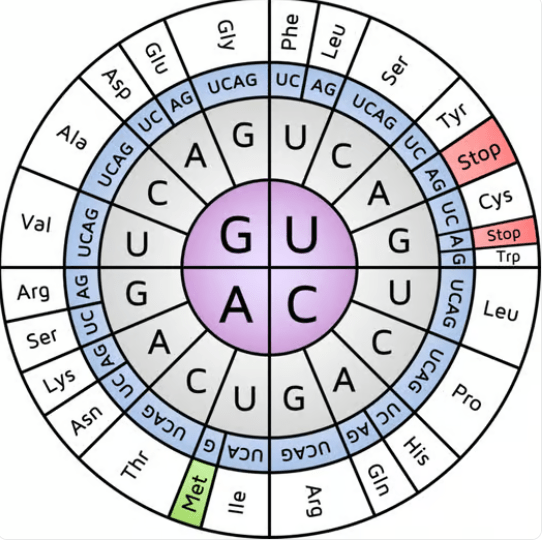
DNA: GGC TTC CTA CTT GGA CAA
RNA: CCG AAG GAU GAA CCU GUU
AA: Pro Lys Asp Glu Pro Val
500
Explain the differences between a stable and an unstable ecosystem
A stable ecosystem has a lot of biodiversity and is more likely to survive even after a natural disaster.
500
When you exercise, there are specific changes in the body that affect the respiratory, circulatory, and muscular systems. Explain how the body uses negative feedback mechanisms to restore homeostasis and bring you back to the set point after exercising.
You need more oxygen and glucose to make ATP, and produce more carbon dioxide because of an increased rate of cellular respiration to make more energy.
Your lungs breathe harder to bring in more oxygen. Your blood travels faster around your body to bring more oxygen and glucose to the cells, and to carry carbon dioxide faster away from the cells.