Reliability tests
Reliability Terminology
Scores & Equations
Reliability
Potpourri
Potpourri
MORE RELIABILITY THINGS!
100
This reliability test is used when you want to know whether a test is consistent over time.
What is Test-retest?
100
This occurs when the first testing influences the second.
What are practice or carryover effects?
100
The equation used to correct split-half reliability, represented by the following equation:

What is the Spearman-Brown formula?
100
The amount of variability one might expect in an individual’s true score if that test is taken an infinite number of times
What is the Standard Error of Measurement?
100
This theory decribes the score on a test as being the result of a true score, which is the average score a person would get on a test if they took it many times, and an error score, which represents some randomness around that true score.
What is Classical Test theory?
200
When you want to know whether there is consistency between different human scorers in the rating of some outcome, you would use this reliability test. Its coefficient is an actual proportion.
What is Interrater?
200
A test that uses many questions and then combines the answers to measure a construct, need to make sure that items are measuring the same thing, evidenced by this.
What is Internal Consistency Reliability?
200
This formula calculates the correlating score for each item with the total score for each individual and then compares that with the variability present for all individual item scores
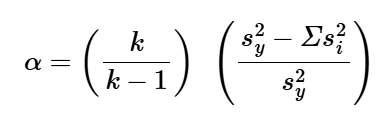
What is Cronbach's Alpha?
200
As this is reduced, reliability is increased.
What is error or randomness?
200
The minimum acceptable reliability coefficient.
What is .70?
300
This reliability test is used when you want to know if different forms of a test give equivalent scores.
What is parallel forms?
300
A means of establishing internal consistency whereby the scores on one half of the test are compared with scores on the second half of the test to see if there is a strong relationship between the two.
What is Split-Half Reliability?
300
This formula is used to measure internal consistency for dichotomous itemed tests,

What is the Kuder-Richardson (20) formula?
300
Raising this decreases randomness in a study (which in turn increases reliability!)
What is Consistency?
300
The name for a correlation between variables that change in the same direction.
What is a direct or positive correlation?
400
This test for reliability is used when you want to know if performance on one part of the test is similar to performance on another part of the test.
What is Internal consistency?
400
The following tests measure this aspect of reliability:
> Spearman-Brown
> Cronbach's Alpha
>Kuder-Richardson 20
What is Internal (reliability)?
400
The common statistic reflecting the correlation between two sets of scores, represented in the following formula:
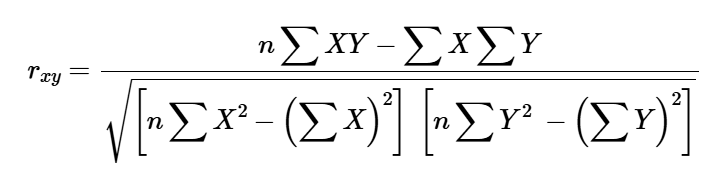
What is a correlation coefficient?
400
This is considered the average score you would get if taking a test infinite times.
What is the true score?
400
The name for the correlation between variables that change in opposite directions.
What is an indirect or negative correlation?
500
Both are the same each time in test-retest or time sampling measures of reliability.
What are the test and the testers?
500
These types of variables have only two possible scores, like "right or wrong."
What are dichotomous items?
500
The largest possible reliability coefficient.
What is +1.00?
500
This is the difference between the observed score and the true score.
What is error?
500
The description of a relationship that has a correlation coefficient of .80 to 1.00.
What is a very strong relationship?