You've Got Some Nerve
Slay the Airway
Passing Gas
Don't Hate, Ventilate
Oxygenate Me
100
A bilateral superior laryngeal nerve block performed to facilitate fiberoptic intubation will provide anesthesia to this structure.
A. base of the tongue
B. larynx above the vocal cords
C. superior surface of the epiglottis
D. tonsillar pillars
E. upper trachea
What is...
B. larynx above the vocal cords?
100
This muscle tenses the vocal cords.
What is...
The cricothyroid muscle?
100
During laminar flow, resistance is directly proportional to this factor.
What is...
Viscosity?
100
Administration of 200 mEq of sodium bicarbonate during cardiopulmonary resuscitation is associated with this.
A. CSF alkalosis
B. hypercalcemia
C. hypercarbia
D. hyperkalemia
E. shift of the oxyhemoglobin dissociation curve to the right
What is...
C. hypercarbia?
100

Name 1 of the following: this actor's name, the character's name, the franchise name, or the movie's director. [Multiple correct answers=more points]
200
You patient is coughing during awake intubation; you may have not adequately localized this/these nerve(s).
A. Glossopharyngeal
B. Hypoglossal
C. Recurrent laryngeal and glossopharyngeal
D. Recurrent laryngeal and superior laryngeal
E. Superior laryngeal and glossopharyngeal
What are the...
D. Recurrent laryngeal and superior laryngeal?
200
This is characteristic of the airway in a 2-month-old when compared with an adult airway.
A. Airway is narrowest at the cricoid cartilage
B. Epiglottis is broader
C. Laryngeal mucosa is more tightly adherent
D. Larynx is positioned lower in the neck
E. Vocal cords have a more cephalad anterior attachment
What is...
A. The airway is narrowest at the cricoid cartilage?
200
During turbulent flow, resistance is directly proportional to this factor.
What is...
Density?
200
A 70-year-old man who underwent bilateral carotid endarterectomies two years ago is to undergo anesthesia and surgery. The denervation of the carotid bodies is likely to result in this.
A. chronic respiratory alkalosis
B. decreased ventilatory response to hypoxemia
C. increased ventilatory response to hypercarbia
D. labile hypertension
E. resting bradycardia
What is...
B. decreased ventilatory response to hypoxemia?
200
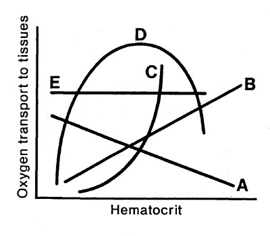 This line illustrates the relationship of hematocrit and oxygen transport.
What is...
Line D?
300
The following statement concerning the innervation of the larynx is TRUE.
A. The glossopharyngeal nerve provides motor innervation to the vocal cords
B. The recurrent laryngeal nerve provides sensory innervation to the mucosa of the larynx above the vocal cords
C. The hypoglossal nerve provides sensory innervation to the aryepiglottic folds
D. Unilateral recurrent laryngeal nerve injury results in an abducted vocal cord on the injured side
E. The vagus nerve provides innervation to all structures below the vocal cords
What is...
E. The vagus nerve provides innervation to all structures below the vocal cords
300
During attempted awake intubation, the patient gags when the laryngoscope presses on the base of the tongue due to the following cranial nerve.
A. Trigeminal
B. Facial
C. Glossopharyngeal
D. Vagus
E. Hypoglossal
What is...
C. The Glossopharyngeal nerve?
300
Write the Alveolar Gas Equation!
What is...

300
Name two molecules that are metabolized in the lungs.
What are...
Norepinephrine, serotonin, bradykinin, prostaglandins, and leukotrienes?
300
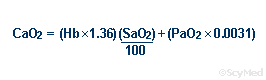
Write the arterial oxygen content equation!
What is...
400
The following statement about the superior laryngeal nerve is TRUE.
A. It provides sensory innervation to the subglottic surface of the vocal cord
B. It provides sensory innervation to the inferior surface of the epiglottis
C. It is a branch of the glossopharyngeal nerve
D. It is blocked by injection of anesthetic near the lateral portion of the cricothyroid membrane
E. It is the most commonly injured nerve during thyroid surgery
What is...
B. It provides sensory innervation to the inferior surface of the epiglottis
400
A patient has decreased lung compliance and hypoxemia after an episode of laryngospasm following extubation. This is the most likely cause.
A. allergic reaction to the anesthetic
B. altered alveolar-capillary membrane permeability
C. anesthetic-induced lymphatic dysfunction
D. increased pulmonary capillary pressure
E. negative pulmonary interstitial hydrostatic pressure
What is...
E. negative pulmonary interstitial hydrostatic pressure?
400
Treatment with prostaglandin E1 is initiated in a newborn with hypoplastic left heart syndrome. This is the MOST likely side effect of prostaglandin E1.
A. Apnea
B. Arrhythmias
C. Hypertension
D. Hypothermia
What is...
A. apnea?
400
This is how the CO2 response curve will look on a person under sevoflurane anesthesia, compared to their normal curve. (normal curve pictured)
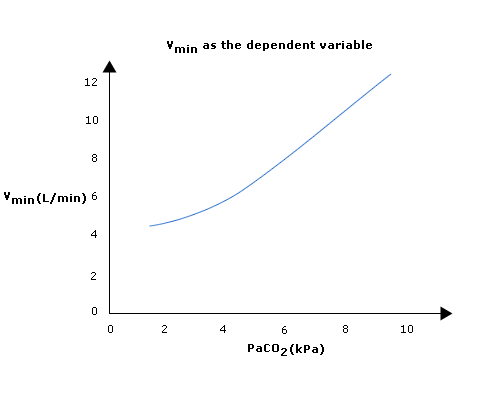
What is...
the curve will have a decreased slope and right shift?
400
During acute normovolemic hemodilution, the following compensatory mechanism helps maintain tissue oxygenation.
A. Increased cardiac output
B. Increased oxygen extraction
C. Increased synthesis of erythropoietin
D. Redistribution of regional blood flow
E. Shift of the oxyhemoglobin dissociation curve
What is...
A. Increased cardiac output?
500
A patient is undergoing exploration of a stab wound to the left side of the neck. On awake laryngoscopy, the left vocal cord is in midposition and the right vocal cord is abducted during inspiration. Trauma to this structure on the LEFT is the most likely cause of these findings.
A. C7-8 nerve root
B. Stellate ganglion
C. Glossopharyngeal nerve
D. Superior laryngeal nerve
E. Vagus nerve
What is...
E. Vagus nerve?
500
A patient sustains blunt thoracic trauma; this part of their airway is most likely injured. (yes, repeat question from my last WEB!)
a. Anterior trachea
b. Posterior trachea
c. Left distal bronchi
d. Right distal bronchi
What is...
d. The right distal bronchi?
500
When inspired gas is changed from air to 20% oxygen and 80% nitrous oxide, PaO2 increases because of this.
A. increased pulmonary artery pressure perfuses alveoli that previously enhanced dead space
B. nitrous oxide stimulates the respiratory center
C. rapid absorption of nitrous oxide increases alveolar oxygen concentration
D. replacement of nitrogen by nitrous oxide expands atelectatic alveoli
E. respiratory depression from nitrous oxide shifts the oxyhemoglobin dissociation curve
What is...
C. the rapid absorption of nitrous oxide increases alveolar oxygen concentration?
500
65-kg 70-year-old man in PACU is breathing spontaneously at 20/min through an ETT connected to a T-piece with a fresh gas flow of 5 L/min. His tidal volume is 350 mL and FiO2 is 0.5. SpO2 decreases from 98% to 84% over 1 hour, then improves to 92% with an FiO2 of 1.0. This is the most likely cause of his hypoxemia.
A. Decreased functional residual capacity
B. Increased dead space ventilation
C. Inhibition of hypoxic pulmonary vasoconstriction
D. Room air admixture during inspiration
E. Shivering
What is...
A. Decreased functional residual capacity?
500
This is your PAO2 in a hyperbaric chamber.
--Hints:
-100% FiO2
-2 atmospheres of pressure
-Assume PACO2 of 40mmHg
Pb at 2atm=760mmHgx2=1520mmHg
[(1520-47)x1]-(40/0.8)
=1473-50
=1423mmHg