rules
find the mistake
signal words
mixed tenses
mixed tenses
sentence transformation
100
What do we use the present simple for?
facts
habits, routines,
states or quality of something (stative verbs)
100
We went yesterday to the cyber security exhibition.
We went to the cyber security exhibition yesterday.
100
Name three signal words for the past simple.
yesterday
Last week
when I was a child
three days ago
in 2022
etc.
100
While he _____ (give) the presentation, his phone _____ (ring) twice.
While he was giving the presentation, his phone rang twice.
100
Look! It _____ (snow) outside. We _____ (not / see) snow here very often.
Look! It is snowing outside. We don't see snow here very often.
100
Did he finish the report?
Use "yet"
Has he finished the report yet?
200
name at least three stative verbs.
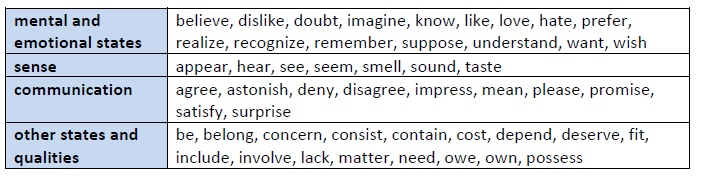
200
When will the concert begin?
Wen does the concert begin?
200
Which tense uses while?
The continuous tense (present or past)
200
She usually _____ (walk) to work, but today she _____ (take) the bus because it ______ (rain).
She usually walks to work, but today she is taking the bus because it is raining.
200
Every time he _____ (have) a job interview, he _____ (feel) nervous.
Every time he has a job interview, he feels nervous.
200
She started working here in 2020 and she still works here.
Use "for"
She has been working here for 6 years.
300
What does QASI stand for?
Question word
Auxiliary word
Subject
Infinitive of the main verb
300
She’s been writing emails since three hours.
She’s been writing emails for three hours
300
What tense is used with the signal word "recently"?
present perfect
300
I _____ (know) Sarah for years, but I _____ (never / meet) her husband.
I have known Sarah for years, but I have never met her husband.
300
When I was a child, I _____ (walk) to school every day. One morning, a dog _____ (chase) me all the way to the gate.
When I was a child, I walked to school every day. One morning, a dog chased me all the way to the gate.
300
He arrived at the office a few minutes ago.
Use "just"
He has just arrived at the office.
400
When do we use the present continuous for future events?
To ask about and discuss future arrangements or plans with a future time expression, but only if these arrangements are very probable to take place and if you can pinpoint the event to 2-3 days.
She is meeting the manager at 12.00.
I am not going to the party tonight.
400
You didn't have a good time at the party, have you?
You didn't have a good time at the party, didn't you (did you)?
400
When and how do we use the expression "since"?
We use “since” + the start of the period of time to express an action that started in the past and continues up until now.
400
I _____ (try) to reach him all morning, but he _____ (not answer) any of my calls. I _____ (leave) him three voicemails already
I have been trying to reach him all morning, but he hasn't answered any of my calls. I have left him three voicemails already.
400
She _____ (just / get back) from a business trip. She _____ (look) exhausted.
She has just got back from a business trip. She looks exhausted.
400
She wrote the report. Her colleague interrupted her.
Use "while"
While she was writing the report, her colleague interrupted her.
500
What do we use the past continuous for?
Name at least two others than "actions that were in progress at a certain moment in the past".
For descriptions and background information of a story htat happened in the past.
For actions that were in progress at the same time in the past (parallel actions)
500
I was going to Paris last summer and I've met some really interesting people there.»
I went to Paris last summer and I met some really interesting people there.»
500
Name three signal words for the past continuous.
When
While
During
As
500
He _____ (work) for the same company since he _____ (leave) university. He _____ (apply) for a promotion last month and he _____ (still / wait) for an answer.»
He has been working for the same company since he left university. He applied for a promotion last month and he is still waiting for an answer.»
500
Where is Tom?" – "He _____ (be) in a meeting since 9 am and he still _____ (not / come) out. I _____ (knock) on the door twice already.
Where is Tom?" – "He has been in a meeting since 9 am and he still hasn't come out. I have knocked on the door twice already.
500
I arrived at the office. My manager talked on the phone.
Use "when"
When I arrived at the office, my manager was talking on the phone.
600
What is an adverb of frequency and where does it go in a sentence (mention the exception too) ?
An adverb of frequency is a word that tells us how often something happens or is done.
The adverb of frequency always comes before the main verb, except the verb to be.
He usually gets up at 6 am.
They are never late.
600
How many mistakes did Tim do? It looks like some students have done mistakes all day.
How many mistakes has Tim made? It looks like some students have been making mistakes all day.
(The day is not over yet and we want to know how many mistakes til now.)
600
Explain the difference and fill in the gaps with the correct tense:
1. She left two hours______.
2. She has been waiting _____ two hours.
3. She has been here _____ 3 o'clock.»
ago = finished past action, measured back from now → Past Simple
for = duration → Present Perfect or Continuous
since = starting point → Present Perfect or Continuous
600
This paragraph has four tense mistakes. Find and correct them all:
She has worked for this company for five years. When I first met her, she was already knowing the job inside out. Last Monday, she gived a presentation to the board and everyone was impressed. She is working on a new project at the moment and she finishes it by next Friday.»
She has been working for this company for five years. When I first met her, she already knew (stative verb) the job inside out. Last Monday, she gave a presentation to the board and everyone was impressed. She is working on a new project at the moment and she will finish, is going to finish it by next Friday.»
600
I _____ (work) here for three years, and in that time I _____ (learn) more than I _____ (expect) when I first _____ (start).
I have been working here for three years, and in that time I have learned more than I expected when I first started.
600
He lost his job. He looks for a new one.
Use "since"
He has been looking for a new job since he lost it.