12.1 RNA
12.2 Ribosomes and Proteins
12.3 Gene Regulation and Expression
12.4 Mutations
DNA
100
How does RNA differ from DNA?
RNA uses the sugar ribose instead of deoxyribose, is usually single stranded, and contains Uracil instead of Thymine.
100
Multiple amino acids joined together in a chain form a ________________.
Polypeptide
100
___________ genes regulate organs that develop in specific parts of the body.
Homeotic genes
100
_______________ can involve changes in the sequence of nucleotides in DNA or changes in the number or structure of chromosomes.
Mutations
100
What are the building blocks (monomers) of DNA called?
Nucleotides
200
What are the complementary bases of RNA?
Adenine --> Uracil
Thymine --> Adenine
Guanine <--> Cytosine
200
The four bases of RNA form a genetic code, it is read three bases at a time. Each "word" of the code is three bases long and corresponds to an amino acid.
What is this three base "word" called?
Ex: ACU - UGU - CGA
A codon
200
Nuclear DNA is coiled around protein clusters called ___________________, to form _________________.
nucleosomes, chromatin
200
What are the 3 different types of point mutations?
Substitution, Missense and Nonsense
200
What are the 4 nitrogen base pairs of DNA?
Adenine
Thymine
Guanine
Cytosine
300
What are the three main types of RNA and what are their roles?
mRNA - makes the instructions (genetic code)
tRNA - reads the instructions (starts the process of translation)
rRNA - puts the code together (joins amino acids)
300
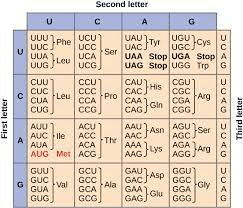 1 codon codes for an amino acid, what is the amino acid for GCA?
Alanine (Ala)
300
The process of genetic differentiation creates specialized _______________ and _______________.
Tissues and organs
300
True or False: Genetic mutations always negatively affect an organism.
False
300
What are the three components of nucleotides?
Deoxyribose sugar
Phosphate group
Nitrogen base
400
What is the process of transcription and which enzyme starts the process?
Transcription is the process of copying a base sequence from DNA into RNA carried out by an enzyme called RNA polymerase.
400
Ribosomes use the sequence of codons in mRNA to assemble amino acids into polypeptide chains.
The process of decoding mRNA into a protein is known as what?
Translation
400
What is the site where RNA polymerase can bind to begin transcription?
Promoter (P)
400
Chemical or physical agents in the environment that can lead to mutations are called _____________.
Mutagens
400
When an error in the DNA sequence occurs, what forms?
A mutation