Scientific Method
Chemistry
Hydrosphere/Atmosphere
Space
Geosphere
Physics
Biosphere
100
What tool is used to measure the amount of rain?
A. Rain Gauge B. Thermometer C. Anemometer
D. Barometer
A. Rain Gauge
100
Define a Solid, Liquid and Gas
Solid has a definite shape and volume
Liquid has a definite volume no definite shape
Gas has no definite volume or shape
100
Where is most of Earth's Freshwater Stored.
A: Ocean B: Air C: Glaciers D: Lakes
C: Glaciers
100
•Fill in the blank: Day and night are caused by Earth’s _________________ about its axis.
A.Revolution
B.Reflection
C.Rotation
D.Transpiration
C.Rotation
100
What is a natural resource?
A resource that comes from the Earth
100
Define Simple Machine
Give 3 examples
Something that makes work easier
100
•The Arizona bark scorpion (Centruroides sculpturatus) is a small light brown scorpion common to the Sonoran Desert in the southwestern United States and northwestern Mexico. It has 8 legs, a segmented body, and an exoskeleton.

A.Reptile B.Mollusk C.Arthropod D.Amphibian
c. Arthropod
200
What tool is used to measure air pressure?
A. Rain Gauge B. Thermometer C. Anemometer
D. Barometer
D. Barometer
200
Define a heterogeneous mixture and a homogenous mixture.
A mixture that is evenly mixed.
A mixture that is NOT evenly mixed.
200
The water cycle includes
storage locations and processes of transportation
200
It takes 27.3 days for the moon to travel all the way around one time on the white line. What does this represent?
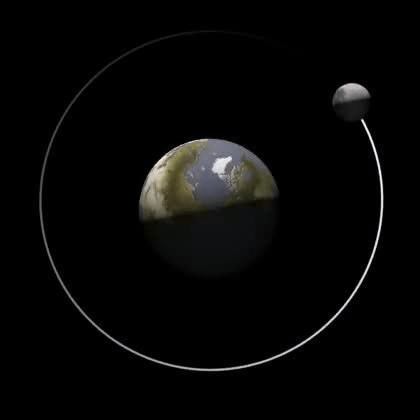
A.The moon’s revolution
B.The moon’s rotation
C.The Sun’s revolution
D.The Earth’s rotation
A.The moon’s revolution
200
What is convection. Give and Example
When warm material rises and cold material sinks
200
What are potential and kinetic energy?
Potential energy is energy stored based on postion
Kinetic energy is anything in motion
200
What is a similarity and difference between vascular and nonvascular plants?
Must use vocab words in answer
The both have cloroplast/chrolopyll. The both reproduce The bott need water, sunlight, carbon dioxide, space, nutrients.
Vascular plants have xylem, phloem, stem roots and leaves. Reproduce with seeds has flowers
Nonvascular plants do not have roots, stem leaves. Reproduce with spores.
300
What graph shows change over something?
What graph is used to compare things?
What graph is used to show parts of a whole?
Line graph shows change over something
Bar Graph used to compare
Circle Graph used to show parts of a whole
300
What are the 6 phase changes matter can go through?
Evaporation, Condensation, Freezing, Melting, Submilation, Deposition
300
What is the difference between weather and climate?
Weather is the daily condition and always changes. Climate is what the weather is like over a long period of time the average.
300
•Which planets have small solid cores, but are mostly made up of hydrogen and helium?
A.Rocky Planets
B.Gas and Ice Giants
C.Inner Planets
D.Dwarf Planets
B Gas and Ice Giants
300
What is the difference between renewable and nonrenewable resources?
Renewable resources cannot be used up . Take a short time to replace.
Nonrenewable can be used up. take a long time to replace.
300
How is energy transformed when you turn on a tv in a solar-powered house?
Light energy to electrical energy to sound energy, light energy, mechanical energy, thermal energy
300
Define Adpatation- Give an example
physical or behavioral characteristics of an organism that helps it to survive better in its environment
Plants having vasuscular tissue, plants with cones, plants with flowers
400
Which of the following questions would a scientist ask?
A: Why is vanilla ice cream the least popular flavor?
B: What can we design to make mopping easier?
C: What type of plant grows the fastest?
D: Why do people frown?
C: What type of plant grows the fastest?
400
Define a Neutron, Proton, and Electron
Neutron- no charge
Proton Positive charge
Electron- negative charge
400
Where does all of the weather occur?
Troposhere
400
How long is Earth's Revolution?
One Year
400
What are 2 examples of nonrenewable and 2 examples of renewable resources?
Oil and Coal
Solar and Wind Energy
400
What are a producer, consumer, and decomposer?
Producer makes their own food. Consumers eat other organisms to get energy. Decomposers break down organisms.
500
We are doing an experiment to see how changing the ramp height affects the distance that a toy car can travel. We will be using 2 ramp heights, letting the car travel down the ramp, then measuring how far it went.
What is the independent, dependent, and control variable in this experiment?
IV: Ramp Height
DV: Distance the car travels
CV: Mass of the car and the texture of the ramp
500
Chlorine is a gas located in group 17 on the periodic table. It is so unstable and reactive, that it can only exist as a molecule in pairs (Cl2) or in compounds with other elements (like NaCl – salt). Fluorine and bromine are also in group 17 on the periodic table. What would you predict to be the properties of fluorine and bromine to be?
A.They would be non-reactive solids
B.They would both be highly reactive gases that exist only in pairs or in compounds
C.Fluorine would be a highly reactive gas, but bromine would be a stable solid
D.It is impossible to tell based on this information
B.They would both be highly reactive gases that exist only in pairs or in compounds
500
Define Transpiration, infiltration
Transpiration- when water leaves a plant and enter the atmosphere
Infiltration- when water soaks into the ground
500
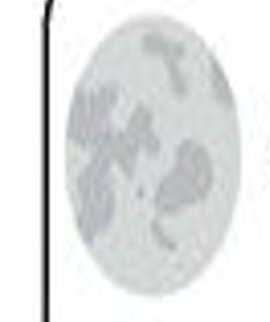
What moon phase is pictured?
A: New Moon B: Quarter Moon C: Full Moon D: Waxing Gibbous Moon
C: Full Moon
500
What is the rock cycle?
Describe weathering, erosion, deposition?
The formation, breakdown, and reformation of rocks
Weathering- Breaks down rocks
Erosion- Takes or moves sediment
Deposition- drops sediment adds to the land
500
Define the 5 types of energy. Melts
M- mechanical energy- Motion AND stored in position
E- electrical energy- electricity-electrons moving
L- light energy- Electromagnetic radiation – photons that can travel as waves through space
T- thermal energy-Heat – vibrations of atoms and molecules
S- sound energy- Vibrations of objects create compression waves
500
What is the difference between a vertebrate and an invertebrate? Give an example of each
Vertebrate has a backbone and invertebrate does not.
Vertebrate: Fish, Bird
Invertebrate: Octopus, Clam, Worm