Bone Tissue
Axial Skeleton
Appendicular Skeleton
Bony Landmarks/Joints
Random
100
The functional unit of compact bone
Osteon
100
The primary function of the axial skeletal system
To support and protect the brain, spinal cord, and organs
100
The primary function of the appendicular skeleton
To produce movement!
100
The two main classifications of joints
Structural and functional
100
Name this type of fracture

Transverse fracture
200
A bone like the scapula contains this type of bone marrow, while a bone like the radius contains this type of bone marrow.
red, yellow
200
The difference between true ribs and false ribs
A true rib connects directly to the sternum while the three pairs of false ribs connect to the lowest true rib.
200
This bone connects the scapula and the sternum
Clavicle
200
Name the type of functional and structural joint found at articulating vertebrae
Cartilaginous and amphiarthrosis
200
Describe how tendons and ligaments are different
Tendons connect muscle to bone, create movement in a joint. Ligaments connect bone to bone, stabilize joints from the inside.
300
List the three major types of bone cells AND what function they are responsible for.
Osteocyte maintains bone matrix
Osteoblast builds new bone matrix
Osteoclast absorbs or removes old bone matrix
300
List the sections of vertebrae in the correct order, including how many are in each section - all the way to the end!
7 cervical, 12 thoracic, 5 lumbar, 5 fused sacrum, coccyx
300
Identify bones 2, 8, and 10.

2. scapula
8. patella
10. humerus
300
The two types of movement that occur at the knee joint
Flexion and extension
300
Name the 5 functions of the skeletal system (as a whole)
1. Support
2. Protection
3. Leverage (movement)
4. Storage
5. Blood cell production
400
Explain the process of endochondral ossification.
When you are born, the skeleton starts off as cartilage. As bone ossification happens, the cartilage is replaced with bone.
400
The difference between a suture and a fontanel
A suture is the immovable connection between bones of the skull. A fontanel is soft connective tissue between the growing bones of the skull to allow for rapid brain growth.
400
Describe a comminuted fracture.
A bone that has been broken into many small pieces
400
The structural difference between a cartilaginous joint and a synovial joint
The joint cavity containing synovial fluid and an outer fibrous layer
400
The steps a bone takes to heal after a fracture has occurred.
1. Fracture hematoma formation
2. Callus formation
3. Spongy bone formation
4. Compact bone formation
500
Identify structure J and describe its function
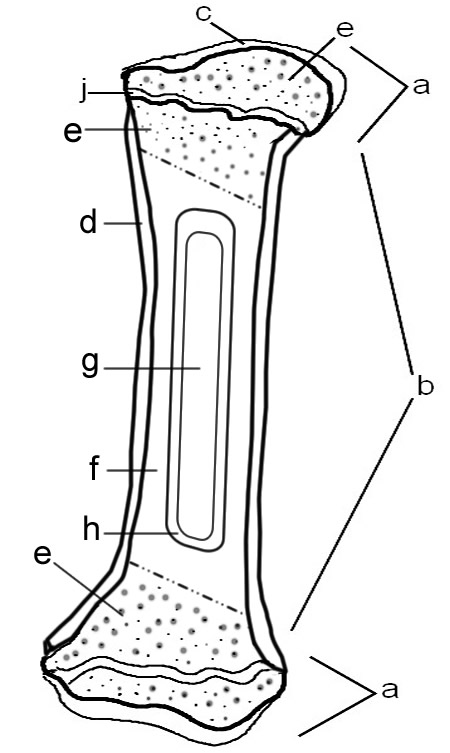
J is the epiphyseal plate (the growth plate) that begins as this large piece of cartilage located at the end of long bones. New bone develops here. The growth plate begins to close as you age and build new bone.
500
Identify bones 3, 4, 5, AND 6 (include either L or R side)

3. frontal bone
4. parietal bone (L)
5. temporal bone (L)
6. occipital bone
500
Identify bones 4, 5, 9, 11, and 14

4. radius
5. ulna
9. fibula
11. carpals
14. tibia
500
Name 3 specific types of bony landmarks that can be found on a femur
Trochanter, head, condyle, epicondyle, crest
500
Describe how the presence of estrogen and testosterone affects bone growth.
Estrogen stimulates bone formation, causing bone to grow faster than in the presence of testosterone and growth plates to close quicker