Universe
Big Bang
Inner Planets
Outer Planets
Small Bodies (meteors etc)
100
What is the Age of the Universe? - or - How Fast is the Universe Expanding?
In the 1920s, Edwin Hubble used the 100" telescope (2.5 meters) at the Mount Wilson Observatory in California to detect variable stars in nebulae. He discovered that the stars he observed had the same characteristic variations in their brightness as a class of stars called Cepheid Variables.
100
Did the Big Bang make a noise?
Yes, the Big Bang did make a noise. Nobody was around to hear it and, even if they had been, the sound would have been far deeper than anything audible to the human ear.
100
What is the order of the inner planets? (from closest to the sun to farthest)First- _______Second- _______Third- _______Fourth- _______
The correct answer is "Mercury, Venus, Earth, Mars." This is the correct order of the inner planets from closest to the sun to farthest.
100
How many outer planets are there?
There are four outer planets in our solar system: Jupiter, Saturn, Uranus, and Neptune. These planets are located beyond the asteroid belt and are often referred to as gas giants. They are much larger than the inner planets and primarily composed of gas and ice. The outer planets have distinct features such as rings and numerous moons.
100
Which is in space?
A meteoroid is a small rocky or metallic object that is in space. It is smaller than an asteroid and usually originates from a comet or asteroid belt. When a meteoroid enters the Earth's atmosphere, it becomes a meteor, commonly known as a shooting star. If the meteor survives the journey through the atmosphere and lands on the Earth's surface, it is then called a meteorite. Therefore, the correct answer is meteoroid.
200
What is Dark matter?
Unlike normal matter, dark matter does not interact with the electromagnetic force. This means it does not absorb, reflect or emit light, making it extremely hard to spot.
200
Could we ever see all the way back to the Big Bang?
By ‘see’, we conventionally mean ‘see with the aid of light’, which means not just visible light but any light, including radio waves and gamma rays.
In theory, it should be possible to see back to any point in the Universe’s history when light-producing material existed.
200
What is the biggest inner planet?
Earth is the correct answer because it is the largest inner planet in our solar system. While Mercury is the smallest planet, Venus is often referred to as Earth's "sister planet" due to its similar size and composition, and Mars is known for its red color and potential for supporting life, Earth is the largest of the four inner planets.
200
What are the Outer planets?
The outer planets refer to the four gas giants in our solar system, namely Jupiter, Saturn, Uranus, and Neptune. These planets are located beyond the asteroid belt and are characterized by their large size, low density, and lack of solid surfaces. They are also known for their ring systems, numerous moons, and distinct atmospheres.
200
Which burns up in the atmosphere?
A meteor is the correct answer because it is a small celestial body that enters the Earth's atmosphere and burns up, creating a streak of light in the sky. Meteoroids are similar but refer to the actual object before it enters the atmosphere. Meteoridis and meteorite are not accurate terms and do not describe objects that burn up in the atmosphere.
300
How Did the Known Structures in the Universe Evolve?
Observations of the farthest reaches of the Universe show that it is 'lumpy', with well developed structures that are very old. We detect galaxies and clusters of galaxies as far back in time as we can see, when the Universe was about one fifth of its current age.
300
Did time run more slowly after the Big Bang due to gravity?
Shortly after the Big Bang, the Universe’s matter was squeezed into a tiny volume, so the gravity exerted by that matter was intensely strong.
According to Einstein’s general theory of relativity, clocks in a strong gravitational field run more slowly than clocks in a weak field.
300
Which planet(s) can not be seen from Earth?
Mercury and Mars are the planets that cannot be seen from Earth. Although Venus is sometimes difficult to see due to its proximity to the Sun, it is still visible to the naked eye under favorable conditions. However, Mercury and Mars are often obscured by the Sun's glare and are only visible during specific times and from specific locations on Earth.
300
(True or False) The outer planets are gas giants.
True : The statement "The outer planets are gas giants" is true. The outer planets in our solar system, namely Jupiter, Saturn, Uranus, and Neptune, are classified as gas giants. These planets are predominantly made up of gases, such as hydrogen and helium, and do not have a solid surface like the inner rocky planets. Their massive sizes and thick atmospheres contribute to their classification as gas giants.
300
What is Pluto?
Pluto is classified as a dwarf planet because it does not meet the criteria to be considered a full-sized planet. It is smaller than the eight planets in our solar system and does not have a clear path around the sun. Additionally, Pluto is located in the Kuiper Belt, a region beyond Neptune that is populated by many similar small objects. While it was once considered the ninth planet, its reclassification as a dwarf planet was due to a redefinition of what constitutes a planet.
400
How Do Massive Black Holes Grow?
How Do Massive Black Holes Grow?
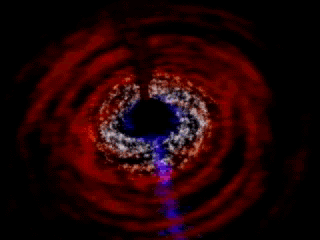
Black holes up to about 50 times the mass of our Sun can be formed by normal processes in very massive stars. This can happen throughout galaxies wherever stars have formed recently. One way to grow a more massive black hole is for a seed black hole in a dense galactic nucleus to swallow up gas and normal stars.
400
If the Universe expands from the Big Bang, why isn't there an empty sphere at the centre?
This would be true if the Big Bang happened at a single location, but it didn’t.
The trouble is that the term ‘Big Bang’ conveys a mental picture that is wrong in almost every detail.
400
How many moon(s) do(es) Mars have?
Mars has two moons, Phobos and Deimos
400
Are the outer planets bigger than the inner planets?
The outer planets are indeed bigger than the inner planets. This is because the outer planets, also known as gas giants, are composed mostly of gases like hydrogen and helium, which make them much larger in size compared to the inner planets, which are primarily composed of rock and metal. The outer planets, such as Jupiter and Saturn, can be several times larger than the inner planets, like Earth and Mars.
400
What is an asteroid made out of?
Asteroids are rocky and metallic objects that orbit the Sun. They are composed primarily of rock and metal, such as iron and nickel. This composition is determined through the analysis of meteorites that have fallen to Earth from asteroids. The presence of ice, dust, and gas is more commonly associated with comets rather than asteroids. Therefore, the correct answer is rock and metal.
500
How do we measure the size and the age of the Universe?
Astronomers estimate that the Big Bang occurred between 10 and 20 billion years ago. They estimate the age of the Universe in two ways: (a) by looking for the oldest stars; and (b) by measuring the rate of expansion of the Universe and extrapolating back to the Big Bang.
500
Are there alternatives to the Big Bang theory?
One of the remarkable features of cosmology is that there are few serious challengers to the Big Bang theory.
These days, only a handful of cosmologists push an alternative, the ‘Quasi-Steady State theory’.
500
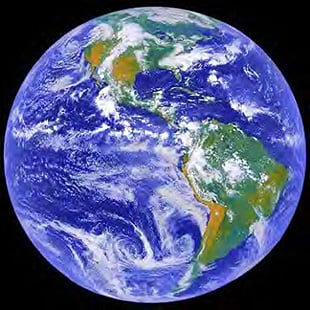 What planet is this?
The question asks for the name of the planet shown in the image. The correct answer is Earth because it is the only planet out of the options that is known to have life and is inhabited by humans.
500
The outer planets all have rings?
The statement is true because the outer planets in our solar system, namely Jupiter, Saturn, Uranus, and Neptune, all have rings. These rings are made up of dust, ice, and other particles that orbit around the planets. While Saturn's rings are the most famous and prominent, the other outer planets also have less visible and less dense ring systems.
500
What is a comet made out of?
Comets are celestial objects made up of a combination of ice, gas, rock, and dust. The ice in comets is primarily composed of frozen water, along with other volatile compounds such as carbon dioxide, methane, and ammonia. As a comet approaches the Sun, the heat causes the ice to vaporize, creating a glowing coma or tail. The gas released from the vaporized ice carries along with it dust particles and small rocks, which form the solid core or nucleus of the comet. Therefore, the correct answer is ice, gas, rock, and dust.