Inner Planets
Outer Planets
Stars
Galaxies
Rotation & Revolution
100
Which planet has a rocky surface?
A. Neptune
B. Venus
C. Saturn
D. Jupiter
Venus
100
Which outer planet is the largest?
Jupiter
100
_____________ is the gas that makes a star shine.
Hydrogen
100
Our galaxy is about ________ years old.
10 (ten) billion
100
The spinning of Earth around its axis is called its _____.
A. rotation
B. revolution
C. orbit
D. ellipse
Rotation
200
Which list shows the correct order of planets from the sun?
A. Mercury, Venus, Earth, Mars
B. Earth, Mars, Venus, Jupiter
C. Mars, Venus, Earth, Saturn
D. Uranus, Jupiter, Neptune, Saturn
Mercury, Venus, Earth, Mars
200
What are the surfaces of the outer planets mostly made of?
gases
200
The hottest stars burn _______
Blue
200
Which is an object in the solar system that is a frozen mass of ice and dust?
A comet
200
The Earth rotates in which direction?
West to East
300
What objects exist between Mars and Jupiter?
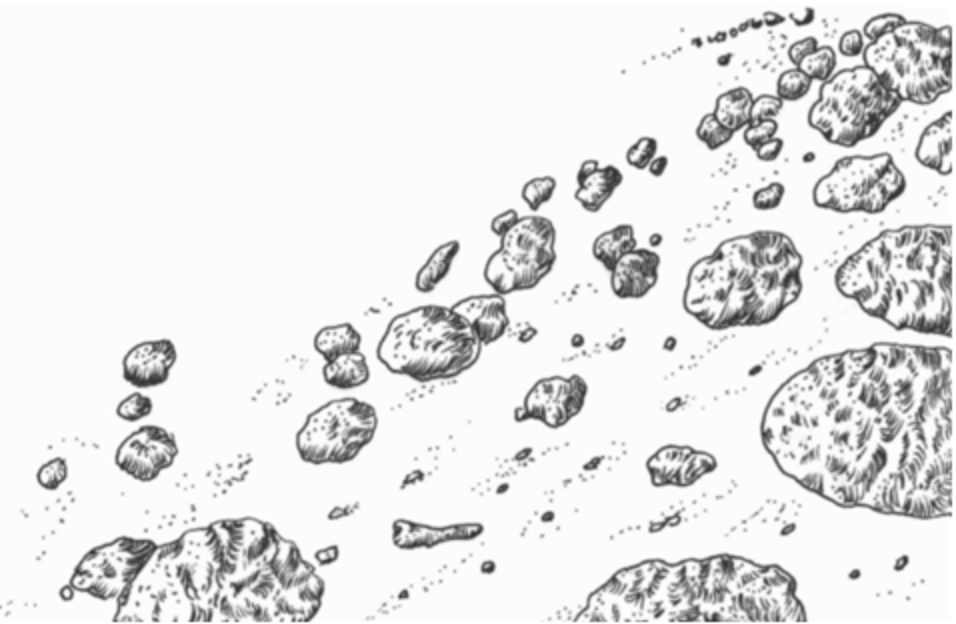
asteroids (The Asteroid Belt)
300
What do Jupiter, Saturn, Uranus, and Neptune have in common?
A. They all have rocky surfaces.
B. They all appear to be similar to Earth.
C. They all are gaseous planets.
D. They all appear to be made of rock and ice.
They're gaseous planets
300
Which of the following provides evidence to support that the sun is different from other stars near Earth?
A. The sun is the largest star, so it appears closer to Earth than other stars.
B. The sun is the closest star to Earth, so it appears larger and brighter than other stars from Earth.
C. The sun has more gravity than other stars, so it only appears during the daytime.
D. The sun is the smallest star, so it appears to be more distant from Earth than other stars.
B. The sun is the closest star to Earth, so it appears larger and brighter than other stars from Earth.
300
Which is true about planets and asteroids?
A. They are round.
B. They have an atmosphere
C. They revolve around the sun.
D. They have cleared their orbit.
They revolve around the sun!
300
Xavier observes a fully lit moon. When can he expect to see the moon look like this again?
In about 30 days.
400
There are two natural objects that revolve around Mars. What are these objects called?
Moons
400
Which planet rotates on its' side?
Uranus
400
How does our sun compare with other stars in size?
It is average-sized.
400
A galaxy is a huge system of ____, _____, _____, and objects orbiting stars that is held together by the force of gravity.
gas, dust, stars
400
Walt is learning about Earth's movement in science class. He records some information in a chart.
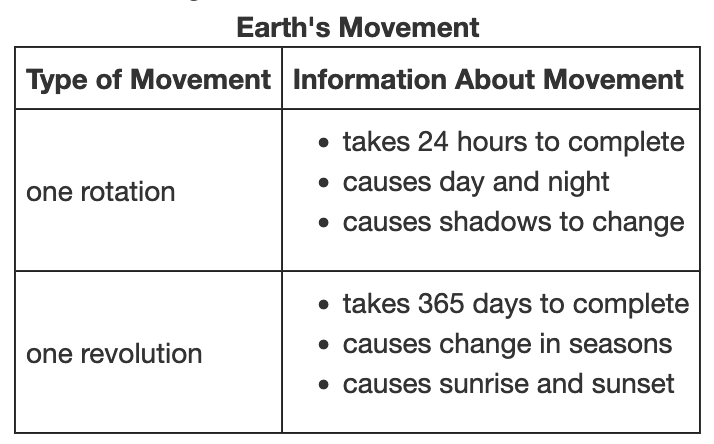
What information in Walt's chart is in the wrong row of the table?
One revolution does not cause sunrise and sunset.
500
Which planet is the solar system’s largest rocky planet?
A. Mars
B. Earth
C. Mercury
D. Jupiter
Earth!
500
Name the outer planets, in order from closest to the Sun to furthest from the Sun.
Jupiter, Saturn, Uranus, Neptune
500
The picture shows four stars. The stars are shown side-by-side, as if they were positioned next to one another in the sky.
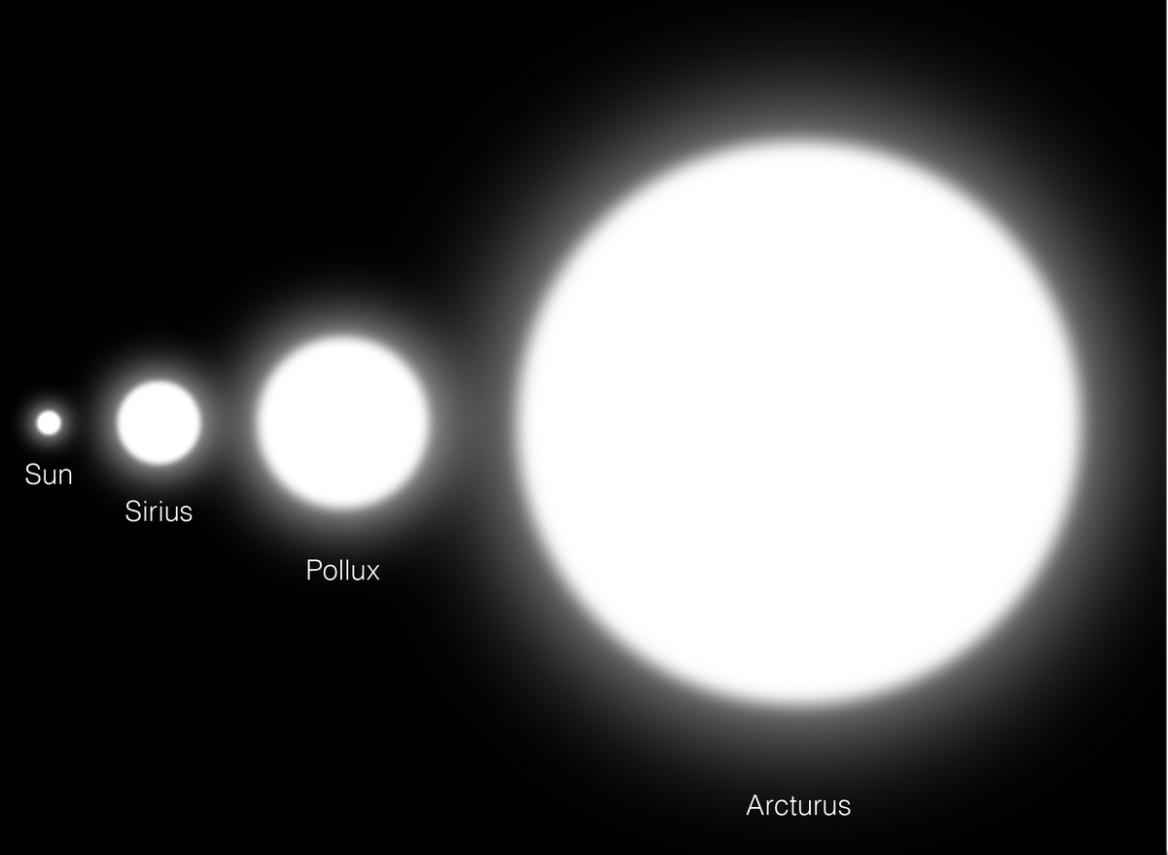
A student claims that the sun must be the largest star, since it appears that way from Earth. Which piece of evidence from the picture challenges the student’s claim?
A. The sun burns the hottest, so it appears larger than other stars from Earth.
B. Some stars are closer to Earth than the sun, but the sun is the largest star.
C. All stars are the same size, but some burn brighter than others.
D. Stars are different sizes and distances from Earth, which affects how large they appear to us.
D. Stars are different sizes and distances from Earth, which affects how large they appear to us.
500
___________ is the closest galaxy to ours.
Andromeda
500
Luca claims that the patterns of stars in the sky only appear to move, but that the patterns do not change. Which piece(s) of evidence would best support this claim?
a.Observations that some stars can be seen in every season.
b.Observations that the patterns of stars change position throughout the night sky.
c. Observations that different stars appear in different seasons, but the patterns of the stars remain the same.
a, b, & c