Day and Night
Miscellaneous
Planets!
Our Place in Space
Stars
100
A __________ occurs when the Moon passes between the Sun and the Earth
solar eclipse
100
What stage of life is our sun in?
Our sun is an average sized star and is middle aged in the Main Sequence part of its life cycle.
100
the asteroid belt.
100
How long does it take the Earth to revolve around the sun?
about 365 days
100
What star is closest to Earth?
The Sun!
200
What do we call spinning of the Earth around the Sun?
Revolution
200
It is a NASA telescope
The Hubble
200
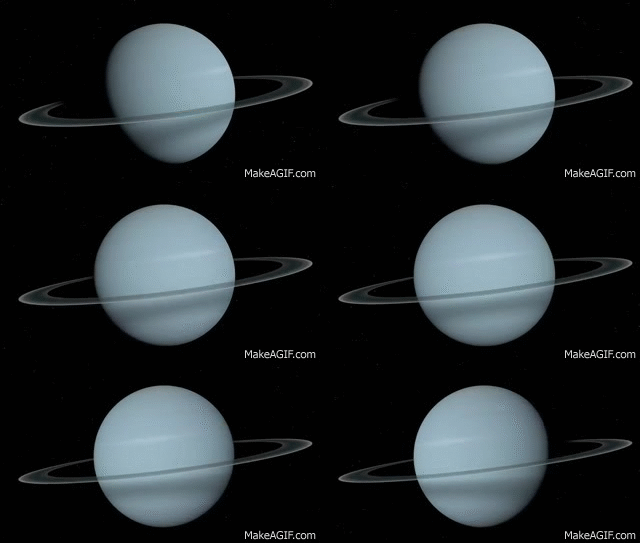
Uranus.
200
How long does a rotation of the earth around it's axis take?
about 24 hours
200
What is the name of our galaxy?
The Milky Way
300
Objects in the sky appear to move in which direction?
Rise in the East and set in the West
300
Compared to the Earth's solar system, the universe is...
A.) Older and Larger
B.) Older and Smaller
C.) Younger and Larger
D.) Younger and Smaller
A
300
What is the largest planet in our solar system.
Jupiter
300
What force is responsible for keeping planets in orbit around the sun?
The force of gravity
300
What are the 3 main types of Galaxies?
Spiral
Elliptical
Irregular
400
The longest day of the year, where the sun's ray are more directly concentrated over the Topic of Capricorn (northern hemisphere)
What is the summer solstice?
400
a star and all the planets and other objects that revolve around that star
What is a solar system?
400
What caused astronomers to reclassify Pluto as a dwarf Planet? (there are three)
-Its icy composition
-It has not cleared its path or neighborhood of other objects
-Its very oval shaped orbit
400
Compared to others stars, our sun is...
average in size and temperature.
400
What is a Galaxy?
Galaxies are systems that contain millions or even billions of stars
500
What causes to have four seasons?
Seasons are the result of the tilt of the Earth's axis.
500
What is the difference between a meteor, an asteroid and a comet?
A meteor is a small space rock (meteoroid) that has entered Earth's atmosphere. Most burn up, but if they reach Earth's surface they are called meteorites.
Asteroids are larger space rocks that orbit the sun and are mostly found in the asteroid belt.
Comets are mostly made of ice and dust, orbiting the sun and produce a tail as they get closer.
500
Why do we see more craters on Mars and the Moon than we do on Earth and Venus?
The Atmosphere of Mars is too thin to protect it from impacts and the Moon has no atmosphere. The Earth and Venus both have a significant atmosphere to burn up objects before they hit the surface.
500
What is the name for the path that a planet takes around the Sun?
Orbit
500
What two main elements make up starts and are part of the fusion process that create energy in stars?
Hydrogen and Helium