BP Physiology &
Hemodynamics
Hemodynamics
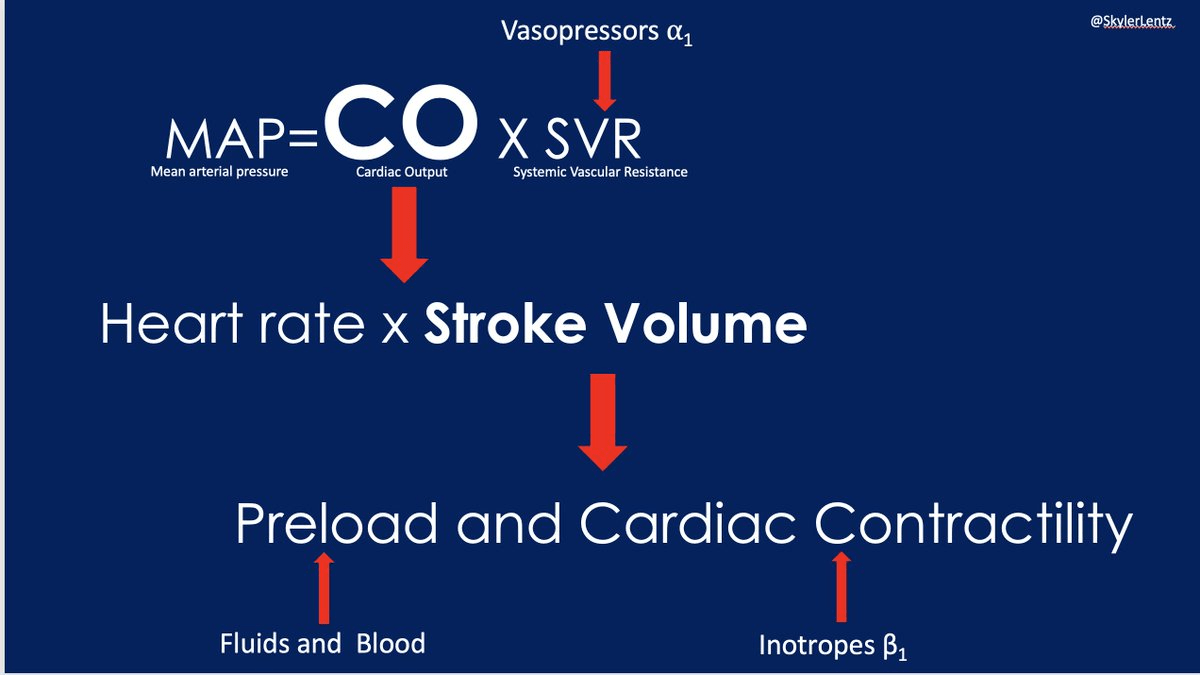
MAP - CVP = ___ x ___
and
CO = ___ x ___
MAP = CO x SVR
* Because CVP is usually at or near 0 mmHg, it is commonly excluded from the formula
CO = HR x SV
What is the most common intraoperative cause of acute hypertension in an otherwise healthy patient?
"Light" anesthesia (inadequate depth of anesthesia relative to surgical stimulus).
What is the first step when you encounter an unexpectedly low blood pressure reading on the NIBP monitor?
Confirm the measurement — check cuff size and position (NIBP) or transducer level and waveform (arterial line) and correlate with the other modality.
What class of drug is clevidipine, and what is a distinctive feature of its formulation?
It is a dihydropyridine calcium-channel blocker formulated in a lipid emulsion (it looks like propofol).
Phenylephrine treats hypotension by acting on which receptor, and what effect does it have on heart rate?
Alpha-1 agonist — increases SVR. Often causes reflex bradycardia (no beta activity).
What are the 3 determinants of stroke volume?
Preload, afterload, and myocardial contractility.
Name the classic triad of Cushing's response and the condition it signals.
Hypertension, bradycardia, and irregular respirations — it signals elevated intracranial pressure (ICP).
A patient receiving vancomycin develops flushing and hypotension intraoperatively. What is the mechanism?
Non-immune-mediated histamine release ("Red Man Syndrome"), causing vasodilation and hypotension.
Compare nitroglycerin and nitroprusside: which has greater venous vs. arterial dilation?
Nitroglycerin causes predominantly venous dilation; nitroprusside causes predominantly arterial dilation.
What is the primary mechanism by which ephedrine raises blood pressure, and why is it preferred over phenylephrine in the obstetric patient with spinal hypotension?
Indirect sympathomimetic — releases catecholamines to increase both CO and SVR. Preferred because it better preserves uteroplacental blood flow and fetal heart rate.
In infants, what is the primary determinant of cardiac output, and why?
Heart rate — because stroke volume is relatively fixed in infants.
Cardiac Output = HR x SV
A patient with a spinal cord lesion at T3 develops severe intraoperative hypertension with diaphoresis above the level of the lesion.
What is the diagnosis, and at what spinal level is the lesion threshold for the severe form?
Autonomic hyperreflexia. Lesions at or above T5 cause the severe form.
How should ventilator settings be adjusted to improve venous return in a hypotensive patient on mechanical ventilation?
Reduce PEEP to decrease intrathoracic pressure, and decrease the I:E ratio (shorten inspiratory time) to allow more time for venous return.
What is the IV alpha:beta receptor selectivity ratio of labetalol, and how does it differ from the oral ratio?
IV labetalol has an alpha:beta ratio of 1:7
PO labetalol has an alpha:beta ratio of 1:4
At low doses (1–5 mcg/kg/min), what receptor does dopamine primarily act on, and what is the predominant physiologic effect?
D1 receptors — renal and splanchnic vasodilation, ↑ CO with minimal SVR change
Stroke Volume is dependent upon Preload, Afterload, and Myocardial Contractility.
What measurement is commonly utilized clinically as a marker of preload? Afterload? Myocardial Contracility?
Preload = LVEDV
Afterload = SVR = [(MAP - CVP) / CO] x 80 = dyns/cm 5 (normal 900-1200)
Contractility = LVEF
Why should both nitroglycerin and nitroprusside be avoided in a patient with intracerebral hemorrhage?
Both are cerebral vasodilators and can worsen intracranial hypertension by increasing cerebral blood volume.
A patient becomes severely hypotensive after a high spinal. Name three components of the management.
Volume loading (crystalloid), vasopressors (e.g., phenylephrine or ephedrine), airway support, and left uterine displacement if pregnant (any 3).
Rank the following antihypertensives from shortest to longest duration of action: hydralazine, esmolol, clevidipine, labetalol.
Esmolol (~10 min) < clevidipine (5-15 min) < labetalol (45 min-6 hr) < hydralazine (2-6 hr).
Vasopressin is used as a vasopressor in refractory septic shock. What is its mechanism of action, and how does it differ from catecholamine vasopressors?
Vasopressin acts on V1 receptors in vascular smooth muscle — independent of adrenergic receptors, making it useful when catecholamine receptors are downregulated in prolonged septic shock
A normal pulse pressure is ~40 mmHg at rest, and up to ~100 mmHg with strenuous excercise.
A narrow PP and a wide PP are suggestive of what? (Name at least 2 causes of each)
Narrow PP (< 25 mmHg): aortic stenosis, coarctation of the aorta, tension PTX, myocardial failure, shock, damping of A-line
Wide PP (> 40mmHg): aortic regurgitation, atherosclerotic vessels, PDA, high output state (Thyrotoxicosis, AVM, pregnancy, anxiety)
Intraoperative hypertension is noted immediately after the surgeon infiltrates the wound. What is the mechanism and the most likely agent involved?
Systemic absorption (or intravascular injection) of epinephrine mixed with a local anesthetic, causing alpha-1-mediated vasoconstriction and beta-1-mediated tachycardia.
A septic patient remains profoundly hypotensive despite vasopressors and adequate volume resuscitation. What metabolic derangements must be corrected for vasopressors to work effectively, and at what pH threshold does the Surviving Sepsis Campaign recommend considering bicarbonate?
Acidosis and hypocalcemia must be corrected. Bicarbonate is considered at pH < 7.15.
A patient on a nitroprusside infusion for 48 hours develops altered mental status, metabolic acidosis, and an elevated mixed venous PO2. What is the diagnosis and the underlying mechanism?
Cyanide toxicity from nitroprusside. Cyanide inhibits cytochrome c oxidase (mitochondrial complex IV), impairing oxidative phosphorylation and causing histotoxic hypoxia - hence elevated mixed venous O2 despite hemodynamic collapse.
In a patient with septic shock, an ABG shows pH 7.30, PaO2 103, and a mixed venous PO2 of 50 mmHg. Is cardiac output high or low, and what is the significance of the venous PO2 value?
Cardiac output is HIGH. Normal mixed venous PO2 is ~40 mmHg; a value of 50 indicates poor oxygen extraction (shunting), consistent with distributive (septic) shock rather than cardiogenic or hypovolemic shock.