Gravity
Stars
How Do Shadows Change During the Day/Year?
The Moon
100
Ella wants to test the effects of gravity on different objects. She decides to test the effects of gravity on objects that have different weights. She chooses a paper crane, a golf ball, and a large book. She then drops them from the same height. How is gravity likely to affect each of these objects?
A. All the objects will fall “down” because they are pulled by gravity.
B. The golf ball and the large book will fall to the ground, but the paper crane will float.
C. All the objects will fall in the exact same location because gravity pulls everything to the exact same place.
D. The objects will all fall in different places because gravity affects objects of different weights in different ways.
A. All the objects will fall “down” because they are pulled by gravity.
100
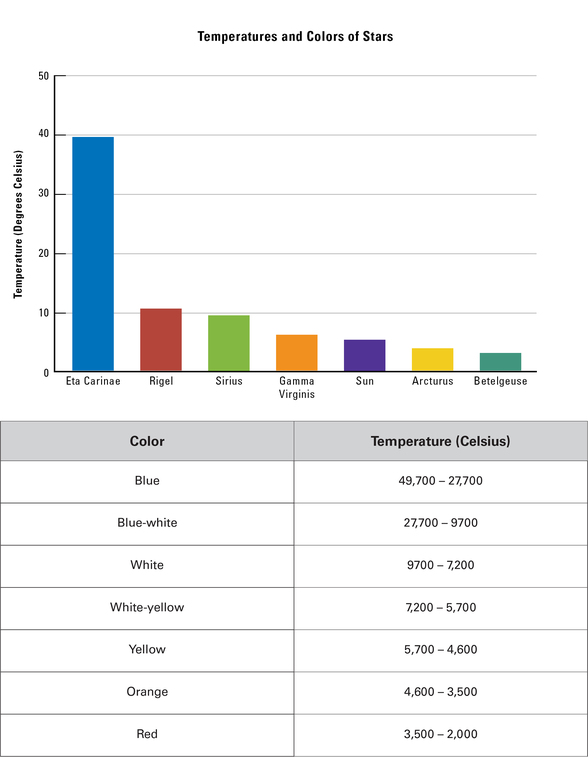 Which star is closest to the sun in temperature? (Hint: the sun is a yellow star.)
A. Betelgeuse B. Gamma Virginis C. Rigel D. Sirius
B. Gamma Virginis
100
Lupe and Kimiko enjoy making shadow puppets on the walls of their school building at school during recess. Today, the shadows are very long and they are cast on a wall located to the west of the playground. Based on this information, which is MOST LIKELY the season and time of day?
a summer afternoon
b summer morning
c winter afternoon
d winter morning
d winter morning
100
The moon appears to glow because
a it is lit up by light from Earth.
b its core burns gases to produce light.
c it reflects the sun’s light that shines on it.
d its surface has substances that glow in the dark.
c it reflects the sun’s light that shines on it.
200
The force of gravity between two objects increases as they are
a. spread apart.
b moved closer together.
c cooled.
d heated.
b moved closer together.
200
How does the temperature of these stars affect their apparent brightness?
a The greater the temperature, the greater the apparent brightness.
b Blue stars have great apparent brightness, while all other stars have similar apparent brightness.
c All these stars will have less apparent brightness than the sun.
d Blue stars will always be visible compared to other stars.
a The greater the temperature, the greater the apparent brightness.
200
When Velina goes for walks with her family, her shadow sometimes makes her seem very tall. Other times, her shadow makes her look very short. During what time of the day and year would Velina’s shadow appear longest?
A. at noon on a summer day
B. at 8 A.M. on a summer day
C. at noon on a winter day
D. at 4 P.M. on a winter day
D. at 4 P.M. on a winter day
200
Arunda’s family plans a week-long camping trip. On the first night, Arunda cannot see the moon in the sky, even though it is a clear night. What phase of the moon is Arunda observing? What phase is she likely to see on her last night camping?
A. full moon; waxing crescent
B. new moon; waxing crescent
C. quarter moon, waxing gibbous
D. new moon; waning crescent
B. new moon; waxing crescent
300
How does the sun’s gravity affect Earth?
a It causes objects to fall to Earth’s surface.
b It holds Earth in its orbit.
c It causes the moon to rotate around Earth.
d It causes objects on Earth to have weight.
b It holds Earth in its orbit.
300
Based on temperature, which three stars have the greatest apparent brightness?
A. Eta Carinae, the Sun, and Betelgeuse
B. Eta Carinae, Rigel, and Sirius
C. Gamma Virginis, Sirius, and Arcturus
D. the Sun, Arcturus, and Betelgeuse
B. Eta Carinae, Rigel, and Sirius
300
A student draws pictures of the same tree near her home at different times of the day. She sees that the tree’s shadow changes throughout the day. Based on her drawing, what claim and evidence BEST explains where the student is located?
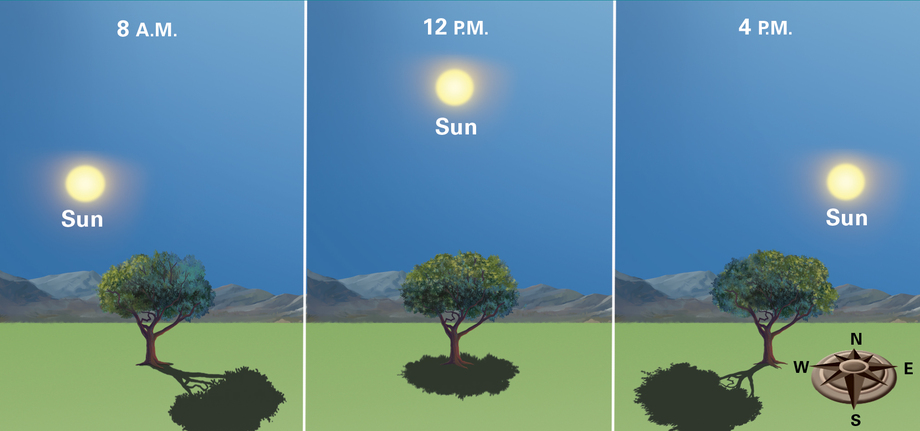
A. Southern Hemisphere, because the shadows point south
B. Southern Hemisphere, because the shadows point north
C. Northern Hemisphere, because shadows point north
D. Northern Hemisphere, because shadows point south
A. Southern Hemisphere, because the shadows point south
300
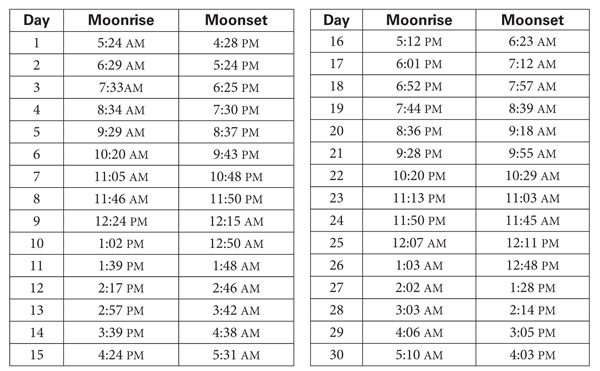
On Day 1, moonrise is at 5:24 in the morning. Sunrise is also around this time. Based on the data in the table and your knowledge of Earth’s rotation, which phase is the moon in on Day 1?
a new moon
b first quarter moon
c third quarter moon
d full moon
a new moon
400
Erick is heading out on a camping trip with his family to the Anza-Borrego Desert. At night 'me, the stars light up the sky. Erick sees a bright light streak across the sky. His dad says, “There’s a shoo'ng star! Make a wish.” As he makes a wish, Erick also thinks about the role gravity plays in his ability to see a shooting star.
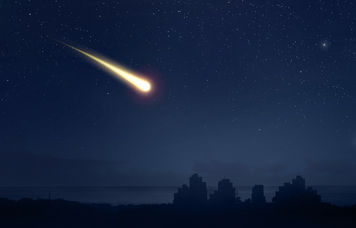
Based on the photo, describe the interaction between Earth and the meteoroid.
A. The meteoroid is much smaller than Earth, so Earth’s gravity pulls it down.
B. The meteoroid is too large and traveling too fast to be affected by Earth’s gravity.
C. The meteoroid is the same size as Earth, so Earth’s gravity does not affect it.
D. The meteoroid is small relative to Earth, so Earth’s gravity keeps it in orbit.
A. The meteoroid is much smaller than Earth, so Earth’s gravity pulls it down.
400
Deray observes the constellation Orion. He first observes it at 8 P.M. and then later at 12 A.M. He notices that it is in a different place in the sky after four hours. What claim and evidence explain why Orion appears to be in different places in the sky at different times?
a. Earth’s orbit around the sun causes Orion to disappear over the horizon.
b Earth’s orbit toward Orion causes the constellation to appear to change size.
c Earth’s rotation moves Orion vertically so that its location in the sky changes.
d Earth’s rotation causes Orion’s stars to move in an arc, tilting the constellation.
d. Earth’s rotation causes Orion’s stars to move in an arc, tilting the constellation.
400
Where on Earth can you stand for your shadow to point noticeably south?
A. equator
B. North Pole
C. Northern Hemisphere
D. Southern Hemisphere
D. Southern Hemisphere
400
Alonso likes to take pictures. He takes the pictures of the moon shown below. He is confused that the moon appears in one place during the day time. And appears again in the same place on a different day at night time. How can this phenomenon be explained to Alonso?
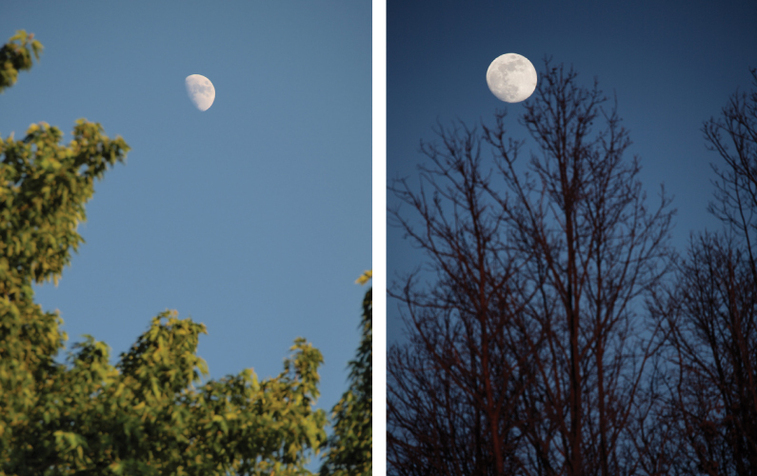
a. The moon is in the same place in the sky at all times, but it is not always visible.
b The moon rises at different times each day because of the moon’s orbit around Earth.
c The moon rises at different times each day because of Earth’s orbit around the moon.
d The moon rises at the same time each day, but Earth’s rotation causes it to appear at different times.
b The moon rises at different times each day because of the moon’s orbit around Earth.
500
Which statement best describes how gravity is affecting the people in the photo?

a. The force of gravity on the family is strong because they are holding hands.
b. The force of gravity on the family is weak because they are near the water.
c. The force of gravity on the family is strong because they are near sea level.
d. The force of gravity on the family is weak because they are jumping into the air.
c. The force of gravity on the family is strong because they are near sea level.
500
Marnie looks through a telescope and finds three different stars. All the stars she finds are the same size. Their relative distance from Earth is shown below. What claim can Marnie make about which of the three stars will have the greatest apparent brightness when viewed from Earth?
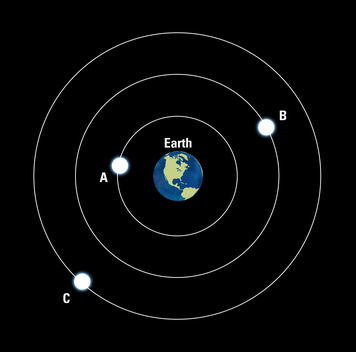
a. Star A, because it is closest to Earth.
b Star B, because it is farther away from the other stars.
c Star C, because it is farthest from Earth.
d All the stars will have the same apparent brightness because she is using a telescope.
a. Star A, because it is closest to Earth.
500
Cory keeps a plant on his desk at home. He notices that the length of the plant’s shadow changes with the time of day. He measures and records the length of the shadows every hour. However, he takes a nap and skips the 2 P.M. measurement. His measurements are in the data table. Based on the pattern of data in Cory’s table, which is MOST LIKELY the correct measurement for 2 P.M.?
 A. 12 cm B. 22 cm C. 55 cm D. 133 cm
C. 55 cm
500
Each day, the moon rises _______ the day before.
A. a little bit later than
B. a little bit earlier than
C. at the exact same time as
D. at random times not related to
A. a little bit later than