Bone Pathology #1
Bone Pathology #2
Hematopoietic
Hematopoietic pt. 2
CNS
Random
100
A bone is subjected to prolonged disuse. Compared with a bone experiencing normal mechanical loading, which structural changes would you expect to observe?
A. Increased diameter of the marrow cavity
B. Increased external diameter of the bone
C. Reduced external diameter of the bone
D. Retarded formation of dense cortical bone
E. Increased thickness of the cortical bone
F. Reduced cortical bone density
A. Increased diameter of the marrow cavity
B. Increased external diameter of the bone
C. Reduced external diameter of the bone
D. Retarded formation of dense cortical bone
E. Increased thickness of the cortical bone
F. Reduced cortical bone density
100
An animal develops a skeletal disorder characterized by inadequate formation of bone matrix, resulting in decreased bone mass. What is the correct term for this condition?
A. Osteopenia
B. Osteopetrosis
C. Osteomalacia
D. Osteodystrophy
A. Osteopenia
B. Osteopetrosis
C. Osteomalacia
D. Osteodystrophy
Osteopenia: Decreased bone mass due to inadequate bone matrix formation.
Osteopetrosis: Increased bone density due to impaired osteoclastic resorption.
Osteomalacia: Defective mineralization of bone matrix.
Osteodystrophy: General term for abnormal bone development or remodeling.
100
A dog develops a mast cell tumor associated with a mutation in the c-KIT proto-oncogene. What is the primary consequence of this mutation?
A. Increased apoptosis of mast cells
B. Constitutive activation of KIT signaling, promoting uncontrolled mast cell proliferation
C. Decreased mast cell growth due to receptor inhibition
D. Transformation of mast cells into lymphocytes
A. Increased apoptosis of mast cells
B. Constitutive activation of KIT signaling, promoting uncontrolled mast cell proliferation
C. Decreased mast cell growth due to receptor inhibition
D. Transformation of mast cells into lymphocytes
100
Question: Which of the following is an important biological vector for the transmission of African swine fever virus (ASFV)?
A. Ixodes hard ticks
B. Ornithodoros soft ticks
C. Mosquitoes of the genus Aedes
D. Fleas of the genus Ctenocephalides
A. Ixodes hard ticks
B. Ornithodoros soft ticks
C. Mosquitoes of the genus Aedes
D. Fleas of the genus Ctenocephalides
100
Which of the following is characterized by tubular cavitation within the spinal cord, resulting in the formation of an abnormal additional cavity or canal?
A. Hydromyelia
B. Syringomyelia
C. Hydrocephalus
D. Porencephaly
E. Hydranencephaly
A. Hydromyelia
B. Syringomyelia
C. Hydrocephalus
D. Porencephaly
E. Hydranencephaly
Explanation: Syringomyelia is the formation of a fluid-filled cavity (syrinx) within the spinal cord. Hydromyelia specifically refers to dilation of the central canal.
100
particularly important to examine due to its dependence on type I collagen?
A. Dentin of the teeth
B. Articular cartilage of the joints
C. Elastic cartilage of the external ear
D. Hyaline cartilage of the trachea
A. Dentin of the teeth
B. Articular cartilage of the joints
C. Elastic cartilage of the external ear
D. Hyaline cartilage of the trachea
200
A young animal presents with abnormal bone growth and radiographic evidence of metaphyseal lines. Which mechanism best explains these changes?
A. Increased osteoblastic activity leading to excessive bone deposition
B. Disruption of endochondral ossification and impaired osteoclastic resorption
C. Increased osteoclastic activity resulting in excessive bone resorption
D. Increased mineralization of the growth plate cartilage
A. Increased osteoblastic activity leading to excessive bone deposition
B. Disruption of endochondral ossification and impaired osteoclastic resorption
C. Increased osteoclastic activity resulting in excessive bone resorption
D. Increased mineralization of the growth plate cartilage
200
Which combination of minerals is essential for maintaining normal bone structure, mineralization, and remodeling?
A. Calcium and phosphorus
B. Calcium and magnesium
C. Phosphorus and potassium
D. Magnesium and sodium
A. Calcium and phosphorus
B. Calcium and magnesium
C. Phosphorus and potassium
D. Magnesium and sodium
200
A 4-year-old dog presents with fever, lethargy, pale mucous membranes, and hemoglobinuria. Blood smear examination reveals paired, pear-shaped organisms within erythrocytes. Which of the following is the most likely causative agent?
A. Anaplasma phagocytophilum
B. Ehrlichia canis
C. Babesia canis
D. Mycoplasma haemocanis
E. Trypanosoma cruzi
A. Anaplasma phagocytophilum
B. Ehrlichia canis
C. Babesia canis
D. Mycoplasma haemocanis
E. Trypanosoma cruzi
200
A flock of 10-week-old chickens develops progressive paralysis and neurologic abnormalities. Necropsy reveals unilateral sciatic nerve enlargement and T-cell lymphoma. Which of the following correctly identifies the causative agent and its primary method of transmission?
A. Avian leukosis virus — transmission through egg yolk
B. Infectious bursal disease virus — transmission through respiratory secretions
C. Reticuloendotheliosis virus — transmission through mosquito vectors
D. Marek’s disease virus — transmission through infected feather follicle dander
E. Newcastle disease virus — transmission through infected feather follicles
200
Which congenital CNS abnormality is characterized by near-complete loss or necrosis of the cerebral hemispheres, resulting in large fluid-filled spaces within the cerebrum?
A. Hydrocephalus
B. Hydroencephaly
C. Porencephaly
D. Hydranencephaly
E. Syringomyelia
A. Hydrocephalus
B. Hydroencephaly
C. Porencephaly
D. Hydranencephaly
E. Syringomyelia
Hydranencephaly = near-complete loss of cerebral hemispheres.
Porencephaly = localized fluid-filled cavity within cerebral tissue.
Hydrocephalus = excessive CSF accumulation within the ventricular system.
200
A domestic cat presents with acute lethargy, anorexia, icterus, splenomegaly, and serosal hemorrhage. Blood smear reveals organisms associated with Cytauxzoon felis. Which of the following correctly describes the natural reservoir and vector of this disease?
A. White-tailed deer; Ixodes tick
B. North American bobcat; Amblyomma americanum and Dermacentor variabilis ticks
C. Domestic cats; mosquitoes of the genus Culex
D. Raccoons; Ctenocephalides fleas
A. White-tailed deer; Ixodes tick
B. North American bobcat; Amblyomma americanum and Dermacentor variabilis ticks
C. Domestic cats; mosquitoes of the genus Culex
D. Raccoons; Ctenocephalides fleas
300
Which of the following would result in the pathology seen in the picture below? (Select all that apply)
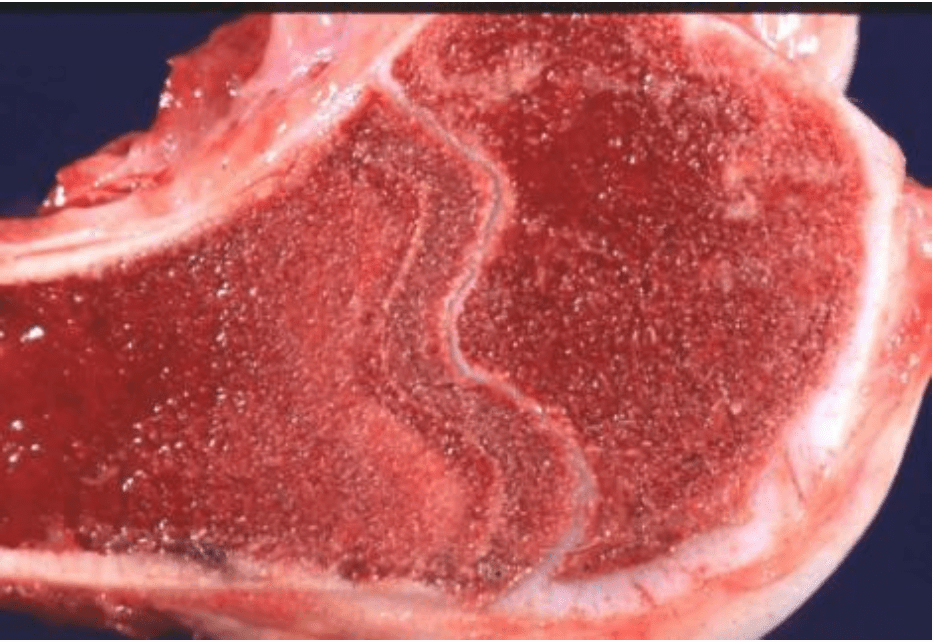 a. Lead Poisoning
b. Mercury Poisoning
c. Canine distemper
d. Bovine Viral Disease
a. Lead Poisoning
b. Mercury Poisoning
c. Canine distemper
d. Bovine Viral Disease
300
Which of the following correctly describes the hormonal regulation of calcium homeostasis and bone remodeling?
A. PTH increases calcium deposition in bone; vitamin D stimulates calcium excretion by the kidneys; calcitonin promotes osteoclastic activity.
B. PTH inhibits osteoclastic bone resorption and decreases renal calcium reabsorption; vitamin D decreases intestinal calcium absorption; calcitonin stimulates bone resorption.
C. PTH stimulates osteoblastic bone formation and decreases blood calcium; vitamin D inhibits intestinal calcium absorption; calcitonin increases renal calcium reabsorption.
D. PTH stimulates osteoclastic bone resorption and increases renal calcium reabsorption; vitamin D increases intestinal calcium absorption; calcitonin promotes calcium deposition in bone.
300
A herd of cattle grazing on bracken fern-infested pasture develops chronic hematuria. Several animals exhibit anemia, and necropsy reveals hemorrhages and neoplastic lesions within the urinary bladder. Which of the following is the most likely underlying cause?
A. Chronic ingestion of pyrrolizidine alkaloids causing hepatic failure
B. Leptospiral infection causing acute renal failure
C. Copper toxicity causing intravascular hemolysis
D. Chronic bracken fern ingestion causing urinary bladder damage and neoplasia
E. Calcium oxalate accumulation causing urinary obstruction
300
You necropsy a young pig in poor body condition and notice that the mesenteric lymph nodes are enlarged, as seen in the image below. What is the likely diagnosis?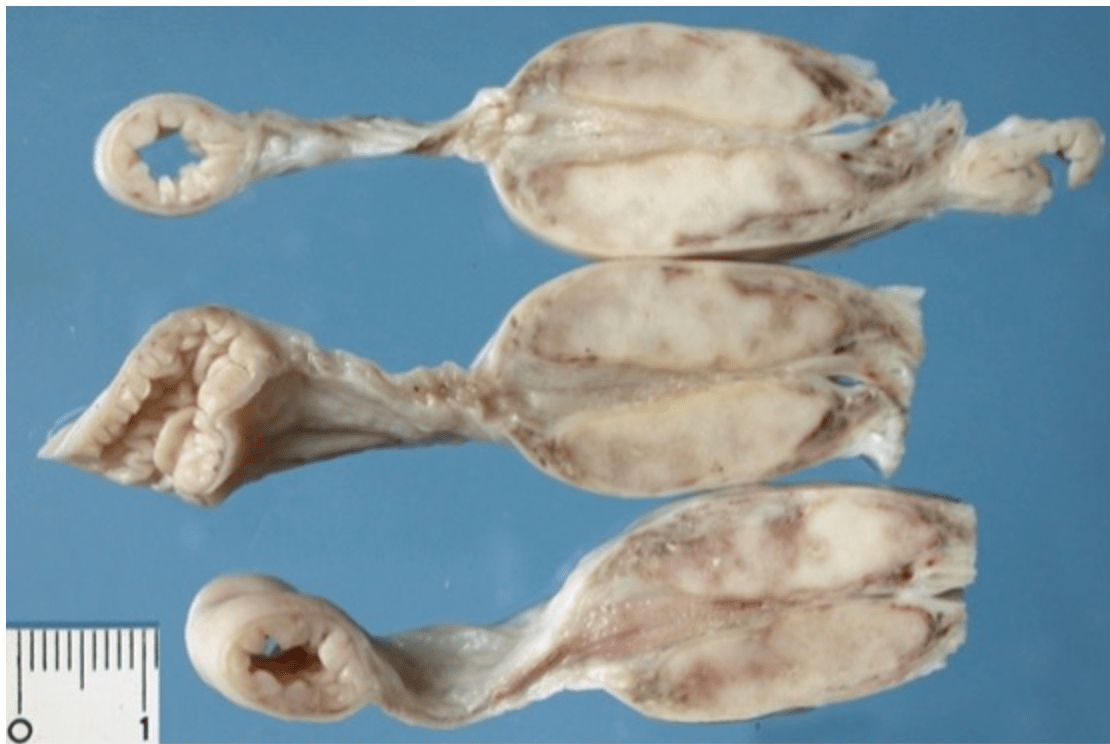
a. Porcine parvovirus
b. Streptococcus porcinus
c. Mycobacterium tuberculosis
d. Porcine circovirus-2
a. Porcine parvovirus
b. Streptococcus porcinus
c. Mycobacterium tuberculosis
d. Porcine circovirus-2
300
Which of the following viruses belongs to the genus Lyssavirus within the family Rhabdoviridae?
A. Rabies virus
B. Canine distemper virus
C. West Nile virus
D. Bluetongue virus
E. Bovine viral diarrhea virus
A. Rabies virus
B. Canine distemper virus
C. West Nile virus
D. Bluetongue virus
E. Bovine viral diarrhea virus
300
A young animal is diagnosed with rickets due to defective mineralization at the growth plate. Which of the following correctly represents the sequence of pathological changes that occur at the physis?
A. Failure of cartilage mineralization → Failure of cartilage degeneration → Persistence of cartilage → Formation of an irregular osteochondral junction → Fibrous overgrowth in the metaphysis → Bone deformation
B. Failure of cartilage degeneration → Failure of cartilage mineralization → Fibrous overgrowth in the metaphysis → Persistence of cartilage → Bone deformation → Formation of an irregular osteochondral junction
C. Failure of cartilage mineralization → Persistence of cartilage → Failure of cartilage degeneration → Fibrous overgrowth in the metaphysis → Bone deformation → Formation of an irregular osteochondral junction
D. Failure of cartilage mineralization → Failure of cartilage degeneration → Formation of an irregular osteochondral junction → Bone deformation → Persistence of cartilage → Fibrous overgrowth in the metaphysis
400
Which of the following best characterizes osteoporosis on gross examination of bone?
A. Thin cortex with abnormal accumulation of woven bone in the marrow cavity
B. Thickened cortex with increased deposition of mature lamellar bone
C. Increased bone density with reduced marrow cavity diameter
D. Normal cortical thickness with excessive cartilage accumulation
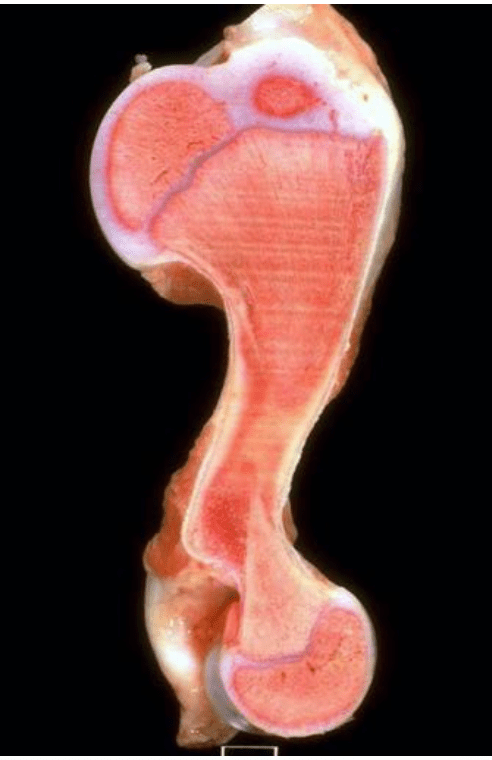
A. Thin cortex with abnormal accumulation of woven bone in the marrow cavity
B. Thickened cortex with increased deposition of mature lamellar bone
C. Increased bone density with reduced marrow cavity diameter
D. Normal cortical thickness with excessive cartilage accumulation
400
A livestock animal develops hypocalcemia associated with an inadequate dietary intake of essential nutrients. Which combination of dietary deficiencies is most concerning, and what skeletal disorder can develop as a result?
A. Calcium and vitamin A deficiencies; osteopetrosis
B. Phosphorus and vitamin D deficiencies; fibrous osteodystrophy
C. Phosphorus and vitamin E deficiencies; osteogenesis imperfecta
D. Calcium and vitamin K deficiencies; osteomalacia
A. Calcium and vitamin A deficiencies; osteopetrosis
B. Phosphorus and vitamin D deficiencies; fibrous osteodystrophy
C. Phosphorus and vitamin E deficiencies; osteogenesis imperfecta
D. Calcium and vitamin K deficiencies; osteomalacia
400
An older dog presents with a rapidly enlarging cutaneous mass. Histopathology reveals an infiltrative neoplasm composed of pleomorphic histiocytic cells. Which of the following is the most likely diagnosis?
A. Cutaneous histiocytoma
B. Cutaneous mast cell tumor
C. Cutaneous hemangiosarcoma
D. Cutaneous melanoma
E. Cutaneous fibrosarcoma
A. Cutaneous histiocytoma
B. Cutaneous mast cell tumor
C. Cutaneous hemangiosarcoma
D. Cutaneous melanoma
E. Cutaneous fibrosarcoma
400
Which of the following diseases is commonly associated with guinea pigs and is characterized by inflammation and abscess formation in the cervical lymph nodes?
A. Cervical lymphadenitis
B. Caseous lymphadenitis
C. Myxomatosis
D. Tularemia
E. Rabbit hemorrhagic disease
A. Cervical lymphadenitis
B. Caseous lymphadenitis
C. Myxomatosis
D. Tularemia
E. Rabbit hemorrhagic disease
400
According to the lecture, which of the following lists the correct order of frequency for metastatic tumors to the CNS, from most frequent to least frequent?
A. Carcinoma → Hemangiosarcoma → Lymphoma → Histiocytic sarcoma → Malignant melanoma
B. Hemangiosarcoma → Histiocytic sarcoma → Carcinoma → Lymphoma → Malignant melanoma
C. Histiocytic sarcoma → Hemangiosarcoma → Lymphoma → Carcinoma → Malignant melanoma
D. Hemangiosarcoma → Carcinoma → Histiocytic sarcoma → Malignant melanoma → Lymphoma
E. Lymphoma → Hemangiosarcoma → Histiocytic sarcoma → Carcinoma → Malignant melanoma
400
A dog presents with regurgitation and radiographic evidence of megaesophagus. During examination, a firm, nodular mass is identified in the cranial mediastinum. Which neoplastic condition is most likely associated with these findings?
A. Lymphoma
B. Pulmonary adenocarcinoma
C. Thymoma
D. Mast cell tumor
A. Lymphoma
B. Pulmonary adenocarcinoma
C. Thymoma
D. Mast cell tumor
500
A Simmental steer is presented for evaluation. Histopathology reveals unresorbed cones of primary spongiosa extending from the physes toward the center of the diaphysis. The animal is diagnosed with osteopetrosis. What is the mode of inheritance associated with this disorder?
A. Autosomal recessive
B. Autosomal dominant
C. X-linked recessive
D. X-linked dominant
A. Autosomal recessive
B. Autosomal dominant
C. X-linked recessive
D. X-linked dominant
500
A 4-month-old puppy is presented with a history of poor growth, lameness, and difficulty walking. Physical examination reveals enlarged metaphyses, angular limb deformities, and pain upon palpation of the long bones. Radiographs show widened growth plates with poorly mineralized bone. The puppy has been fed an improperly balanced homemade diet.
Which of the following best explains the underlying pathogenesis of this condition?
A. Defective type I collagen synthesis resulting in abnormal bone matrix formation
B. Impaired osteoclastic bone resorption resulting in excessive accumulation of primary spongiosa
C. Failure of mineralization of osteoid and growth plate cartilage due to inadequate vitamin D, calcium, or phosphorus availability
D. Excessive parathyroid hormone secretion resulting in increased cortical bone deposition
500
A group of 8–16-week-old piglets develops progressive weight loss, poor growth, respiratory distress, and diarrhea despite adequate nutrition. Necropsy reveals generalized lymphadenopathy and lymphoid depletion. Which of the following is the most likely causative agent?
A. Porcine parvovirus
B. Porcine circovirus type 1
C. Porcine circovirus type 2
D. Porcine reproductive and respiratory syndrome virus (PRRSV)
E. Swine influenza virus
A. Porcine parvovirus
B. Porcine circovirus type 1
C. Porcine circovirus type 2
D. Porcine reproductive and respiratory syndrome virus (PRRSV)
E. Swine influenza virus
500
A 16-week-old chicken presents with lymphoproliferative disease. Histopathology reveals a neoplastic proliferation of B lymphocytes, with tumor involvement of the bursa of Fabricius. Which of the following is the most likely causative agent?
A. Marek’s disease virus — T-cell lymphoma
B. Infectious bursal disease virus — B-cell lymphoma
C. Reticuloendotheliosis virus — peripheral nerve enlargement
D. Avian leukosis virus — B-cell lymphoma
E. Newcastle disease virus — lymphoid neoplasia
A. Marek’s disease virus — T-cell lymphoma
B. Infectious bursal disease virus — B-cell lymphoma
C. Reticuloendotheliosis virus — peripheral nerve enlargement
D. Avian leukosis virus — B-cell lymphoma
E. Newcastle disease virus — lymphoid neoplasia
500
A young puppy is presented with a dome-shaped skull, behavioral abnormalities, and progressive neurologic deficits. MRI reveals enlargement of the lateral and third ventricles, while the fourth ventricle remains normal in size. Which of the following is the most likely underlying cause?
A. Congenital absence of the cerebral hemispheres
B. Diffuse granulomatous inflammation of the meninges
C. Degeneration of cerebellar Purkinje cells
D. Formation of a fluid-filled cavity within the spinal cord
E. Obstruction of the mesencephalic aqueduct
A. Congenital absence of the cerebral hemispheres
B. Diffuse granulomatous inflammation of the meninges
C. Degeneration of cerebellar Purkinje cells
D. Formation of a fluid-filled cavity within the spinal cord
E. Obstruction of the mesencephalic aqueduct
500
Which of the following correctly represents the sequence of events during secondary (indirect) fracture healing?
A. Hematoma formation → soft callus formation → removal of ischemic dead bone by osteoclasts → hard callus formation → granulation tissue formation → remodeling of woven bone into lamellar bone
B. Hematoma formation → removal of ischemic dead bone by osteoclasts → soft callus formation → invasion of the clot by fibroblasts, endothelial cells, osteoprogenitor cells, and macrophages → remodeling of woven bone into lamellar bone → hard callus formation
C. Hematoma formation → granulation tissue formation → hard callus formation → removal of ischemic dead bone by osteoclasts → soft callus formation → remodeling of woven bone into lamellar bone
D. Hematoma formation → removal of ischemic dead bone by osteoclasts → invasion of the clot by fibroblasts, endothelial cells, osteoprogenitor cells, and macrophages → soft callus formation → hard callus formation → remodeling of woven bone into lamellar bone
600
A young animal is diagnosed with osteogenesis imperfecta. Which of the following best describes the underlying pathogenesis of this disorder?
A. Defective type I collagen production resulting in abnormal bone matrix formation
B. Impaired osteoclastic resorption resulting in excessive accumulation of primary spongiosa
C. Excessive osteoblastic activity resulting in increased cortical bone thickness
D. Defective endochondral ossification resulting in delayed growth plate closure
600
Question: A young animal presents with neurological deficits associated with vitamin A deficiency. Which of the following best explains the pathogenesis of these neurological abnormalities?
A. Demyelination caused by impaired myelin synthesis
B. Compression of the brain and cranial nerves due to abnormal skull bone development
C. Neuronal necrosis caused by excessive calcium deposition
D. Degeneration of peripheral nerves due to impaired glucose metabolism
A. Demyelination caused by impaired myelin synthesis
B. Compression of the brain and cranial nerves due to abnormal skull bone development
C. Neuronal necrosis caused by excessive calcium deposition
D. Degeneration of peripheral nerves due to impaired glucose metabolism
600
A dead animal was brought for pathology after experiencing sudden mortality is examined. Cytology reveals bipolar-staining, gram-negative bacilli with a characteristic “safety-pin” appearance. Which of the following correctly identifies the causative agent and an important reservoir species?
A. Francisella tularensis — rabbits
B. Yersinia pestis — prairie dogs
C. Bacillus anthracis — cattle
D. Brucella abortus — cattle
E. Pasteurella multocida — poultry
A. Francisella tularensis — rabbits
B. Yersinia pestis — prairie dogs
C. Bacillus anthracis — cattle
D. Brucella abortus — cattle
E. Pasteurella multocida — poultry
600
A pig dies following an acute febrile illness. Necropsy reveals hemorrhagic lesions, and laboratory testing identifies prolonged PT, aPTT, and thrombin time, along with thrombocytopenia and disseminated intravascular coagulation (DIC). Which virus family is the causative agent associated with this disease?
A. Flaviviridae
B. Asfarviridae
C. Circoviridae
D. Arteriviridae
E. Orthomyxoviridae
A. Flaviviridae
B. Asfarviridae
C. Circoviridae
D. Arteriviridae
E. Orthomyxoviridae
600
Which of the following CNS tumors would you confirm with immunohistochemistry ?
a. Astrocytoma
b. Oligiodendroglioma
c. Meningioma
d. Ependymoma
a. Astrocytoma
b. Oligiodendroglioma
c. Meningioma
d. Ependymoma
600
A 3-month-old pig presents with necrotizing lymphadenitis and markedly enlarged inguinal and mesenteric lymph nodes. Histopathological examination reveals botryoid, grape-like intracytoplasmic inclusions. Which infectious agent is most likely responsible for these findings?
A. Porcine circovirus type 2 (PCV2)
B. Porcine parvovirus
C. African swine fever virus
D. Porcine reproductive and respiratory syndrome virus (PRRSV)
A. Porcine circovirus type 2 (PCV2)
B. Porcine parvovirus
C. African swine fever virus
D. Porcine reproductive and respiratory syndrome virus (PRRSV)
700
What species are we most concerned with having congenital cortical hyperostosis?
a. Neonatal Pigs
b. Scottish and West Highland White Terriers
c. Holstein Calf
d. Arabian Horses
a. Neonatal Pigs
b. Scottish and West Highland White Terriers
c. Holstein Calf
d. Arabian Horses
700
An animal presents with neurological abnormalities associated with abnormal skull bone remodeling. Serum biochemistry reveals increased phosphorus and low-to-normal ionized calcium. Which condition is most consistent with these findings?
A. Primary hyperparathyroidism
B. Secondary nutritional hyperparathyroidism
C. Hypovitaminosis D
D. Primary hypoparathyroidism
A. Primary hyperparathyroidism
B. Secondary nutritional hyperparathyroidism
C. Hypovitaminosis D
D. Primary hypoparathyroidism
700
A horse presents with fever, mucopurulent nasal discharge, and suppurative lymphadenitis involving the mandibular and retropharyngeal lymph nodes. Which of the following correctly identifies the affected lymph nodes and the causative agent?
A. Submandibular and prescapular lymph nodes — Rhodococcus equi
B. Mandibular and parotid lymph nodes — Actinobacillus equuli
C. Mesenteric and mediastinal lymph nodes — Streptococcus equi subsp. zooepidemicus
D. Popliteal and inguinal lymph nodes — Corynebacterium pseudotuberculosis
E. Mandibular and retropharyngeal lymph nodes — Streptococcus equi subsp. equi
700
A dog is suspected of having multiple myeloma. Which of the following combinations includes diagnostic abnormalities associated with this disease?
A. Increased plasma cells in bone marrow, monoclonal gammopathy, osteolysis, and Bence-Jones proteinuria
B. Decreased plasma cells in bone marrow, polyclonal gammopathy, osteosclerosis, and hematuria
C. Increased neutrophils in bone marrow, hypoglobulinemia, osteolysis, and glucosuria
D. Increased erythrocytes in bone marrow, monoclonal gammopathy, osteosclerosis, and albuminuria
700
Which of the following correctly differentiates discospondylitis from spondylitis deformans in veterinary patients?
A. Discospondylitis is a degenerative condition characterized by smooth osteophyte formation, whereas spondylitis deformans is an infectious disease causing vertebral endplate destruction.
B. Discospondylitis primarily affects the vertebral bodies without involving intervertebral discs, whereas spondylitis deformans causes infectious destruction of the vertebral endplates.
C. Discospondylitis is an infectious/inflammatory condition affecting intervertebral discs and adjacent vertebral endplates, whereas spondylitis deformans is a degenerative condition characterized by ventral osteophyte formation.
D. Both conditions are infectious diseases characterized by vertebral endplate lysis and disc space narrowing.
700
When evaluating animals for osteochondrosis (OC), which combination of anatomical locations represents common predilection sites in dogs and horses, respectively?
A. Dogs: distal intermediate ridge of the tibia; Horses: head of the humerus
B. Dogs: vertebral bodies; Horses: femoral head
C. Dogs: femoral head; Horses: proximal radius
D. Dogs: head of the humerus; Horses: distal intermediate ridge of the tibia
A. Dogs: distal intermediate ridge of the tibia; Horses: head of the humerus
B. Dogs: vertebral bodies; Horses: femoral head
C. Dogs: femoral head; Horses: proximal radius
D. Dogs: head of the humerus; Horses: distal intermediate ridge of the tibia