Theories and Hypotheses
Prokaryotes
Eukaryotes
Biomolecules
Misc.
100
Define a hypothesis...
A tentative explanation based on limited evidence that explains a specific phenomena.
100
What are two types of prokaryotes?
Bacteria and archaea.
100
What are four types of eukaryotic cells?
Animal, plant, fungi, and protista.
100
What are the four biomolecules?
Carbohydrates, lipids (fat), nucleic acid (DNA), and protein.
100
Explain these learning strategies: spaced practice and retrieval practice.
Spaced practice - learning that occurs over multiple sessions at different points in time (for example, revisiting a textbook chapter once every three days).
Retrieval practice - attempting to recall that information from memory (such as by taking a practice test).
200
Define a theory...
A substantial explanation based on observations and experiments that describes a wide range of phenomena.
200
Where is the DNA material stored?
The nucleoid.
200
Where is the DNA stored?
The nucleus.
200
What is the monomer of carbohydrates and proteins?
monosaccharides and amino acids.
200
What are the domains of life?
Bacteria, archaea, and eukaryota.
300
Is this an example of a theory or a hypothesis...
"The earth is rotating on an axis."
Theory
300
True or false....
a prokaryotic organism has membrane bound organelles.
False
300
Name three differences between an animal cell and a plant cell...
1. A plant cell has chloroplasts
2. A plant cell has a cell wall
3. A plant cell has a large vacuole
300
What is the monomer of lipids and nucleic acids?
Fatty acids/glycerol and nucleotides.
300
What are the five components makes something a cell?
Cytoplasm, cytoskeleton, plasma (cell) membrane, DNA genome, and ribosomes.
400
Is this an example of a theory or a hypothesis...
"Bounty is the most absorbent paper towel brand."
Hypothesis
400
Are prokaryotes single-celled or multi-cellular?
Single-celled (unicellular)
400
Are eukaryotes single-celled (unicellular) or multi-cellular?
Both
400
What is the structure of each biomolecule?
Carbs: CHO
Lipids: CHO
Protein: CHON
Nucleic acid: CHONP
Carbon, hydrogen, oxygen, nitrogen, and phosphorus.
400
What are the seven characteristics of life?
1. Order - composed of cells
2. Growth and development
3. Metabolism
4. Regulation - homeostasis
5. Evolve over time
6. Respond to stimuli in environment
7. Reproduce
500
Come up with your own hypothesis and theory and explain why they are different.
example:
H - "Students will do bad on the test."
T - "The rate of acceleration of falling objects on earth is constant."
They differ because the hypothesis isn't based on facts and explains a specific phenomena, while the theory is based on lots of evidence and experiments and explains a wide range of phenomena.
500
Draw a simple bacteria cell...
500
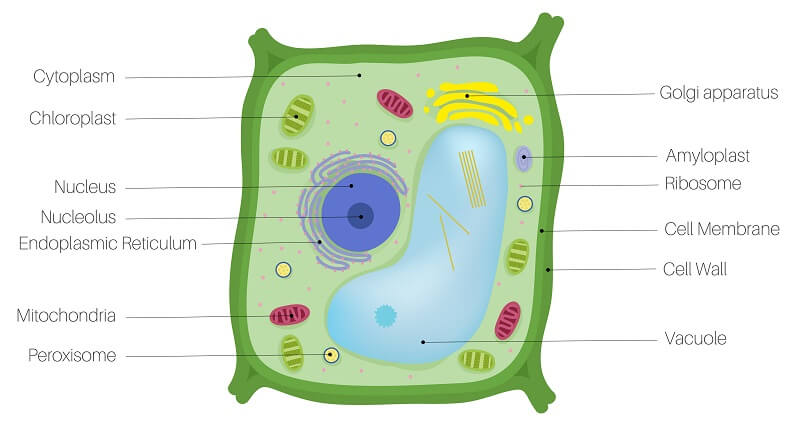
Draw an animal and a plant cell...

500
Name a function for each biomolecule...
Protein: enzymes speed up chemical reactions, muscle contraction and movement, support to the body, moves essential molecules around the body, and antibodies support immune system.
Fats: insulation, long-term energy, etc.
Carbs: Provides energy to the brain
DNA: encodes traits and eventually encodes proteins
500
What evidence is there to argue that a virus is living and non-living?
Living: -they're able to evolve
-they're able to reproduce (they have the mechanism, but cannot reproduce on their own)
Non-living: -they're not composed of cells
-they cannot metabolize