states of matter
gas laws (not math)
gas laws MATH(except for one)
heat
rando/review
100
a state of matter that particles move past each other but stay close together
liquid
100
What is STP? (with the numerical values)
standard temperature and pressure 1 atm and 0 celcius
100
A gas occupies 1.56 L at 1.00 atm. What will be the volume of this gas if the pressure becomes 3.00 atm?
.52 L
100
Describe temperature on the molecular level.
Average kinetic energy of atoms and molecules.
100
how to convert from celsius to kelvin?
273.15+
200
going from a gas directly to solid is known as
deposition
200
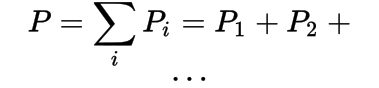
what is this?
Daltons law of partial pressure
200
If a gas at 25.0C occupies 3.60 liters at a pressure of 1 atm, what will be its volume at a pressure of 2.50 atm?
1.44 L
200
What is the difference between work and heat?
Heat: Transfer of energy in a disorderly format, into or out of a system
Work: Transfer of energy in an orderly format.
200
What is called when heat is added to a substance but the temperature of the substance does not increase?
phase change
300
has no fixed shape and no fixed volume
gas
300
a gas that conforms, in physical behaviour, to a particular idealized relation between pressure, volume, and temperature
ideal gas
300
The specific heat of nickel is 540 J/kgK. If you add 5400 J of heat to 1.0 kg of nickel, by how many Kelvins will the temperature rise?
10 KELVIN
300
When will q have a positive value and when negative?
q pos = endothermic
q neg=exothermic
300
Oil does not dissolve in water because?
water is polar
400
plasma
Plasma is a form of matter in which many of the electrons wander around freely among the nuclei of the atoms.
400
what is the symbol for temperature?
T
400
why is a burn from steam at 100 celcius is expected to be more severe than a burn from boiling water at 100 celcius?
It becomes water again. This is a fundamental change from a gas to a liquid. Steam touches your skin, drops in temperature — transferring that energy (and heat) to your skin — and switches back into liquid form.
400
Why is water's specific heat (H2O) stronger than methane's CH4?
water has hydrogen bonds (strong) while methane can only form dispersion forces (weak)
400
What mixture will not be separated by dialysis?
solutions
500
any substance at a temperature and pressure above its critical point, where distinct liquid and gas phases do not exist, but below the pressure required to compress it into a solid.
supercritical fluid
500
What is avogadro's law?
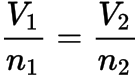
500
You have a 4 L balloony in your freezer at -12C and the air pressure is 1 atm. you then decide to take balloony scuba diving with you in the tropics and the pressure is 5 atm and balloony shrinks to 1.08 L, what is the temperature of the water in the tropics?
oop
500
How many grams of water would require 2200 joules of heat to raise its temperature from 34°C to 100°C? The specific heat of water is 4.18 J/g°C
7.97 g
500
What kind of electrolyte fully dissociates into ions?
strong electrolytes