The Planets and Other Objects
The Sun
Stars
Galaxies and the Universe
Exploring Space
100
Name the 4 inner planets. What are 2 things that are same about all of them?
Name the 4 outer planets. What is the same about them?
The 4 inner planets are Mercury, Venus, Earth and Mars. They are all small and rocky. They are all relatively close to the sun compared to the other planets.
The 4 outer planets are Jupitar, Saturn, Uranus, and Neptune. They are all large, cold, and made of gas. They all have rings (Saturn's are the biggest) and they all have multiple moons.
100
The sun is composed mainly of which two gases?
Hydrogen and Helium
100
Where do stars form?
Stars form in a cloud of gas and dust called a Nebula.
100
How are galaxies classified and what are the three types of galaxies?
Galaxies are classified by shape. There are three general types: elliptical, spiral, and irregular.
100
What two countries were involved in the "Space Race?"
The United States and the Soviet Union.
200
What is an asteroid? Where is the asteroid belt located?
Asteroids are small rocky objects (smaller than a dwarf planet but bigger than a meteoroid) that orbit the sun. They are found in the asteroid belt, which is between Mars and Jupitar.
200
What are the 6 layers of the sun in order from inside out?
Core, Radiactive Zone, Convective Zone, Photosphere, Chromosphere and Corona.
200
What color stars are the hottest? What color stars are the coolest? Where does the sun fit in?
Blue stars are the hottest. Red stars are the coolest. The sun is a yellow star and it is in the middle range of heat.
200
What is the difference between a star cluster and a galaxy?
Galaxies are generally larger than star clusters and contain dark matter. Star clusters are collections of hundreds of thousands of stars, held together by gravitational attraction. Galaxies can contain thousands or more individual star clusters.
200
What is a parallax?
A parallax is a tool for calculating distances of far away stars.
Astronomers use an effect called parallax. Parallax is the apparent motion of an object because of a change in the observer's point of view.
300
What is the difference between a meteor and a meteoroid?
Meteoroid: A “space rock”—a relatively small object traveling through space, between the size of a grain of dust and a small asteroid.
Meteor: A meteoroid that enters Earth’s atmosphere and burns up.
300
In which layer of the sun is most of the heat in the form of electromagnetic energy?
The Radiative Zone
300
What is a protostar?
A protostar is a very young star that is still gathering mass from its parent molecular cloud. It is the earliest phase in the process of stellar evolution.
300
What is the Big Bang Theory?
The big bang theory is how astronomers explain the way the universe began. It is the idea that the universe began as just a single point, then expanded and stretched to grow as large as it is right now—and it is still expanding!
300
What were the first living organisms sent into space and when?
Fruit flies in 1947.
400
What two gases make up the majority of the outer planets?
Hydrogen and Helium
400
What is this? 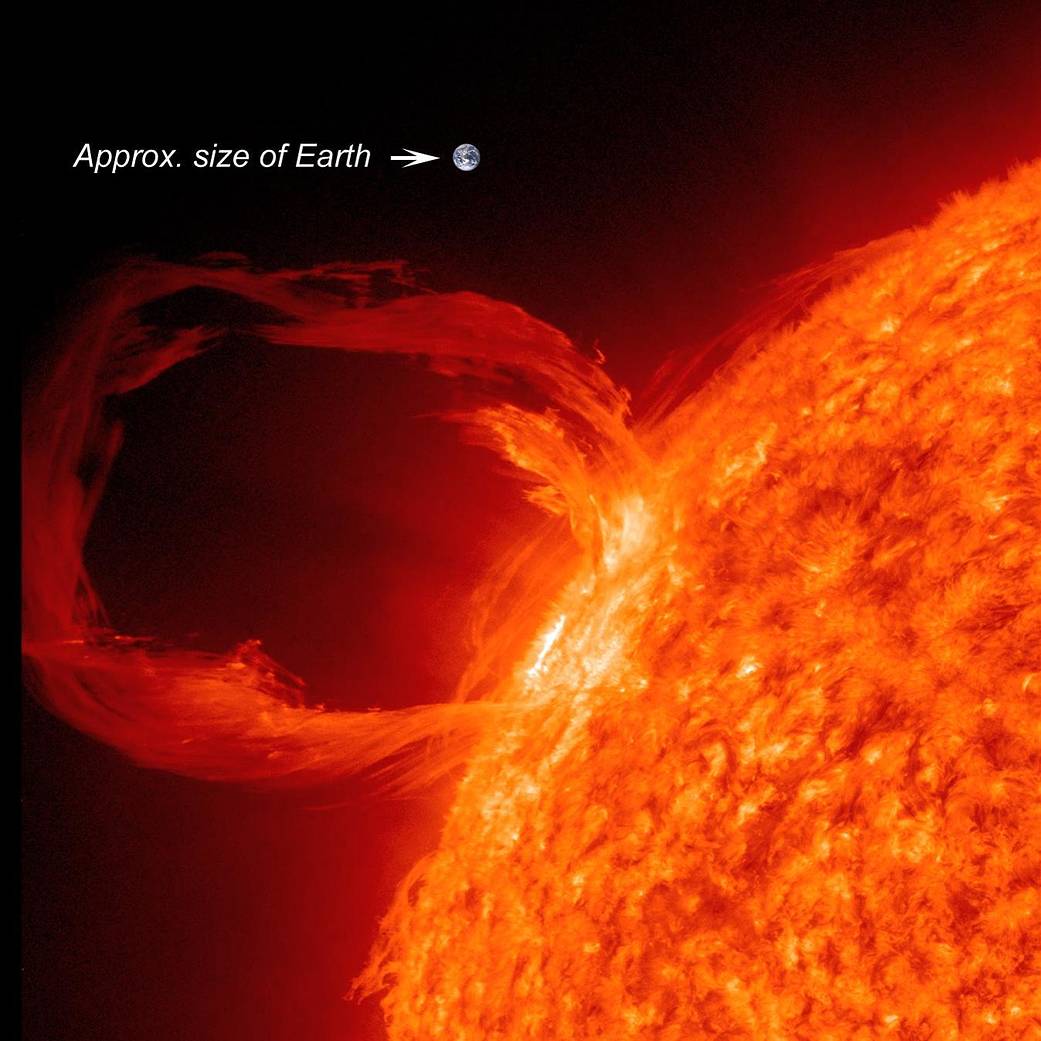
It is a prominence.
400
What is a binary star?
A binary star is a system of two gravitationally bound stars that orbit a common center of mass
400
Explain the general movement of galaxies in relation to each other?
In general, galaxies are moving away from each other at an ever increasing rate, carried along by the expansion of the Universe. The further away a galaxy is from us, the faster it is moving away
400
What is a black hole?
A black hole forms when a very massive star exhausts the nuclear fuel in its core and collapses under its own weight. The collapse triggers a supernova explosion that blows off the star’s outer layers. If the crushed core contains more than about three times the Sun’s mass, no known force can stop its collapse to a black hole.
500
In what year was Pluto reclassified as a dwarf planet and for what reason?
Pluto was reclassified as a dwarf planet in 2006.
It did not meet the three criteria the International Astronomical Union (IAU) uses to define a full-sized planet. Essentially Pluto meets all the criteria except one—it “has not cleared its neighboring region of other objects.”
500
Does the sun rotate? How do astronomers know?
The sun does rotate. We know this by watching the motion of sunspots and other solar features move across the Sun.
500
What is the difference between apparent magnitude and absolute magnitude. How do you find each?
Apparent magnitude is the brightness of a star as it appears to the observer.
Absolute magnitude is the brightness a star actually is.
Apparent magnitude is observed by looking at the sky and noticing that some stars appear brighter than others.
To calculate the absolute magnitude, you need to know a stars apparent magnitude and its distance form Earth.
500
What are two possible fates of the universe that scientists are considering?
The universe is currently expanding. There is debate on whether this will continue.
If the expansion of the universe slows down, then eventually it would stop expanding, and then start contracting, eventually leading to a Big Crunch.
If the expansion of the universe doesn't change very much, eventually the universe would just “run out of energy”, all the stars would exhaust their fuel, everything would decay into it’s basic particles, all the heat would spread out evenly. This is the Big Chill.
500
Name three types of telescopes and what they are used to study.
X-ray and gamma-ray telescopes study the hottest and most explosive objects in space. Infrared telescopes study the places where stars are born and can look into the centers of galaxies. Optical telescopes study the visible light from space. Ultraviolet telescopes study very hot stars.