Unit circle review
Problem solving
Answers in context
100
Write a degree/x value that gives you sin(x) = 1.
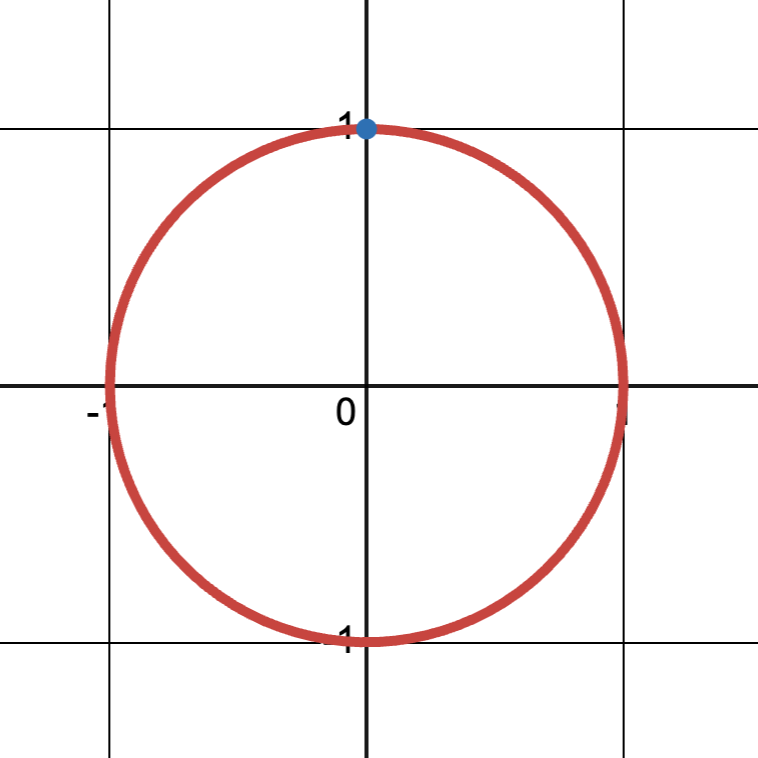
x = 90 (and many other possible responses!)
100
Daylight hours in Pittsburgh, PA are modeled by the equation y=2.892sin(0.986x)+12.175 , where day 0 is March 21. Use the equation to find the number of daylight hours on March 26 (5 days after March 21).
y=2.892sin(0.986(5))+12.175~~12.424
Pittsburgh experiences 12.424 hours of daylight on March 26.
100
Alex starts his graph on June 21. What does x = 30 mean in context?
30 days after June 21, or July 21
200
Write two degree/x values that give you sin(x) = 0.
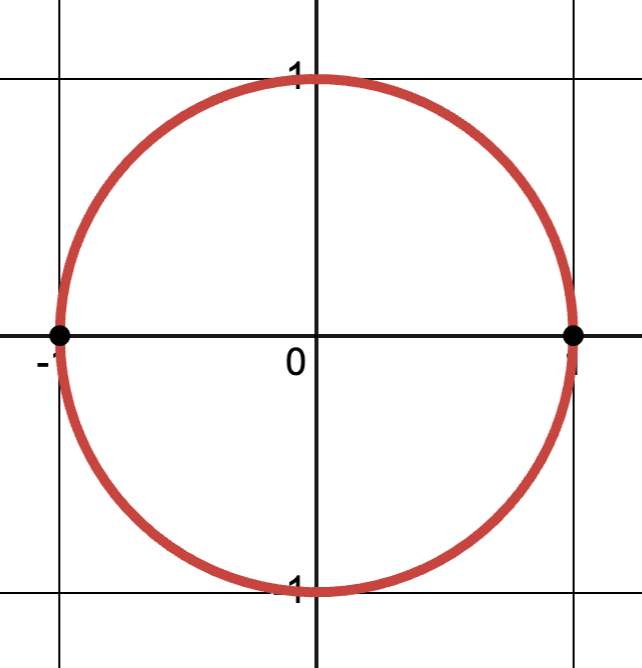
x = 0, x = 180
(and many other coterminal angles!)
200
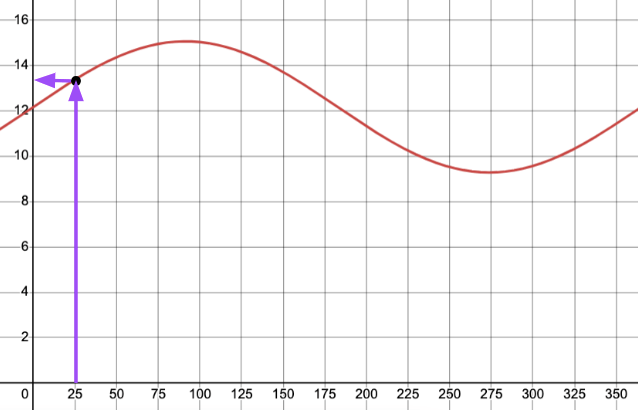
Daylight hours in Pittsburgh, PA are modeled by this graph, where day 0 is March 21. Using the graph, estimate the amount of daylight hours 25 days after March 21.
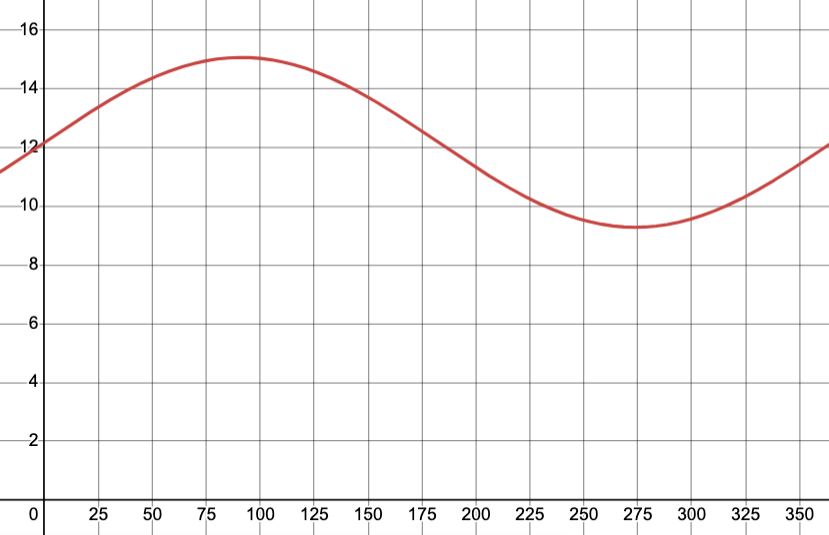
When x = 25, y ≈ 13.5
200
Brandon calculated his midline to be 12.125. What does this number mean in context?
Average or mean of the maximum daylight hours and the minimum daylight hours
300
Write a degree/x value that gives you sin(x) = 0.866.
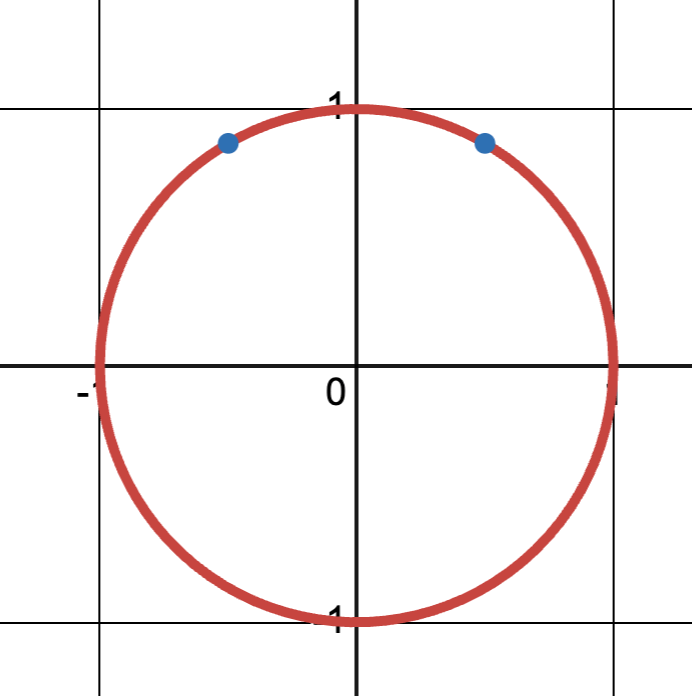
sin^-1(0.866)~~60
x = 60
x = 120
(and many other possible responses!)
300
Daylight hours in Pittsburgh, PA are modeled by the table below, where day 0 is March 21. According to the table, which days of the year have greater than average daylight hours?
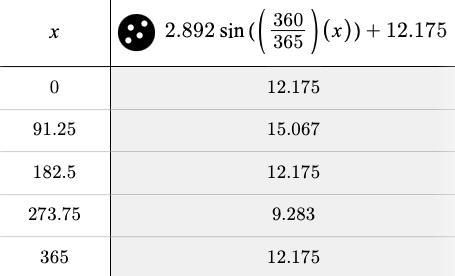
Day 0 - Day 182.5 (March 21 - September 21)
300
After plugging in x = 50 into her equation, Chaia got y = 12. What does this answer mean in context?
Day 50 in Chaia's location has 12 hours of daylight.
400
Write two degree/x values that give you sin(x) = -0.707.
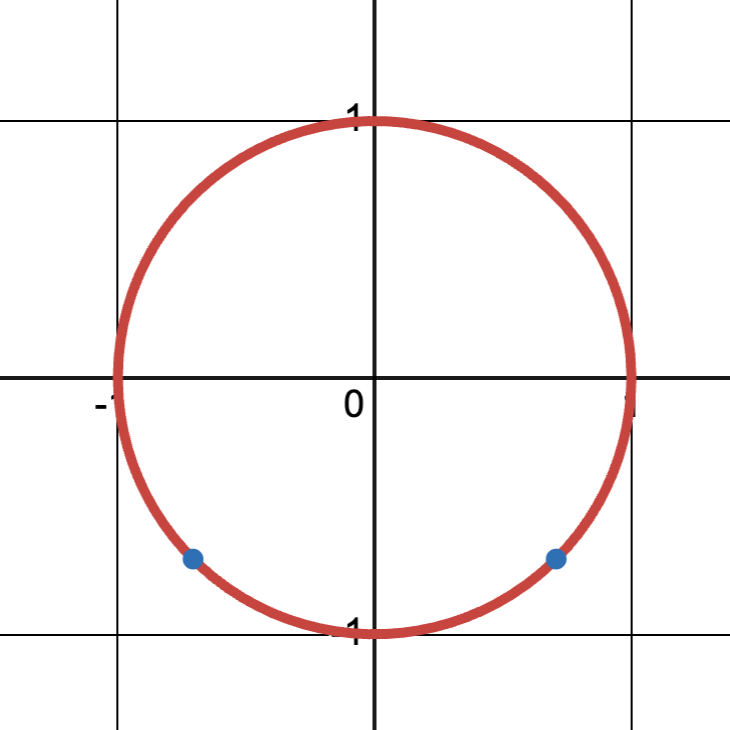
sin^-1(-0.707)~~-45
270 - 45 = 225
x = -45, x = 225
(and many other possible responses!)
400
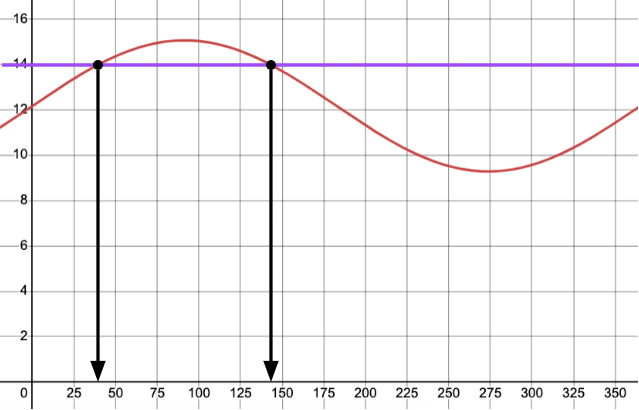
Daylight hours in Pittsburgh, PA is modeled by this graph, where day 0 is March 21. Using the graph, estimate two days of the year with 14 hours of daylight.
x~~40,145 => 40 and 145 days after March 21 have 14 hours of daylight.
400
Delilah calculated her phase shift to be c = -91. What does this value mean in context?
The spring equinox in Delilah's location occurs 91 days after her starting date.
500
Write two degree/x values that give you sin(x) = 0.25.
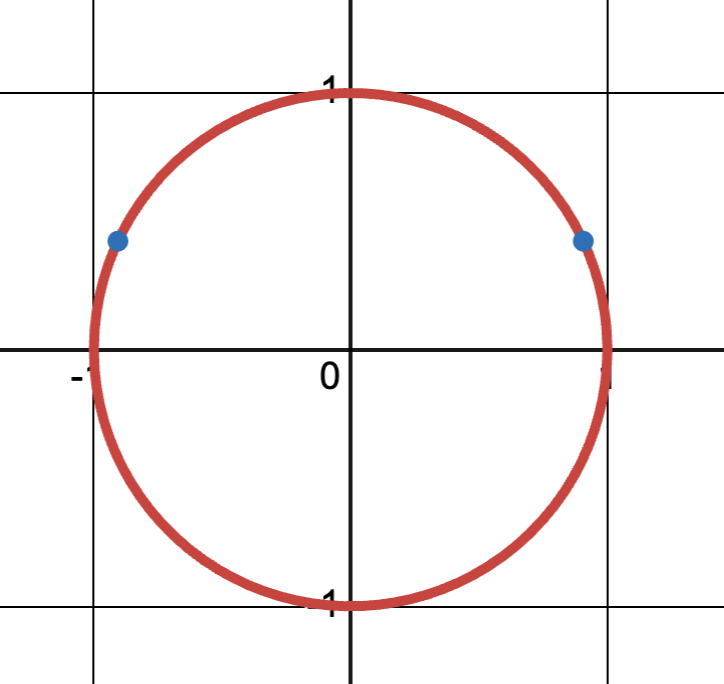
sin^-1(0.25)~~14.478
180-14.478=165.522
x = 14.478, 165.522
(and many other possible x values!)
500
Daylight hours in Pittsburgh, PA are modeled by the equation y=2.892sin(0.986x)+12.175, where day 0 is March 21. Use the equation to find at least one day with 11 hours of daylight.
11=2.892sin(0.986x) + 12.175
-0.406=sin(0.986x)
-23.972=0.986x, 203.972=0.986x
-24.313=x, 206.868=x
500
Edoardo plotted the point (0, 15.1) on his graph. What does this point mean in context?
Day 0 in Edoardo's location has 15.1 hours of daylight.