Artificial Selection/Selective Breeding
Genetic Modification
Designer Dogs
Changes in Ecosystems
Biomes
100
What is selective breeding?
When humans choose organisms with desired traits to reproduce.
100
Which process involves directly changing an organism's genetic information?
Genetic modification.
100
What is the main difference between Method 1 and Method 2 shown in the diagram?
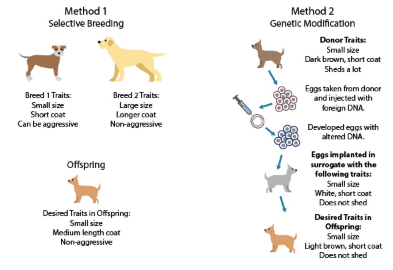
Method 1 uses selective breeding, while Method 2 uses genetic modification.
100
Food, water, space, sunlight, and shelter are all considered what?
Resources.
100
Which biome has very little precipitation and can have extreme differences between daytime and nighttime temperatures?
The desert.
200
Why might a farmer selectively breed plants?
To increase desired traits, such as larger fruits, disease resistance, or better production.
200
What does the word genetic refer to?
Information related to genes/heredity.
200
What is the term used when humans breed dogs for a desired trait?
Humans are using selective breeding/artificial selection.
200
What happens when organisms need the same limited resource?
They compete for the resource.
200
A biome is warm and receives a large amount of rainfall. It also contains many trees. Which biome is it?
The tropical rainforest.
300
What is one disadvantage of selecting for the same desired trait over many generations?
It can reduce genetic variation/genetic diversity.
300
What is the main difference between genetic modification and selective breeding?
Selective breeding chooses organisms with desired traits to reproduce, while genetic modification directly changes genetic information.
300
A breeder wants dogs with a particular type of coat. What are they selecting for?
A desired trait.
300
A drought causes a pond to lose much of its water. How could this affect organisms in the ecosystem?
Organisms may have less water available and may have to compete more for the remaining water.
300
Which biome is characterized by consistently low temperatures and low precipitation?
The tundra.
400
Explain how selective breeding can reduce variation in a population.
Humans repeatedly select organisms with a desired trait to reproduce, so fewer different traits are passed to future generations.
400
A scientist adds a gene to a crop that helps it resist insects. Is this selective breeding or genetic modification? Explain.
Genetic modification because the organism's genetic information is directly changed.
400
A breeder repeatedly chooses dogs with a particular physical characteristic to reproduce. How will this affect the population over generations?
The desired characteristic will become more common.
400
A forest is cleared to build a shopping center. Birds move into a nearby habitat where birds already live. What problem could occur?
The birds may compete with one another for limited resources.
400
A region has four distinct seasons and high amounts of precipitation. Which biome is most likely?
The temperate forest.
500
A farmer repeatedly breeds chickens that produce the most eggs. After many generations, most chickens produce many eggs, but the population has less genetic diversity. Explain why.
The farmer repeatedly selected the same desired trait, causing that trait to become more common while other variations became less common.
500
A farmer wants corn that is resistant to insects. Explain one way selective breeding could be used and one way genetic modification could be used to produce this desired trait.
Selective breeding would involve repeatedly breeding corn plants that naturally show greater insect resistance. Genetic modification would involve directly changing the plant's genetic information to give it the desired trait.
500
Look at the designer dog photo. Explain how humans could have produced dogs with these characteristics through selective breeding. Include what happens to the traits over multiple generations.
Humans choose dogs with desired characteristics and breed them. Their offspring inherit traits from their parents, and repeated selection makes the desired characteristics more common over generations.
500
Heavy rainfall causes a river to flood and wash plants and soil away from the riverbank. Explain how this environmental change could affect ecosystem stability.
The loss of plants and soil can change the habitat and available resources, potentially causing organisms to compete more and making the ecosystem less stable.
500
A region has long, cold winters, low precipitation, small plants, and soil that only thaws near the surface during summer. Identify the biome and explain how the plants are adapted to the environment.
Tundra. Plants are adapted to cold and dry conditions and have characteristics that allow them to survive with a short growing season and shallow/thawed soil.