Lunar Phases 1
Lunar Phases 2
Seasons 1
Seasons 2
Earth's Motions
100
1. The ____________ revolves around the ____________, causing different parts of the moon to be illuminated by sunlight, leading to the phases of the moon.
Answer: Moon, Earth
100
The light we see from the moon is reflected off of the _____________.
Sun
100
The ____________ is tilted on its axis, leading to variations in sunlight intensity at different latitudes, causing ____________.
- Answer: Earth, seasons
100
The tilt of the Earth's axis causes different parts of the Earth to receive varying amounts of ____________ throughout the year, resulting in different seasons.
Sunlight
100
_______ Is the turning or spinning, of a body on it's axis.
Rotation
200
The ____________ of the moon you can see from Earth depends on the positions of the Earth, moon, and sun, creating different ____________ of the moon.
- Answer: portion, phases
200
How many days does a cycle of moon phases take?
29.5 days
200
Longest OR Shortest Day of the Year
Solstice
200
Earth's revolution causes us to experience 1 _______.
Year.
200
______is the motion of a body, such as a planet ir moon, along a path around some point in space.
Orbit or Revolution
300
The force that attracts a body toward the center of the Earth, or toward any other physical body having mass
Gravity
300
How long does it take the moon to orbit Earth?
27.3 days
300
______2 days when there is Equal day and night
Equinox
300
Where is the sunlight hitting most directly during the equinoxes?
The equator.
300
Why do we see the sun rise and set each day?
Earth's rotation.
400
The word used to describe the shape of the moon that is almost full.
Gibbous.
400
The word used to describe the moon increasing in the amount of light from phase to phase.
Waxing
400
The longest day of the year in the Northern Hemisphere occurs during the ____________ solstice when the North Pole is tilted ____________ the sun.
summer, toward
400
According to the diagram, on December 21 in the Northern hemisphere, the sunlight is _________ direct and therefore temperatures are __________.
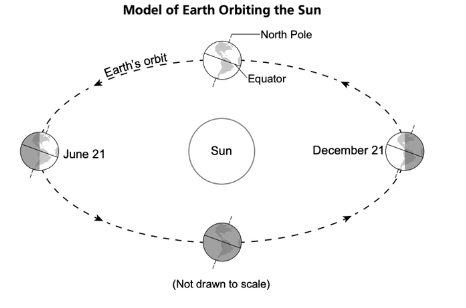
Less, cooler
400
What explains the repeated yearly pattern of constellations that we see from Earth?
Earth is revolving around the Sun.
500
The waning gibbous phase occurs after the ____________ moon and before the ____________ moon.
Answer: full, last quarter
500
The waxing crescent phase occurs after the ____________ moon and before the ____________ moon.
- Answer: new, first quarter
500
The Earth's axial tilt is approximately ____________ degrees, which leads to the changing ____________ on Earth throughout the year.
- Answer: 23.5, seasons
500
During summer in the northern hemisphere, the Sun appears _________ in the sky, and Earth receives more _________ sunlight.
Higher, direct
500
What would happen to the length of a day of Earth's rotation sped up?
The day would be shorter.