Plant Power
Ecosystem Experts
Matter Matters
Energy & Forces
Science Detectives
100
What are three things plants need to live and grow?
Air, water, and light.
100
What is a producer? Give ONE example.
An organism that makes its own food, usually using sunlight. Example: grass or a tree.
100
Is air matter? Explain why or why not.
Yes. Air is matter because it takes up space and has mass/weight.
100
What is the original source of energy in most food chains?
The Sun
100
What is evidence in a scientific investigation?
Observations or data that support or challenge a claim.
200
True or False: Plants must grow in soil to survive.
False. Plants can grow without soil if they receive water, air, light, and necessary nutrients.
200
In the food chain grass → rabbit → fox, which organisms are consumers?
The rabbit and the fox.
200
What is a particle?
A tiny piece of matter too small to see individually.
200
A magnet pulls a paper clip without touching it. What does this tell us about magnetic forces?
Magnetic forces can act at a distance without objects touching.
200
A student wants to test whether sunlight affects plant growth. What ONE variable should the student change?
The amount of light the plant receives.
300
A plant grows from 2 grams to 20 grams, but the dry soil stays at 100 grams. What does this tell us?
The soil was not the main source of new matter. The plant gained 18 grams while the soil's weight/mass stayed the same.
300
What is the role of decomposers in an ecosystem?
They break down dead organisms and waste, returning matter to the environment.
300
Which has particles farther apart: air or liquid water
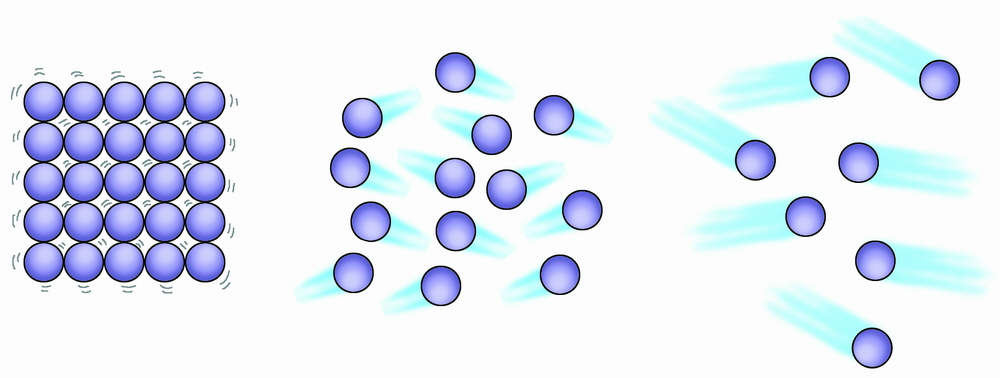
Air. Gas particles are generally farther apart than particles in liquid water.
300
Two identical toy cars are moving. Car A moves faster than Car B. Which car has more energy of motion?
Car A, because it is moving faster.
300
A solar cooker originally takes 50 minutes to cook food. Design A takes 40 minutes and Design B takes 70 minutes. Which design is fastest, and how much faster is it than the original?
Design A. It cooks food 10 minutes faster than the original.
400
A student wants to test whether plants need soil to grow. Name TWO things they should keep the same in their investigation.
Examples: amount of light, amount of water, type of plant, starting plant size, or length of time. Other needed nutrients should be provided in both conditions.
400
A food chain contains grass, a mouse, and an owl. Put them in the correct order and explain what the arrows show.
Grass → Mouse → Owl. The arrows show the direction energy moves when organisms eat other organisms.
400
Water freezes into ice and then melts back into water. Is this a reversible change? Explain.
Yes. It is reversible because the ice can melt back into liquid water without becoming a new substance.
400
A sled speeds up as it moves down a hill. Are the forces acting on it balanced or unbalanced? Explain.
Unbalanced, because the sled's speed is changing.
400
Students test two earthquake-resistant buildings. What should they measure to determine which design works better?
The amount of movement or shaking each building experiences under the same test conditions.
500
A plant receives water and sunlight but no air. Predict what happens to its growth and explain why.
The plant will not grow normally because plants need carbon dioxide from the air to make sugars and build new matter.
500
A new fish species enters a lake and eats large amounts of zooplankton. Predict TWO possible effects on the food web.
The zooplankton population may decrease, and other animals that depend on zooplankton for food may also decrease.
500
A log burns and turns into ash and gases. Is this a reversible or irreversible change? Explain.
Irreversible. Burning creates new substances, and the original wood cannot simply be restored.
500
A sled is stopped at the top of a hill, speeds up going downhill, slows down on flat ground, and stops. Identify when the forces are balanced and unbalanced.
Stopped at the top: balanced. Speeding up: unbalanced. Slowing down: unbalanced. Stopped at the end: balanced.
500
An earthquake-resistant building design reduces shaking but costs more money. What TWO things should an engineer consider when deciding whether it is the best design?
How effectively it reduces shaking and whether its cost meets the project's budget or constraints.