Particle Models
Bath bomb reaction
Evidence of a Chemical Reaction
Properties
Science Knowledge
100
What are the three states of matter?
solid, liquid, and gas
100
What phenomenon did we see in class that creates bubbles & colors the water a different color when combined with it
Bath Bomb
100
A silver nail is left outside for several weeks. Before: shiny, silver-colored metal. After: a dull, reddish-brown coating forms on the nail. Did a chemical reaction occur?
Yes. The color and appearance changed as rust formed, indicating a new substance.
100
This is a characteristic that does not change for a substance, if it does change a reaction may have occurred.
Properties
100
The left side of a chemical equation contains these substances
Reactants
200
This is the name for the smallest piece of matter that cannot be divided or destroyed.
Atom (will accept particle)
200
When the mass decreased as we opened the bath bomb system (removed the lid) what did that tell us about the substance this reaction created?
It was a gas that escaped!
200
A piece of ice melts in a cup. Before: solid water at 0°C. After: liquid water at 10°C. Did a chemical reaction occur?
No. Only the state and temperature changed. The substance is still water.
200
A piece of wood burns and produces ash, smoke, and gases. What chemical property describes the wood's ability to burn?
Flammability
200
The right side of a chemical reactions contain these substances
Products
300
In order for a model to accurately represent a chemical reaction, what does it need to show?
-Equal atoms on both sides of the equation
AND
-Atoms rearranging to make new substances
300
What did we discover were the ingredients that reacted to produce the reaction with the bath bomb?
water, citric acid and baking soda
300
Baking soda and vinegar are mixed. Before: baking soda is a white powder, and vinegar is a clear liquid. After: bubbles form and a gas is released. Did a chemical reaction occur?
Yes. The production of a gas indicates that a new substance formed.
300
Two clear liquids look identical. One floats in water, and the other sinks in water. Which property could help a student distinguish between the liquids?
Density
300
more dense things do this; and less dense things do this
sink; float
400
Everything in the universe are made of these
particles/atoms/molecules
400
When we tested the individual ingredients which ones were insoluble in water?
olive oil, and coconut oil.
400
A student mixes two clear liquids. Before: both liquids are colorless. After: the mixture becomes cloudy and a yellow solid forms. Did a chemical reaction occur?
Yes. A new solid formed, and the change in properties indicates a chemical reaction.
400
Substance A turns into a liquid at 50°C, while Substance B turns into a liquid at 120°C. Both are white solids. Which property would best help a student identify the substances, and why?
Melting point, because different substances can have different characteristic melting points that help identify them.
400
the law of conservation of matter states that matter cannot do these two things
Be created or destroyed
500
Are the number of atoms in the reactants equal to the number of atoms in the products? How many atoms are on each side? 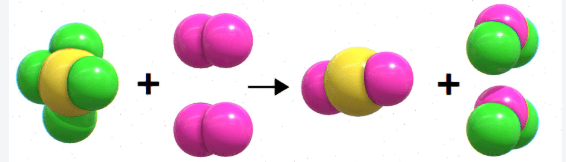
Yes, 9 atoms on both sides.
500
What are the three gases that the bath bomb gas could be?
nitrogen, carbon dioxide, and/or argon
500
A student crushes a piece of chalk into a fine white powder. Before: a hard, white solid. After: a soft, white powder. Did a chemical reaction occur?
No. The chalk changed size and shape, but its chemical composition and properties remain essentially the same.
500
The scientific name for smell is the property of this.
What is odor?
500
This term describes a process where substances atom's rearrange to form new substances.
A chemical reaction