Composite Functions
Domain & Range
Inverse Functions
Function Operations
Odd/Even Functions
Increasing, Decreasing
& Extrema
& Extrema
100
Find f(2).
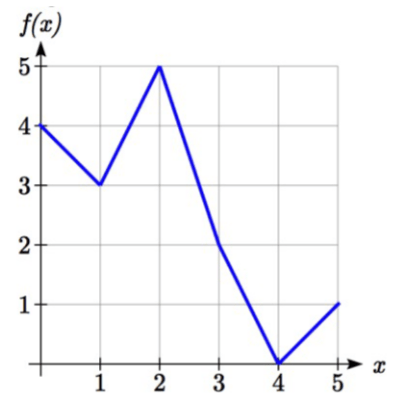
f(2) = 5
100
This domain of this relation, makes it a function. (Yes or No?):
{(7,2), (6,4), (5,2), (8,3), (7,4), (9,5)}
NO, the number seven in the domain maps to two elements in the range.
100
What is the inverse of the point (-1,3)?
Final answer: (3,-1)
100
Given g(x) = x + 2
What is g(2)?
g(2) = 4
100
Is this function odd or even?
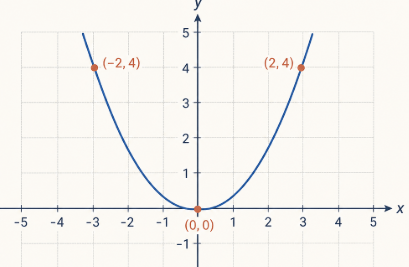
Even (has symmetry along the y-axis)
100
Does this graph have an absolute or relative minimum? If so, what are they?
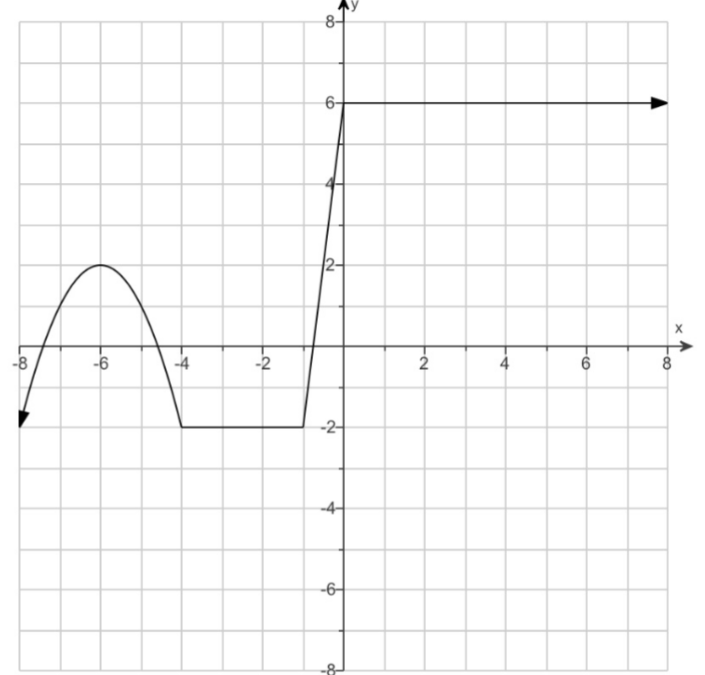
This graph has neither a relative or absolute minimum.
200
Find f(g(6)).
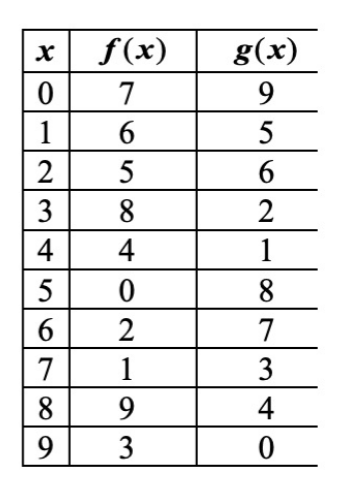
f(g(6)) = f(7)
f(7) = 1
Final answer: f(g(6)) = 1
200
What is the range of this function:
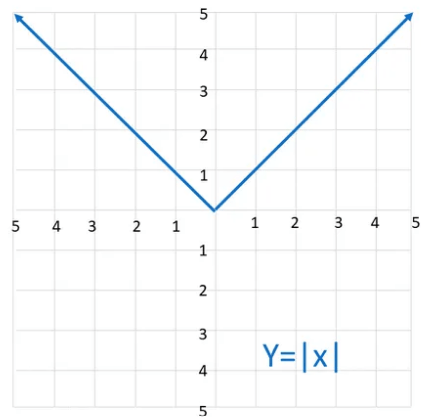
(0, ∞)
200
Find the inverse of the function: f(x) = 2x
This inverse is: f-1(x) = x/2
200
Given f(x) = x - 6
What is f(a2+1)?
f(a2+1) = (a2 +1)- 6
Final answer: f(a2+1) =a2-5
200
Is this function odd or even?
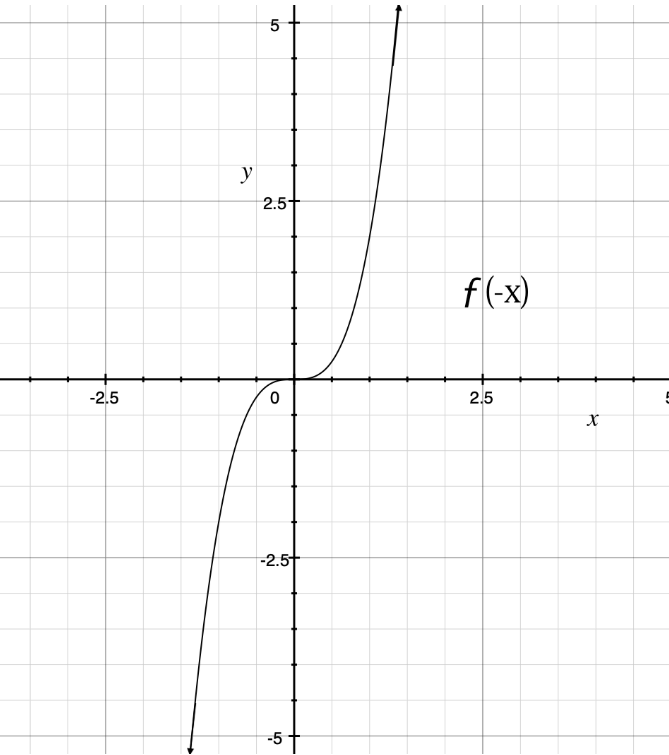
Odd (symmetric about the origin)
200
Does this graph have an absolute maximum?
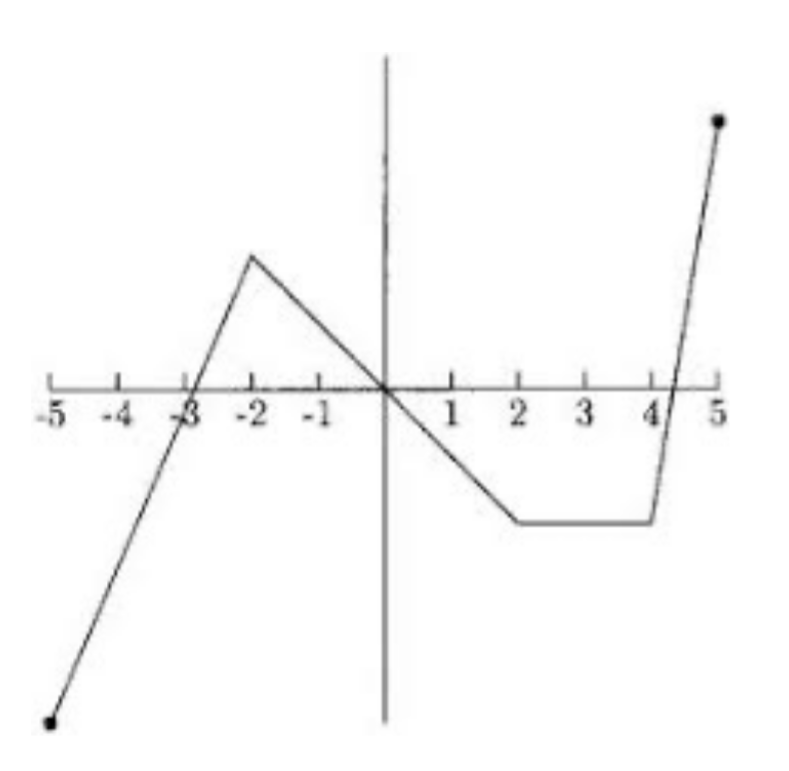
Yes
300
Given: f(x) = -5x+6 and g(x) = 2x2-x
Find f(g(x)).
f(g(x)) = -5(2x2-x)+6
Final answer: f(g(x)) = -10x2 + 5x + 6
300
What is the domain AND range of this function:
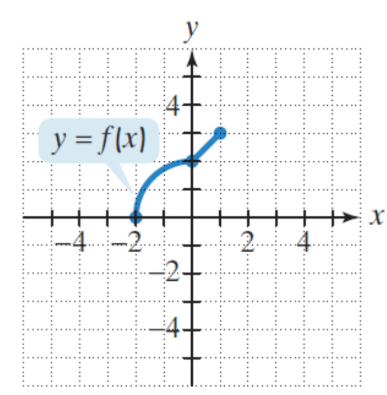
Domain: [-2,1]
-2 ≤ x ≤ 1
Range: [0,3]
0 ≤ y ≤ 3
300
Given the function: f(x) = {(-1,2), (4,7), (6,11), (8,9)}
What is the domain of the inverse function?
The domain of the inverse function is:
{2,7,9,11}
300
Given, f(x) = 3x - 5 and g(x) = x2
What is (f+g)(x)?
f(x)+g(x)
3x-5 + x2
Proper form: x2+3x-5300
Determine if this function is odd or even?
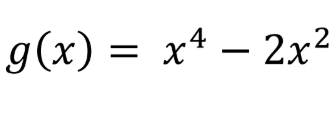
This is an EVEN function.
300
On what interval(s) is this graph decreasing?
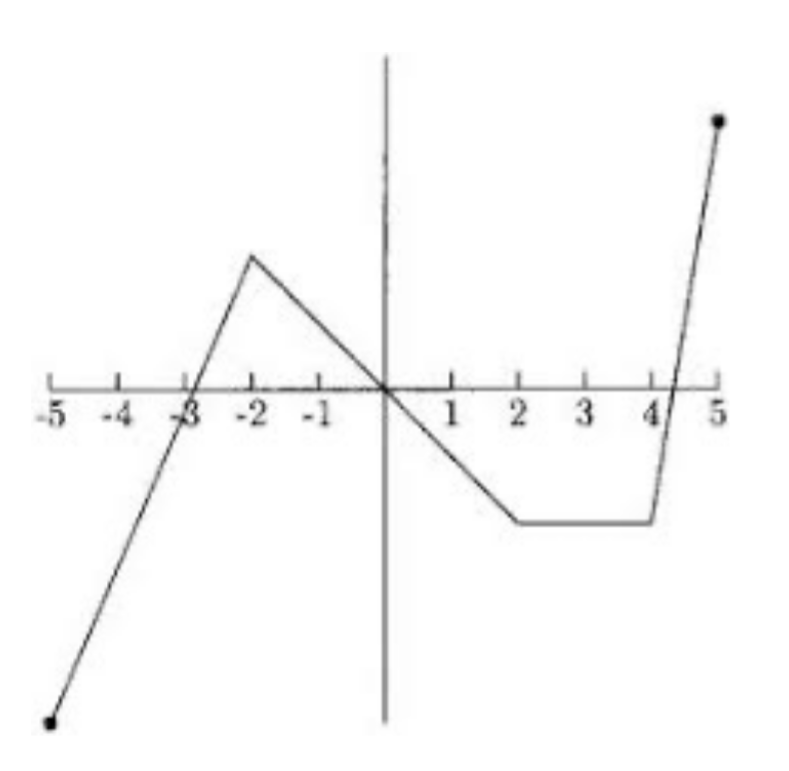
The graph decreases on the interval (-2,2).
400
Find g(f(-1))
f(x) = 1/x+2, g(x) = 2x-5
g(f(x)) = 2(1/x+2)-5
Final answer: -3
400
What is the domain of this function:
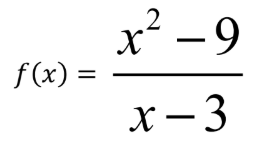
All real numbers, x ≠ 3
400
Find the inverse of the function: g(x) = 3x - 9
Simplify completely.
Final answer: f-1(x) =
x/3+3
400
Given f(x) = 3x -5 and g(x) = x2
What is (f·g)(x)?
f(x)*g(x)
(3x-5)(x2)
Final answer: 3x3-5x2
400
Determine if this is an even or odd function.
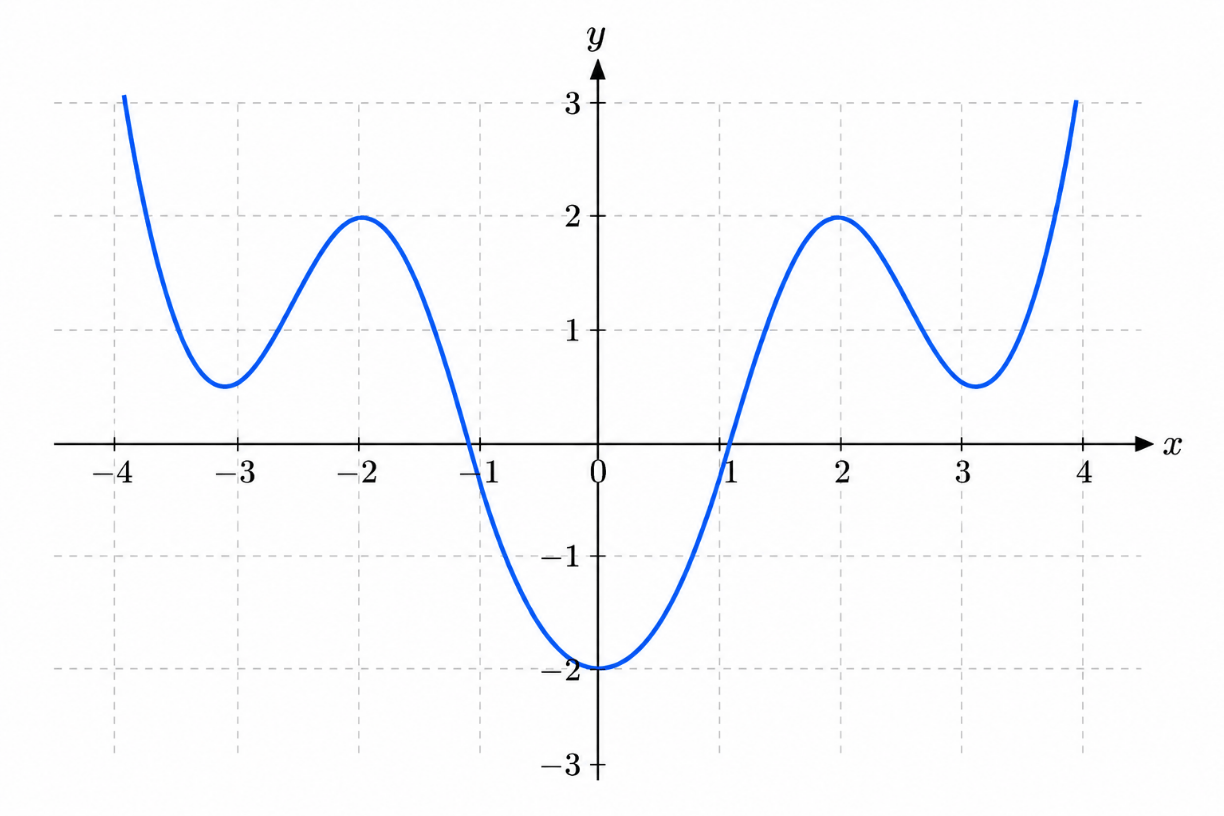
Even function (y-axis symmetry)
400
Does this graph have absolute or relative maxima? If so, what are they?
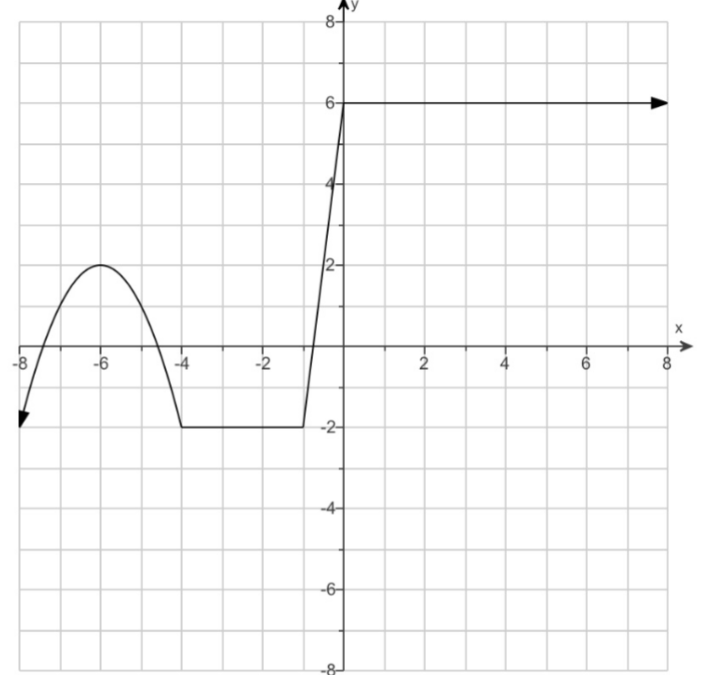
Does NOT have absolute maxima.
DOES have relative/local maximum at (-6,2)
500
Given: f(x) = ½ + x,
g(x) = 1/x2- 2x, h(x) = 5x-1
Find f(h(½)) and h(g(-3)).
f(h(x)) = ½ + 5x - 1
Final answer 1: f(h(½)) = 2
h(g(x)) = 5((1/x2) - 2x) - 1
Final answer 2: h(g(-3)) = 29.56
500
What is the domain AND range of this function:
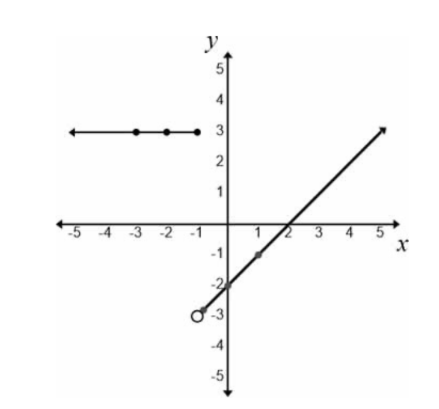
Domain: (-∞ , -1] and (-1, ∞ )
x≤ -1 and x > -1
Range: (-3, ∞)
y > -3
500
Verify that the two functions are inverses:
f(x) = 2x + 6 and g(x) = 1/2x - 3
Yes they are inverses.
500
Given p(n) = n2+n+1.
Find p(a-3).
p(a-3) = (a-3)2 + (a-3) + 1
p(a-3) = a2-6a+9 + a-3 + 1
p(a-3) = a2 - 5a + 7
500
Determine if this function is odd or even.
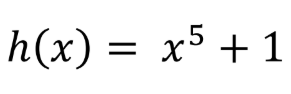
This function is NEITHER. (No symmetry about the y-axis or origin)
500
On what interval(s) is the graph increasing?
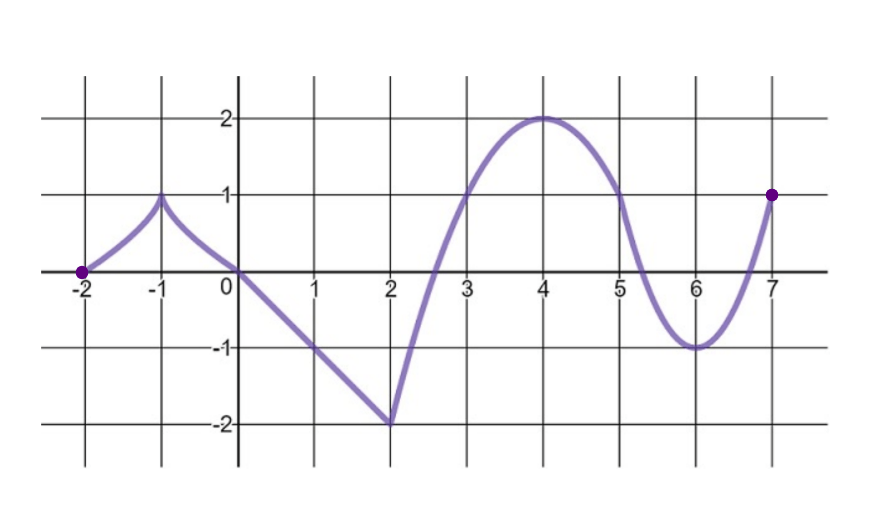
The graph is increasing on three intervals:
(-2,-1) U (2,4) U (6,7)
600
Given: f(x) = 2x, g(x) = x2-2x,
h(x) = 1/x^2
Find g(h(f(-6))).
g(h(f(x))) = ¹⁄₆₄x⁴ − ¹⁄₄x²
Final answer: g(h(f(-6))) = -0.0069..
600
Find the domain of this function:
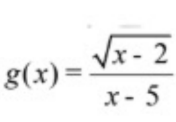
All real numbers, x ≥ 2, x ≠ 5
600
Show that each function is an inverse of one another:
f(x) = 5x - 8 and g(x) = (x+8)/5
Show Ms. Sanderson your work :)
600
Given C(t) = ¹⁄t + 2 and N(t) = t2 + t + 1
Find (C-N)(2).
C(t) - N(t)
(¹⁄t + 2 ) - (t2 + t + 1)
¹⁄t + 2 - t2 - t - 1
(C-N)(2) = -4.5
600
Determine if this is an odd or even function.
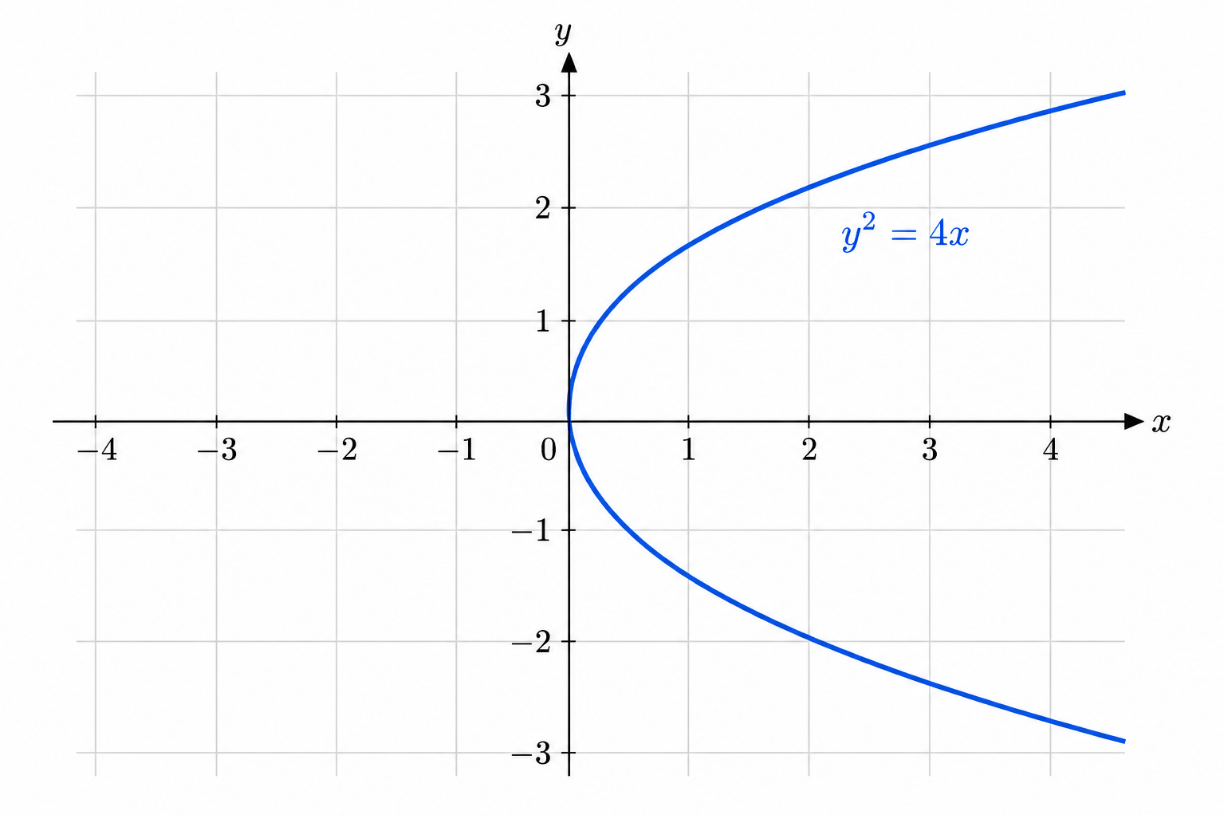
NEITHER (no symmetry about the y-axis or origin)
ITS NOT A FUNCTION.
600
Are there any relative or absolute minima and maxima in this graph? If so, what are they?
When is the graph constant?
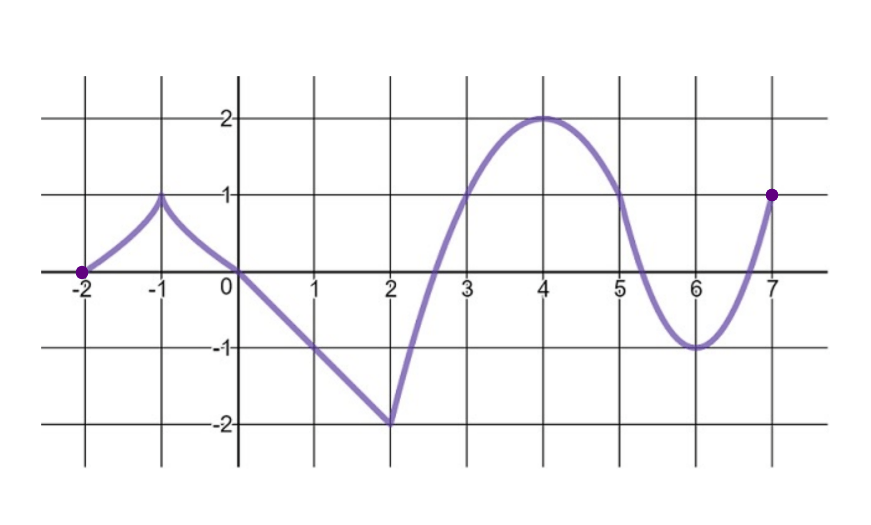
There are relative AND absolute minima and maxima.
Relative minimum: (6, -1)
Absolute minimum: (2, -2)
Relative maximum: (-1, 1)
Absolute maximum: (4, 2)
The graph is NEVER constant (flat).