Label It!
Organelle Functions
Levels of Organization
Body Systems
Cells
100
What is shown in letters A & I?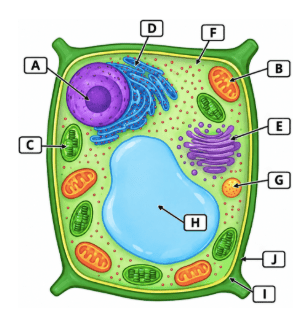
A - Nucleus; I - cell membrane.
100
A cell needs to produce proteins to help it grow and repair itself. Which organelle is responsible for making proteins?
Ribsomes
100
What is the smallest level of organization?
Cell
100
A student touches a hot pan and quickly pulls their hand away. Which organ helps process information and coordinate this response? What organ system does the organ belong to?
Brain; Nervous System
100
A scientist observes two cells. Cell A has chloroplasts, a cell wall, and a large central vacuole. Cell B does not have these structures. What can the scientist conclude about the two cells? Use evidence to support your answer.
Cell A is a plant cell, and Cell B is most likely an animal cell. The chloroplasts, cell wall, and large central vacuole are characteristic plant cell structures.
200
What is shown in letters J & C?
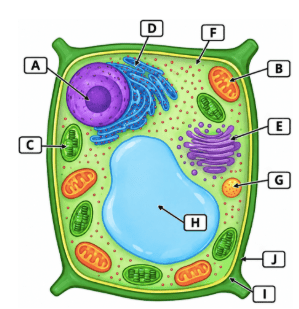
J - Cell Wall; C - Chloroplast
200
A cell makes a protein, but it needs to be modified, sorted, and packaged before being transported. Which organelle performs this job?
Golgi Apparatus
200
The stomach contains different tissues working together to digest food. What level of organization is the stomach?
Organ
200
The stomach contains different types of tissues that work together to break down food. What level of organization is the stomach, and what larger level does it belong to?
The stomach is an organ. It belongs to the digestive system, an organ system.
200
A cell needs to release usable energy from stored food. A student suggests that the nucleus performs this job because it controls the cell. Is the student correct? Explain which organelle actually performs this function.
No. Mitochondria release usable energy from food. The nucleus stores DNA and helps direct cell activities.
300
What is shown in letters B & H?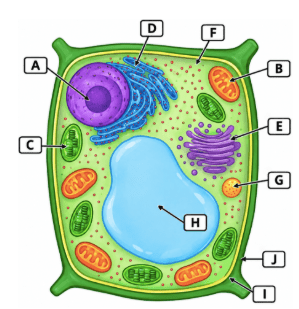
B - Mitochondria; H - Large Central Vacuole
300
A plant cell is not receiving enough sunlight. Explain why this could affect its ability to make food. Name the organelle involved.
Chloroplasts need light energy for photosynthesis. Without enough light, the cell will have difficulty producing food (glucose).
300
A group of similar muscle cells work together to perform the same job. What level of organization do they form?
Tissue
300
A scholar says that blood and blood vessels are the same level of organization. Explain why the scholar is incorrect.
Blood is made of red blood cells working together. The blood vessels are an organ made of different tissues working together.
300
A plant cell has a strong outer layer and a thin boundary just inside it. Explain why the cell needs both structures instead of just one.
The cell wall provides support and protection, while the cell membrane controls what enters and leaves the cell.
400
What is shown in letters D & E?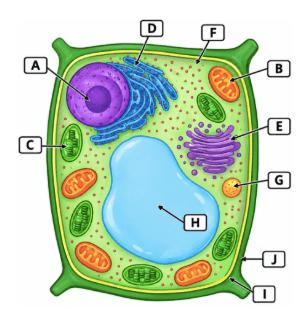
D - Endoplasmic Reticulum; E - Golgi Apparatus
400
Which organelle is responsible for breaking down unwanted materials using enzymes in the cell?
Lysosome
400
Put these structures in order from smallest to largest: brain, nerve cell, human, nervous tissue, nervous system.
Nerve cell → Nervous tissue → Brain → Nervous system → Human
400
A student identifies the brain, heart, and small intestine. Match each organ to its correct body system and explain why each belongs there.
Brain—nervous system; heart—circulatory system; small intestine—digestive system. Each organ performs a specialized function within its system.
400
A scientist observes a cell structure that captures energy from sunlight. Which organelle should the scientist identify, and what process does it help perform?
Chloroplast; photosynthesis.
500
What is shown in letters F & G?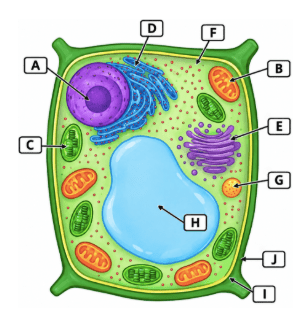
F - Cytoplasm; G - Lysosome
500
A plant cell is placed in an environment where it cannot take in enough water. Which organelle's function would be most directly affected, and how could this impact the cell?
The vacuole - stores water and nutrients. Without enough stored water, the plant cell may lose its firmness and become less rigid.
500
A student claims that an organelle and an organ are the same because they both perform specialized jobs. Explain why this claim is incorrect using an example of each.
An organelle is a structure inside a cell, such as the nucleus. An organ is made of different tissues working together, such as the heart.
500
A person's brain is injured, damaging several types of nervous tissue. Explain how this injury could affect the nervous system and the organism.
The brain may not process or send messages correctly. This can affect movement, thinking, senses, and the organism's ability to respond to its environment.
500
Which is the chloroplast? Mitochondria?

Left -Mitochondria; Right - Chloroplast