Discovery of Cells
Organelles
Cell Membrane
Membrane Transport
Pictures and Graphs
100
Cells without a nucleus are called this.
Prokaryotes
100
This organelle is found in both plant and animal cells. It is responsible for producing usable energy (from sugar) for the cell.
Mitochondria
100
This is the organelle that controls what enters and leaves the cell and it responsible for maintaining homeostasis.
Cell Membrane
100
The movement of water across a membrane from an area of high to low concentration is called what?
Osmosis
100
 This picture is showing what type of active transport?
Exocytosis
200
Who discovered and gave cells their name? We credit him for giving us "Calls are the basic unit of life" in the traditional cell theory.
Robert Hooke
200
These two structures cannot be found in an animal cell, but you can find them in a plant cell. They are responsible for structural support and photosynthesis.
Cell wall and chloroplasts
200
True or False:
In the phospholipid bilayer, phospholipids are arranged with their hydrophobic heads on the outside and their hydrophilic tails on the inside
False
200
Unlike active transport, passive transport does not require this.
Energy
200
 These plant cells are happily filled with water, giving them plenty of turgid pressure. What type of state can we say the plant is in?
Hypotonic
300
This scientist invented the first practical microscope. He used it to observe blood cells and microorganisms.
Anton Von Leeuwenhoek
300
Microtubules and microfilaments are long proteins that make up which organelle? It provides all cells with a structural framework of support.
Cytoskeleton
300
When passive transport moves small molecules through the membrane by diffusion, they move from an area of ____ to ____ concentration.
High to Low
300
When water diffuses across the membrane it will always move to an area of _________ solute concentration.
Higher (this is really important)
300
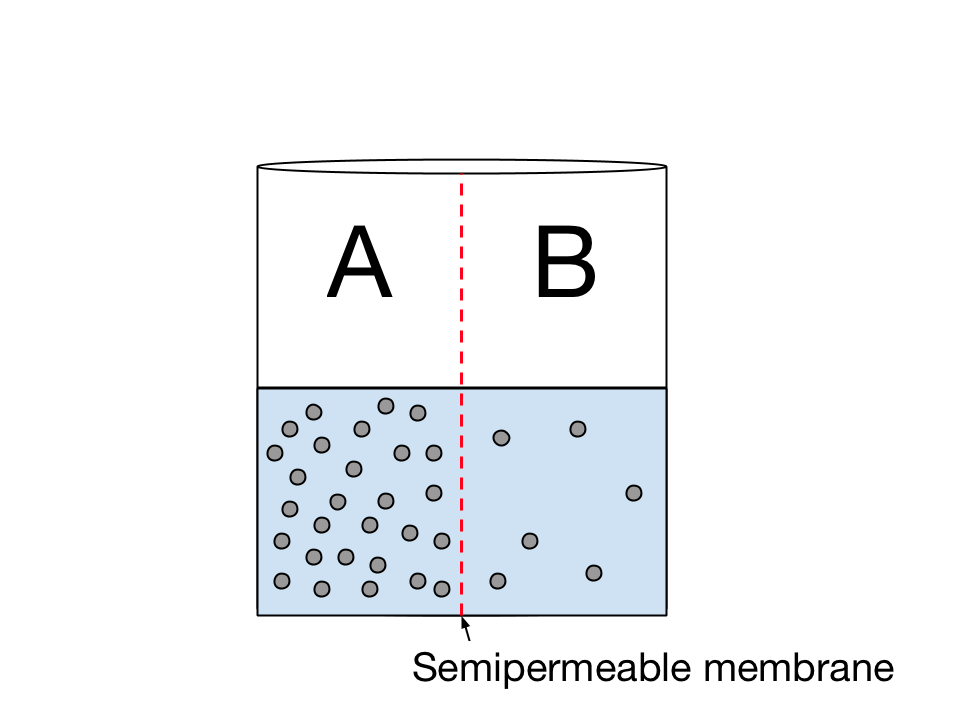
The light blue presents water. The grey circles represent a molecule that cannot pass through the membrane. Due to osmosis water will flow from ______ to _____.
B to A
400
Who are the two scientists that we credit with the discovery that all living things are made of cells?
Schleiden and Schwann
400
This organelle is found only in animal cells. It contains enzymes that breaks down and cleans the cell.
Lysosome
400
This is how we describe the cell membrane because it allows some molecules to pass through, while blocking the entrance of others.
Semi-permeable (Selective Permeability)
400
This is the movement of large molecules against the concentration gradient (from low to high).
Active Transport
400
 What type of solution is the cell in?
Isotonic
500
Rudolf Virchow is credited with which part of the traditional cell theory?
All cells come from pre-existing (other) cells
500
The Rough ER is covered in these tiny organelles, giving it a bumpy texture but also allowing it to synthesize proteins.
Ribosomes
500
This structure requires energy to move large molecules across the cell membrane against the concentration gradient.
Protein Pumps
500
In the grocery store, vegetables are misted with cold water. Using what you know about osmosis, describe why that is.
The water flows into the vegetables making them bigger.
500
 This image is showing us blood cells in a hypertonic solution. Why does the water flow out of the cells?
There is more solute outside the cell.