Anatomical Terms
Musculoskeletal System
Labelling Bones
Neuromuscular System
Reflexes & Proprioception
100
The standard position used to describe the locations and relationships of anatomical parts on your body is called what?
The Anatomical Position
100
The degenerative condition that involves low bone mass and deterioration of the bone tissue is called ___?
Osteoporosis
100
Which bone is labelled "A"? Options: Maxilla, Nasal bone, Mandible, or Zygomatic bone
Nasal bone
100
Fill in the blank:
The neuromuscular system is a general term referring to the complex linkages between the muscular system and the _____ system
nervous
100
What is one example of a reflex?
Answers will vary
200
What term would I use to describe the front surfaces of the body, or to describe something as "in front of" in relation to structures within the body?
Anterior
200
Name one place in the body where you may find long bones.
Arms & Legs
200
Label the 4 regions of the vertebral column. Options: Lumbar region, cervical region, sacral & coccygeal region, thoracic region
Top to bottom: Cervical, Thoracic, Lumbar, S&C
200
The motor neuron, its axon (pathway), and the muscle fibres it stimulates are together referred to as what?
Motor unit
200
Reflexes that involve activation of smooth muscle, cardiac muscle, and glands (ex: regulating digestion, sweating, blood pressure) are mediated by which division of the nervous system?
autonomic
300
Flexion and extension when performing a bicep curl occurs in what plane of movement?
The sagittal plane
300
Name the 3 types of muscle tissue. Which one(s) are involuntary?
Smooth muscle (I)
Cardiac muscle (I)
Skeletal muscle (V)
300
Label the true ribs, false ribs, and floating ribs
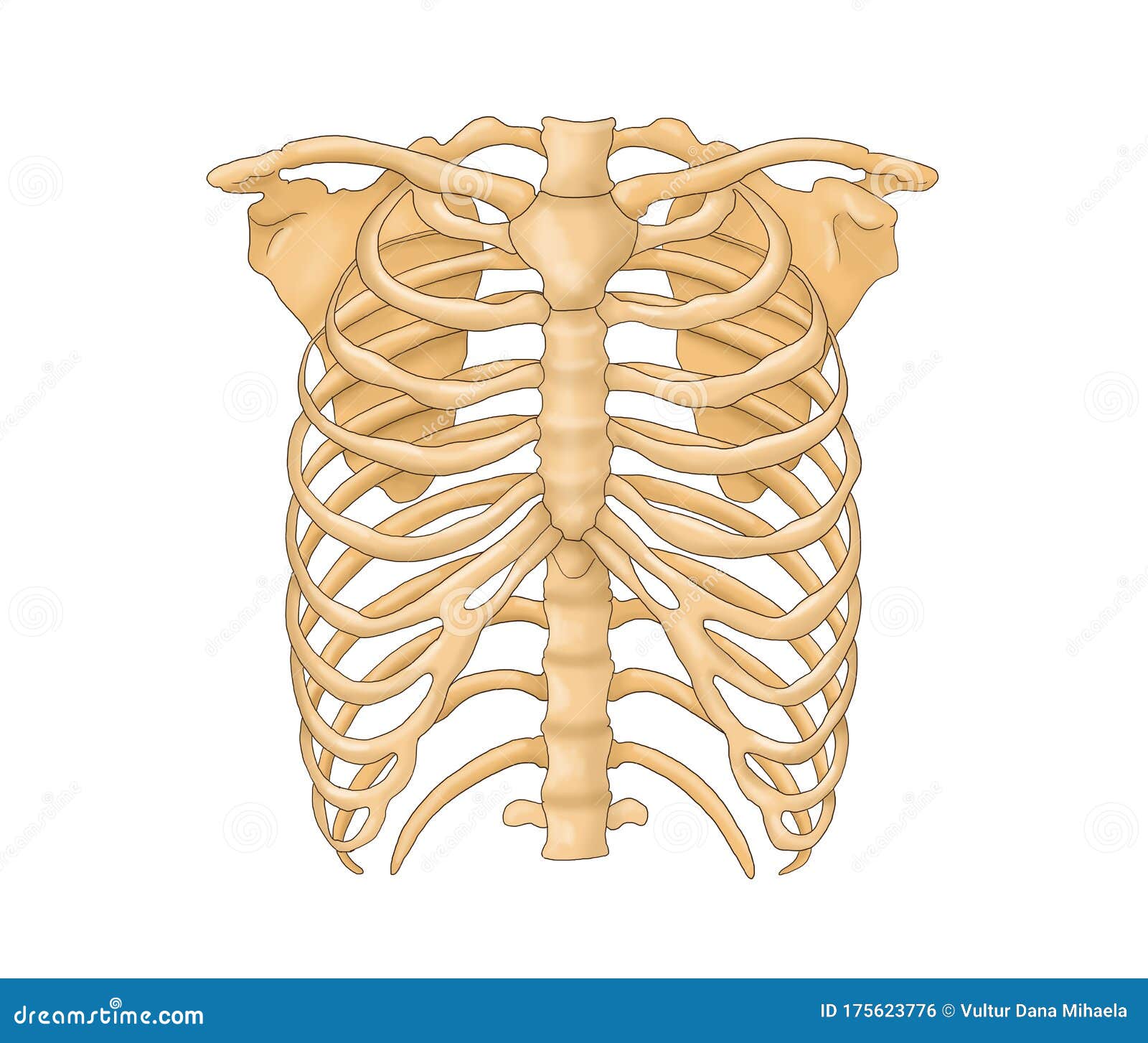
Top to bottom: first 7 are true, next 3 are false, 2 that aren't connected are floating
300
List a movement that may be produced from a small motor unit and one that may be produced by a large motor unit
answers will vary
ex: small - blinking/movements of eye
large - moving quads
300
What is proprioception?
A person’s ability to sense the position, orientation, and movement of the body
400
Fill in the blank:
The point at which the sagittal, frontal, and transverse planes intersect is called the _____
Centre of gravity
400
In one minute, provide 1 example of a concentric contraction, eccentric contraction, and isometric contraction.
Answers will vary
C - muscle shortens
E - muscle lengthens
I - no change in muscle length
400
Identify the carpals, phalanges, and metacarpals. Specify distal, middle and proximal where need be.
Purple - carpals
yellow - metacarpals
green, blue, red - phalanges (green = proximal phalanx, blue = middle phalanx, red = distal phalanx)
400
At the molecular level, the “trigger mechanism” for the sliding filament process is the release of what?
Calcium ions
400
Muscle spindles are sensory receptors within a muscle fibre that primarily detect what?
Changes in muscle length
500
Label the following diagram using anatomical terms:
1. posterior 2. anterior 3. inferior 4. superior 5. proximal 6. distal 7. deep 8. superficial 9. medial 10. lateral
500
What are the 5 main functions of the skeletal system?
1. provide structural support
2. protect vital organs
3. growth centre for cells
4. reserve for minerals
5. plays major role in movement
500
Match the number to the following bones: Sacrum, Coccyx, Ilium, Symphysis pubis, Acetabulum.
Sacrum - 5
Coccyx - 6
Ilium - 2
Symphysis pubis - 7
Acetabulum - 10
500
Briefly describe the process of muscle contraction aka “excitation-contraction coupling”
The electrical signal that begins the process originates in the spinal cord and moves along the nerve axon to the neuromuscular junction
The signal is then transmitted down into the muscle fiber through tubular membranes
Calcium ions are released into the sarcoplasm
The interaction of calcium with the proteins troponin and tropomyosin removes the obstacles to actin-myosin interaction
The “coupling” effect is then allowed to unfold and the muscle contraction is the result
500
List and describe the 5 parts to a reflex arc.
The receptor, which receives the initial stimulus. Ex: A pinprick to the skin
The sensory (or afferent) nerve, which carries the impulse to the spinal column or brain
The intermediate nerve fibre (the adjustor or interneuron), which interprets the signal and issues an appropriate response
The motor (or efferent) nerve, which then carries the response message from the spinal cord to the muscle or organ
The effector organ itself (ex: a skeletal muscle), which carries out the response (such as removing the hand or leg away from danger)