Atoms
Properties of Matter
States of Matter
Nature of Science
Periodic Table
MISC
100
What is the smallest unit of an element that still has the properties of that element?
Atom
100
A student is trying to identify an unknown liquid by examining its color, mass, volume, and boiling point. Which of these physical properties would be most useful for identifying the unknown liquid? And why?
Boiling point: that property is independent of the sample size of the liquid. All the other properties mentioned are dependent on the size of the liquid.
100
What is another way to describe a substance's temperature in terms of its particles?
The average kinetic energy of the particles.
100
What is the main purpose of a scientific theory: to explain why something happens or simply describe what happened?
To explain why something happens.
100
What are the horizontal rows and vertical columns on the periodic table called?
Horizontal = periods; Vertical = groups
100
Which organelle contains DNA and controls most of a cell's activities?
Nucleus
200
Which two subatomic particles account for most of an atom's mass, and where are they located?
Nucleus; Protons & Neutrons
200
Corn syrup has a density of 1.33 g/mL. A plastic cube has a mass of 18 g and a volume of 15 cm³. What will happen when the cube is placed in the corn syrup? Explain why.
The cube will float because its density is 1.2 g/cm³, which is less than the density of the corn syrup.
200
The particles of a substance are very far apart and move freely in all directions. What state of matter is being described?
Gas
200
Scientists have accepted a scientific theory for many years. New technology allows them to collect evidence that does not completely agree with the theory. What should scientists do?
Modify or revise the theory based on the new evidence.
200
Carbon has an atomic number of 6 and Nitrogen has an atomic number of 7. Why does Nitrogen come immediately after Carbon on the periodic table?
Because the periodic table is arranged in order of increasing atomic number.
200
Which TWO body systems work together to remove wastes from the body?
Respiratory and excretory systems
300
What determines the identity of an atom?
# of protons
300
A mixture contains sand, salt, and steel. A student wants to remove the steel without changing any of the substances. Which physical property could the student use to separate the cobalt from the mixture?
Magnetism
300
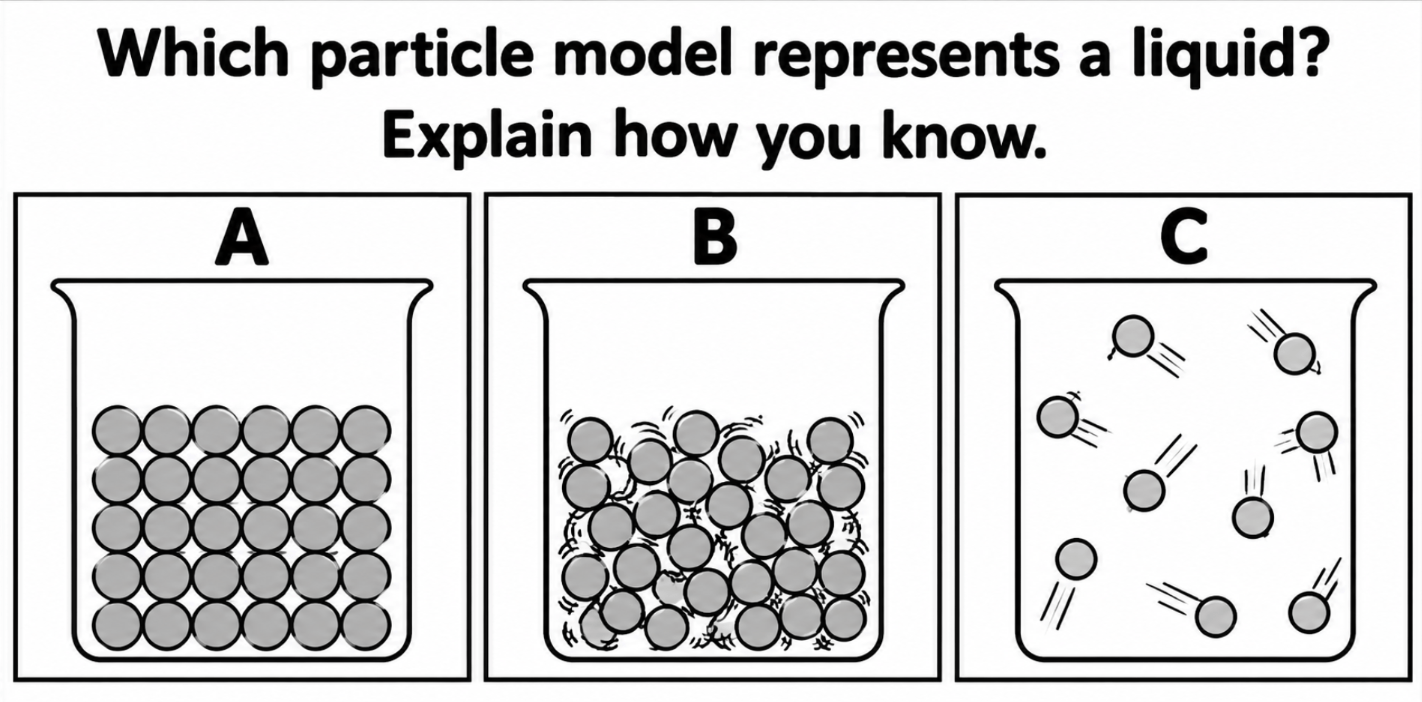
B; the particles are close together but not in fixed positions, allowing them to move/slide past one another.
300
What words can help identify the variables on a graph, and what do they mean?
DRY - Dependent variable on the y-axis
MIX - Independent variable on the x-axis
300
An element has an atomic number of 12. Identify the element, determine the number of protons it has, and state its group and period on the periodic table.
Magnesium (Mg)
12 protons
Group 2
Period 3
300
A book is sitting on a shelf above the floor. What type of energy does the book have because of its position?
Potential energy
400
What are the two subatomic particles found in the nucleus?
Protons & Neutrons
400
What is the difference between mass and weight?
Mass doesn't change. Weight changes; depends on gravity.
400
A sample keeps its own shape when it is moved from one container to another. What can you infer about the arrangement and motion of its particles?
The particles are tightly packed together and vibrate in fixed positions.
400
One class investigates how water temperature affects how quickly sugar dissolves. The next day, a different class follows the same procedures to see whether they obtain similar results. What scientific process is the second class performing?
Replication
400
What is unique about the properties of the elements that border the staircase on the periodic table?
They have properties of both metals and nonmetals.
400
What type of organism makes its own food and provides the original source of energy for consumers in a food web?
Producer
500
What makes an atom's charge neutral?
# of protons equal # of electrons
500
A student breaks a large piece of an unknown material into two smaller pieces. Which TWO properties would remain the same for all three pieces: mass, volume, density, or boiling point?
Density and boiling point
500
A cup of juice is placed in a freezer. As its temperature decreases, what happens to the average kinetic energy and movement of its particles?
The particles' average kinetic energy decreases, so they move more slowly.
500
A student investigates whether the amount of salt added to water affects the water's boiling point. Identify the independent variable and the dependent variable.
IV: Amount of salt added
DV: Boiling point of the water
500
Which pair of elements would you expect to have the most similar properties: Sodium (Na) and Potassium (K), Sodium (Na) and Magnesium (Mg), or Sodium (Na) and Chlorine (Cl)? Explain why.
Sodium and Potassium, because they are located in the same group on the periodic table. Elements in the same group have similar properties.
500
Water at the bottom of a pot is heated. The warmer water rises while cooler water sinks, creating a circular movement. What type of heat transfer is occurring?
Convection
600
Name all three subatomic particles and give the electrical charge of each.
Proton - positive
Electron - negative
Neutron - No charge/neutral
600
A metal bolt has a mass of 54 g. The water level in a graduated cylinder is initially 30 mL. After the bolt is completely submerged, the water level rises to 36 mL. What is the density of the bolt?
9 g/mL
600
Two samples of the same substance are at different temperatures. Sample A is 20°C and Sample B is 75°C. Which sample has particles with the greater average kinetic energy, and how would their motion compare?
Sample B. Its particles have greater average kinetic energy and therefore move faster.
600
A student wants to determine whether the amount of fertilizer affects plant growth.
Plant A: 0 g fertilizer + 100 mL water each day
Plant B: 5 g fertilizer + 100 mL water each day
Plant C: 10 g fertilizer + 200 mL water each day
What problem with the investigation could prevent the student from determining whether fertilizer caused differences in plant growth?
The amount of water was not kept constant. Plant C received more water, so two variables changed between some of the plants.
600
Lithium (Li), Sodium (Na), Potassium (K), and Calcium (Ca) are shown on the periodic table. Which element would you expect to have properties that are LEAST similar to the other three? Explain why.
Calcium (Ca) because Li, Na, and K are in the same group, while Ca is in a different group.
600
Two heterozygous parents for a trait are crossed: Bb × Bb. What are the THREE possible genotypes their offspring could have?
BB, Bb, and bb
700
A neutral atom has an atomic number of 17 and a mass number of 35. Identify the element and determine the number of protons, electrons, and neutrons.
Chlorine (Cl) — 17 protons, 17 electrons, and 18 neutrons.
700
A hollow plastic ball and a solid rubber ball have the same mass. When placed in water, the plastic ball floats while the rubber ball sinks. What can you conclude about the volumes of the two objects? Explain your reasoning.
The plastic ball has a greater volume. Since the objects have the same mass, the object with the greater volume has the lower density. Therefore, the plastic ball is less dense than the rubber ball.
700
A student heats a liquid until it changes into a gas. Describe TWO changes that occur to the particles as energy is added.
The particles move faster and spread farther apart.
700
A scientist uses a model of an atom to show the location of protons, neutrons, and electrons. Give ONE benefit and ONE limitation of using this model.
Benefit: It helps scientists/students visualize parts of an atom that are too small to see directly.
Limitation: The model does not show exactly what a real atom looks like, its true scale, or exactly how its particles behave.
700
A newly discovered element is placed in the same group as F, Cl, and Br. What could scientists predict about the new element based on its location?
It should have similar properties because elements in the same group have similar properties
700
Put these classification levels in order from BROADEST to MOST SPECIFIC:
Class, Species, Domain, Kingdom, Genus, Phylum, Order, Family
Domain → Kingdom → Phylum → Class → Order → Family → Genus → Species