Who's Who
Terms
Resistance
British Blunders
Other
100
Author of the Declaration of the Independence
Thomas Jefferson
100
To stop buying goods as a form of protest
Boycott
100
The exact moment when the Revolutionary War began
"the shot heard 'round the world"
100
Tax on paper goods (1765)
Stamp Act
100
Bostonians committed this famous act of protest at Griffin's Wharf
The Boston Tea Party
200
Royal Governor of Boston after the Boston Tea Party
Thomas Gage
200
A colonist who was sympathetic to the British
Loyalist
200
The British regular troops retreated down this during the Battle of Lexington and Concord
Battle Road
200
Written by John Dickinson, this document sought peace with Great Britain after the Battle of Lexington and Concord
The Olive Branch Petition
200
Who did the Declaration of Independence blame for the Colonies' problems?
King George III
300
Son of Liberty, Doctor, Spymaster, Roxbury Latin alumnus, sent Paul Revere on his famous midnight ride
Dr. Joseph Warren
300
An elite group of militia, known for being ready at a moments notice
Minutemen
300
This group was tasked by the 2nd Continental Congress to create the Declaration of Independence
The Committee of Five
300
Five colonists were killed in during this incident on March 5th, 1770
The Boston Massacre
300
The First and Second Continental Congresses were held in this city
Philadelphia, Pennsylvannia
400
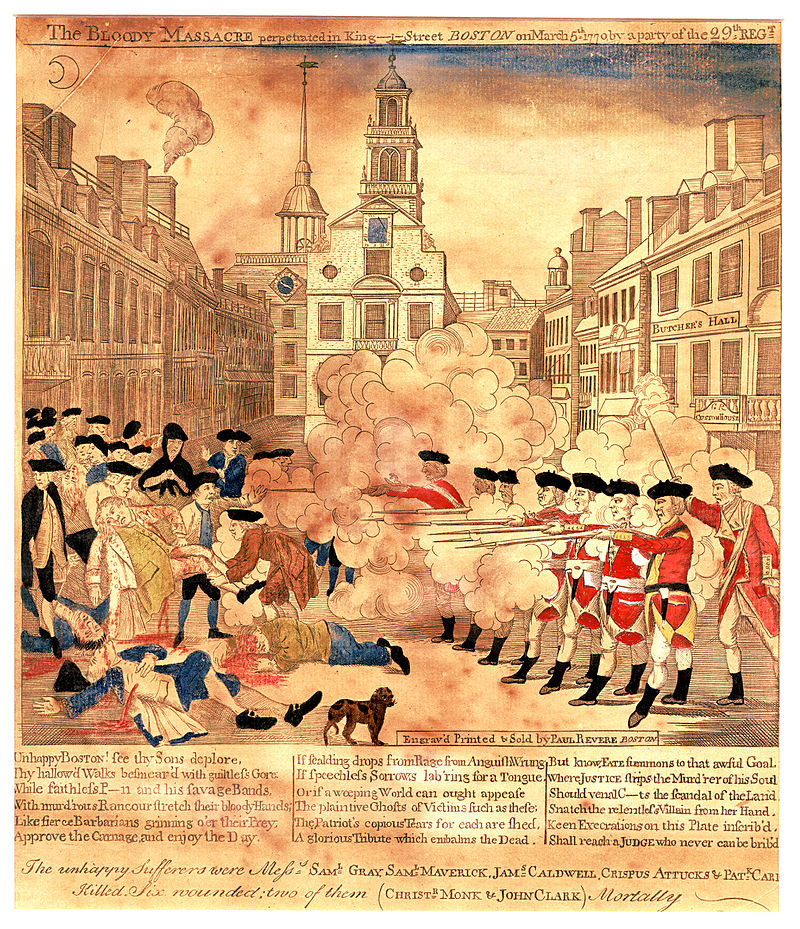
Paul Revere
400
A sculpture or model of a human body used to depict people as a form of protest
Effigy
400
The man who alerted Concord that "the British were coming"
Samuel Prescott
400
The Tea Act was created in 1773 to save this failing company
The British East India Company
400
The famous location of the first Stamp Act riot in Boston, leading to the destruction of the homes of Thomas Hutchinson and Andrew Oliver
The Liberty Tree
500
Captain of the Dartmouth
Francis Rotch
500
Information that is deliberately biased, with the goal of influencing its audience to adopt a certain viewpoint
Propoganda
500
The secret Massachusetts government, created by the Sons of Liberty after the Massachusetts Government Act
The Massachusetts Provincial Congress
500
This law permitted British Troops to house themselves in the property of American colonists
The Quartering Act
500
This group was created by Samuel Adams to increase communication between the colonies
Committees of Correspondence