Chemical Equilibrium
Equilibrium Disturbances
Kc, Q, and Ksp
Acids and Bases
pH, Ka, Kb and Buffers
Indicators and Volumetric Analysis
Redox and Galvanic Cells
Electrolytic Cells
100
Discriminate between an open system and a closed system.
An open system can exchange both matter and energy with its surroundings. A closed system can exchange energy but not matter with its surroundings.
100
Predict the effect of adding more Hydrogen gas to the following equilibrium.
N2(g) + 3H2(g) <=> 2NH3(g)
The equilibrium shifts to the right to consume some of the added (H2), increasing the equilibrium concentration of (NH3).
100
Determine the equilibrium-law expression for:
2SO₂(g) + O₂(g) ⇌ 2SO₃(g)
Kc = [SO₃]² / ([SO₂]²[O₂])
100
Identify the Brønsted–Lowry definition of an acid and a base.
An acid is a proton donor. A base is a proton acceptor.
100
Calculate the pH of 2.5 × 10⁻³ mol L⁻¹ hydrochloric acid.
[H⁺] = 2.5 × 10⁻³ mol L⁻¹
pH = −log(2.5 × 10⁻³)
pH = 2.60
100
Discriminate between the equivalence point and the end point of a titration.
The equivalence point occurs when the reactants are present in their stoichiometric ratio. The end point is the observed indicator colour change.
100
State what happens to electrons during oxidation and reduction.
Oxidation is the loss of electrons. Reduction is the gain of electrons.
100
Discriminate between galvanic and electrolytic cells.
A galvanic cell uses a spontaneous redox reaction to generate electrical energy. An electrolytic cell uses an external electrical potential difference to drive a non-spontaneous redox reaction.
200
Explain why the following reaction is represented using a reversible arrow - between dinitrogen tetroxide (N₂O₄) and nitrogen dioxide (NO₂).
The products can react to reform the reactants. The forward and reverse reactions can therefore occur under the same conditions.
200
Predict the effect of increasing pressure on the position of this equilibrium.
N2(g) + 3H2(g) <=> 2NH3(g)
The equilibrium shifts to the right because the product side contains fewer moles of gas: two moles compared with four moles on the reactant side.
200
Determine the equilibrium-law expression for the heterogeneous system:
CaCO₃(s) ⇌ CaO(s) + CO₂(g)
Kc = [CO₂]
Pure solids are not included in the equilibrium-law expression.
200
Classify each acid as monoprotic, diprotic or triprotic:
1. HCl
2. H2SO4
3. H3PO4
1. Monoprotic
2. Diprotic
3. Triprotic
200
Calculate the pH of 4.0 × 10⁻³ mol L⁻¹ sodium hydroxide.
[OH⁻] = 4.0 × 10⁻³ mol L⁻¹
pOH = −log(4.0 × 10⁻³) = 2.40
pH = 14.00 − 2.40
pH = 11.60
200
An indicator has pKa = 4.7. Determine its approximate colour-change range.
Range = pKa ± 1
pH 3.7–5.7
200
Determine the oxidation state of chromium in Cr₂O₇²⁻.
Let the oxidation state of chromium be x.
2x + 7(−2) = −2
2x − 14 = −2
2x = 12
x = +6
200
Determine the products formed during the electrolysis of molten sodium chloride.
At the cathode:
Na⁺(l) + e⁻ → Na(l)
At the anode:
2Cl⁻(l) → Cl₂(g) + 2e⁻
The products are sodium metal and chlorine gas.
300
Explain what is meant by dynamic equilibrium.
Dynamic equilibrium occurs in a closed system when the forward and reverse reactions continue at equal rates. The concentrations of reactants and products remain constant but are not necessarily equal.
300
The forward reaction below is exothermic.
2SO2(g) + O2(g) <=> 2SO3(g) ΔH < 0
Determine the effect of increasing temperature on the position of equilibrium and Kc.
The equilibrium shifts to the left because the system favours the endothermic reverse reaction. The value of Kc decreases.
300
A reaction has Kc = 4.8 × 10⁻⁸. Determine the extent of the reaction at equilibrium.
The equilibrium strongly favours the reactants. Only a very small proportion of the reactants is converted into products.
300
Discriminate between a strong acid and a concentrated acid.
Acid strength describes the extent to which the acid ionises in water. Concentration describes the amount of acid present per unit volume. A strong acid ionises almost completely, whereas a concentrated acid contains a relatively large amount of acid per unit volume.
300
A solution has [OH⁻] = 6.3 × 10⁻⁶ mol L⁻¹. Calculate [H⁺].
Kw = [H⁺][OH⁻]
[H⁺] = 1.00 × 10⁻¹⁴ / (6.3 × 10⁻⁶)
[H⁺] = 1.6 × 10⁻⁹ mol L⁻¹
300
A weak acid is titrated with a strong base. The equivalence point occurs at pH 8.7. Select the most appropriate indicator.
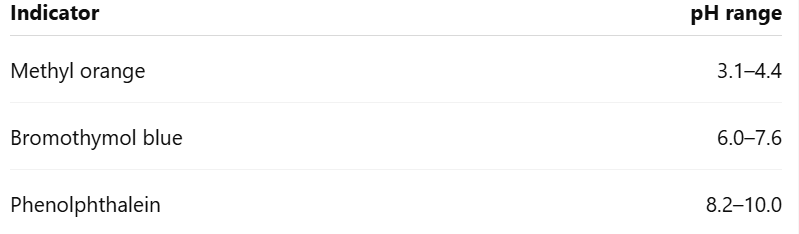
Phenolphthalein is most appropriate because its colour-change range includes the equivalence-point pH of 8.7.
300
For the reaction below, identify:
1. the species oxidised
2. the species reduced
3. the reducing agent
4. the oxidising agent
Zn(s) + Cu²⁺(aq) → Zn²⁺(aq) + Cu(s)
1. Zn(s) is oxidised.
2. Cu²⁺(aq) is reduced.
3. Zn(s) is the reducing agent.
4. Cu²⁺(aq) is the oxidising agent.
300
Explain how the products at the anode differ during the electrolysis of dilute and concentrated aqueous sodium chloride using inert electrodes.
In dilute NaCl(aq), water is preferentially oxidised and oxygen gas is produced at the anode. In concentrated NaCl(aq), chloride ions are preferentially oxidised and chlorine gas is produced.
Hydrogen gas is generally produced at the cathode in both solutions.
400
A concentration–time graph shows the concentration of the reactants decreasing before becoming constant. The concentration of the products increases before becoming constant. Infer whether equilibrium has been reached.
Equilibrium has been reached when all concentrations become constant. This indicates that the forward and reverse reaction rates are equal.
400
Explain, using collision theory, why the equilibrium concentration of products changes when temperature is increased.
Increasing temperature raises the kinetic energy of particles. A greater proportion of collisions have sufficient energy to overcome the activation energies of the forward and reverse reactions. The reaction with the larger activation energy experiences the greater proportional increase in rate, causing the equilibrium position to shift.
400
For the equilibrium: N₂(g) + 3H₂(g) ⇌ 2NH₃(g) Calculate (Q):
The concentrations are:
[N₂] = 0.20 mol L⁻¹
[H₂] = 0.30 mol L⁻¹
[NH₃] = 0.40 mol L⁻¹
Q = [NH₃]² / ([N₂][H₂]³)
Q = (0.40)² / ((0.20)(0.30)³)
Q = 29.6
400
Identify the two conjugate acid–base pairs in:
NH₃(aq) + H₂O(l) ⇌ NH₄⁺(aq) + OH⁻(aq)
(NH₃/NH₄⁺)
(H₂O/OH⁻)
NH3 accepts a proton and acts as the base.
H2O donates a proton and acts as the acid.
400
A 0.100 mol L⁻¹ solution of a weak monoprotic acid has a pH of 2.87. Calculate Ka.
[H₃O⁺] = 10⁻².⁸⁷ = 1.35 × 10⁻³ mol L⁻¹
For:
HA + H₂O ⇌ H₃O⁺ + A⁻
[H₃O⁺] = [A⁻] = 1.35 × 10⁻³
[HA] = 0.100 − 0.00135 = 0.09865
Ka = ([H₃O⁺][A⁻]) / [HA]
Ka = (1.35 × 10⁻³)² / 0.09865
Ka = 1.85 × 10⁻⁵
400
Identify the point on a weak-acid–strong-base titration curve where (pH=pKa).
At the half-equivalence point, where half of the original weak acid has reacted and the concentrations of the weak acid and its conjugate base are equal.
400
Write the cell diagram and calculate E°cell for a zinc–copper galvanic cell.
E°(Cu²⁺/Cu) = +0.34 V
E°(Zn²⁺/Zn) = -0.76 V
The positive potential indicates a spontaneous reaction under standard conditions.
Cell diagram:
Zn(s) | Zn²⁺(aq) || Cu²⁺(aq) | Cu(s)
Cell potential:
E°cell = E°reduction − E°oxidation
E°cell = 0.34 − (−0.76)
E°cell = +1.10 V
400
A current of 2.50 A is passed through a silver nitrate solution for 32.0 minutes. Calculate the mass of silver deposited.
Ag⁺(aq) + e⁻ → Ag(s)
M(Ag) = 107.87 g mol⁻¹
t = 32.0 × 60 = 1920 s
q = It
q = 2.50 × 1920 = 4800 C
n(e⁻) = q / F
n(e⁻) = 4800 / 96485 = 0.04975 mol
The mole ratio of electrons to silver is 1:1:
n(Ag) = 0.04975 mol
m = nM
m = 0.04975 × 107.87
m(Ag) = 5.37 g
500
Explain the reversibility of a chemical reaction by referring to activation energy.
Reactant particles must possess enough energy to overcome the activation energy of the forward reaction. Product particles can also collide with sufficient energy to overcome the activation energy of the reverse reaction. Therefore, both reactions can occur under suitable conditions.
500
A catalyst is added to a chemical system at equilibrium. Determine its effect on:
- the forward reaction rate
- the reverse reaction rate
- the position of equilibrium
- the value of Kc
1. The forward reaction rate increases.
2. The reverse reaction rate increases.
3. The equilibrium position does not change.
4. Kc does not change.
500
The molar solubility of Ag₂CO₃(s) is 1.30 × 10⁻⁴ mol L⁻¹
Calculate Ksp:
Ag₂CO₃(s) ⇌ 2Ag⁺(aq) + CO₃²⁻(aq)
Let the molar solubility equal (s).
[Ag⁺] = 2s = 2.60 × 10⁻⁴ mol L⁻¹
[CO₃²⁻] = s = 1.30 × 10⁻⁴ mol L⁻¹
Ksp = [Ag⁺]²[CO₃²⁻]
Ksp = (2.60 × 10⁻⁴)²(1.30 × 10⁻⁴)
Ksp = 8.79 × 10⁻¹²
500
Explain why HCO₃⁻(aq) is amphiprotic. Support the response with two equations.
HCO₃⁻ can donate or accept a proton:
Acting as an acid: HCO₃⁻(aq) + H₂O(l) ⇌ CO₃²⁻(aq) + H₃O⁺(aq) Acting as a base: HCO₃⁻(aq) + H₂O(l) ⇌ H₂CO₃(aq) + OH⁻(aq)
500
A buffer contains CH₃COOH and CH₃COO⁻. Explain how the buffer resists a change in pH when a small amount of H⁺ is added.
The added H⁺ reacts with the conjugate base:
CH₃COO⁻(aq) + H⁺(aq) → CH₃COOH(aq)
The equilibrium CH₃COOH(aq) ⇌ H⁺(aq) + CH₃COO⁻(aq) shifts to the left, removing most of the added H⁺. Therefore, the pH decreases only slightly.
500
A 25.00 mL sample of hydrochloric acid is titrated with 0.1000 mol L⁻¹ sodium hydroxide. The equivalence point occurs after 18.60 mL of sodium hydroxide is added. Calculate the concentration of the hydrochloric acid.
HCl(aq) + NaOH(aq) → NaCl(aq) + H₂O(l)
n(NaOH) = cV
n(NaOH) = 0.1000 × 0.01860
n(NaOH) = 1.860 × 10⁻³ mol
The mole ratio is 1:1:
n(HCl) = 1.860 × 10⁻³ mol
c(HCl) = n / V
c(HCl) = (1.860 × 10⁻³) / 0.02500
c(HCl) = 0.07440 mol L⁻¹
500
Balance the following redox equation under acidic conditions.
MnO₄⁻(aq) + Fe²⁺(aq) → Mn²⁺(aq) + Fe³⁺(aq)
Reduction:
MnO₄⁻ + 8H⁺ + 5e⁻ → Mn²⁺ + 4H₂O
Oxidation:
Fe²⁺ → Fe³⁺ + e⁻
Overall equation:
MnO₄⁻ + 8H⁺ + 5Fe²⁺ → Mn²⁺ + 4H₂O + 5Fe³⁺
500
A current of 10.0 A is passed through acidified water for 1930 s. Calculate the volume of hydrogen gas and oxygen gas produced at SLC.
Cathode:
2H⁺ + 2e⁻ → H₂(g)
Anode:
2H₂O(l) → O₂(g) + 4H⁺ + 4e⁻
q = It
q = 10.0 × 1930 = 19,300 C
n(e⁻) = 19,300 / 96,485 = 0.200 mol
For hydrogen:
n(H₂) = 0.200 / 2 = 0.100 mol
V(H₂) = 0.100 × 24.8
V(H₂) = 2.48 L
For oxygen:
n(O₂) = 0.200 / 4 = 0.0500 mol
V(O₂) = 0.0500 × 24.8
V(O₂) = 1.24 L
Hydrogen and oxygen are produced in a 2:1 volume ratio.