Nervous System and Brain Function
Communication, Movement and Disorders
Seeing and Hearing
Perception
Models and Types of Memory
Remembering and Forgetting
Classical and Operant Conditioning
Learning in Action
100
Identify the two structures that form the central nervous system.
The brain and spinal cord.
100
Contrast the effects of glutamate and GABA on postsynaptic neurons.
Glutamate is generally excitatory and increases the likelihood that the postsynaptic neuron will produce an action potential.
GABA is generally inhibitory and decreases the likelihood that the postsynaptic neuron will produce an action potential.
100
Identify the two processes below:
- Detecting physical stimulus energy
- Organising and interpreting sensory information
1. Sensation
2. Perception
100
Identify the perceptual principle illustrated when a person recognises a door as rectangular even when it is partly open and its retinal image is trapezoidal.
Shape constancy.
100
Name the three stores in the multi-store model of memory.
- Sensory memory
- Short-term memory
- Long-term memory
100
Contrast recall and recognition.
Recall requires information to be retrieved with few or no external cues, such as answering a short-response question.
Recognition involves identifying previously learned information when it is presented, such as selecting an answer in a multiple-choice question.
100
Compare classical and operant conditioning.
Classical conditioning involves learning an association between two stimuli and usually produces an involuntary response.
Operant conditioning involves learning an association between a behaviour and its consequence. Consequences affect the likelihood that a voluntary behaviour will be repeated.
100
Discriminate between modelling and vicarious conditioning.
Modelling involves observing and imitating another person’s behaviour.
Vicarious conditioning involves observing the consequences experienced by a model and changing one’s own behaviour as a result.
200
Complete the organisation of the human nervous system.
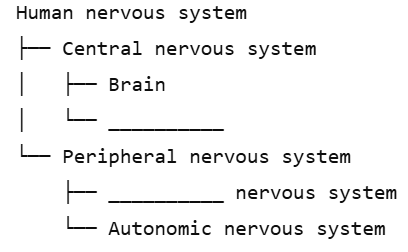
- Spinal cord
- Somatic nervous system
The somatic nervous system controls voluntary skeletal-muscle movement. The autonomic nervous system regulates involuntary processes involving internal organs and glands.
200
Describe the roles of the three brain regions involved in voluntary movement.
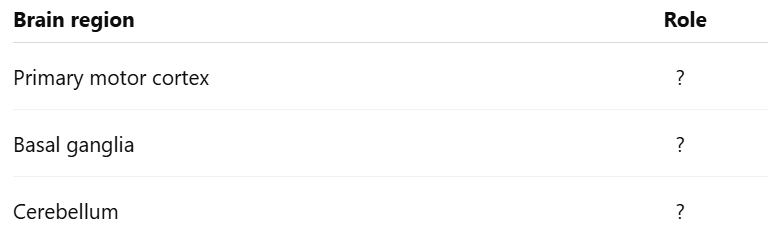
- Primary motor cortex: generates and sends commands for voluntary movement.
- Basal ganglia: assists in selecting, initiating and controlling intended movements while suppressing unwanted movements.
- Cerebellum: coordinates timing, balance, precision and correction of movement.
200
Identify where visual and auditory transduction occur.
- Visual transduction occurs in photoreceptors in the retina.
- Auditory transduction occurs in hair cells in the cochlea.
Transduction converts physical stimulus energy into neural signals.
200
Discriminate between loudness, pitch and timbre.
- Loudness is the perceived intensity or volume of a sound and is mainly related to amplitude.
- Pitch is how high or low a sound is perceived and is mainly related to frequency.
- Timbre is the distinctive quality of a sound that allows sounds with the same pitch and loudness to be distinguished.
200
What is the role for each working-memory component.
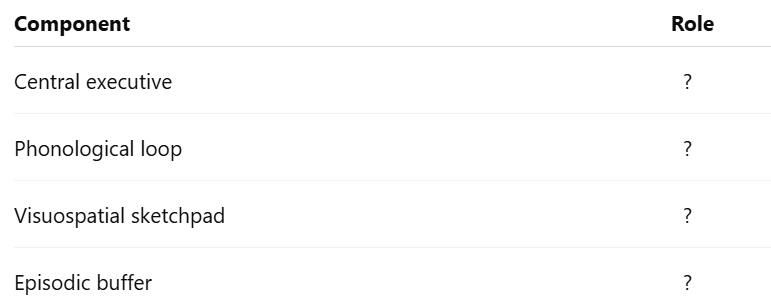
- Central executive: directs attention and coordinates the other components.
- Phonological loop: temporarily stores and rehearses verbal and auditory information.
- Visuospatial sketchpad: temporarily stores and manipulates visual and spatial information.
- Episodic buffer: integrates information from the other components and long-term memory into a coherent episode.
200
State the approximate duration and capacity of:
- iconic memory
- echoic memory
- short-term memory
- long-term memory
• Iconic memory: approximately 0.3–0.5 seconds; very large capacity
• Echoic memory: approximately 3–4 seconds; large capacity
• Short-term memory: approximately 15–30 seconds without rehearsal; about (7 ± 2) items or chunks
• Long-term memory: potentially permanent duration and potentially unlimited capacity
200
A dog naturally salivates when food is presented. After a bell is repeatedly paired with food, the dog salivates when it hears the bell.
Identify the:
- unconditioned stimulus
- unconditioned response
- neutral stimulus
- conditioned stimulus
- conditioned response
- UCS: food
- UCR: salivation in response to food
- NS: bell before conditioning
- CS: bell after conditioning
- CR: salivation in response to the bell
200
Describe the operation of a Skinner box.
A Skinner box is a controlled chamber used to study operant conditioning. An animal performs a behaviour, such as pressing a lever, and receives a consequence such as food or an electric shock. Researchers measure how consequences affect the frequency of the behaviour.
300
Discriminate between monosynaptic and polysynaptic spinal reflexes.
A monosynaptic reflex involves one synapse between a sensory neuron and a motor neuron.
A polysynaptic reflex involves one or more interneurons and therefore contains multiple synapses. It allows a more complex response.
300
Place the following stages of synaptic transmission in the correct order:
A. Neurotransmitters bind to postsynaptic receptors.
B. An action potential reaches the axon terminal.
C. Neurotransmitters are released into the synaptic cleft.
D. The postsynaptic neuron is excited or inhibited.
E. Synaptic vesicles fuse with the presynaptic membrane.
B → E → C → A → D
300
Arrange the stages of visual processing in the correct order:
- Primary visual cortex
- Optic nerve
- Retina
- Thalamus
- Accessory structures of the eye
Accessory structures → retina → optic nerve → thalamus → primary visual cortex
The primary visual cortex is located in the occipital lobe.
300
Identify the Gestalt principle illustrated in each example:
- Elements located close together are perceived as a group.
- An incomplete circle is perceived as complete.
- Similar-looking objects are perceived as belonging together.
1. Proximity
2. Closure
3. Similarity
300
Compare shallow and deep encoding according to the levels of processing model.
Shallow encoding focuses on surface features, such as the appearance or sound of information.
Deep encoding focuses on meaning and connections with existing knowledge. Deeper semantic processing generally produces stronger and more durable long-term memories.
300
Discriminate between encoding failure, retrieval failure and interference.
- Encoding failure occurs when information is not effectively processed into memory.
- Retrieval failure occurs when stored information cannot be accessed because suitable retrieval cues are unavailable.
- Interference occurs when other information disrupts storage or retrieval.
300
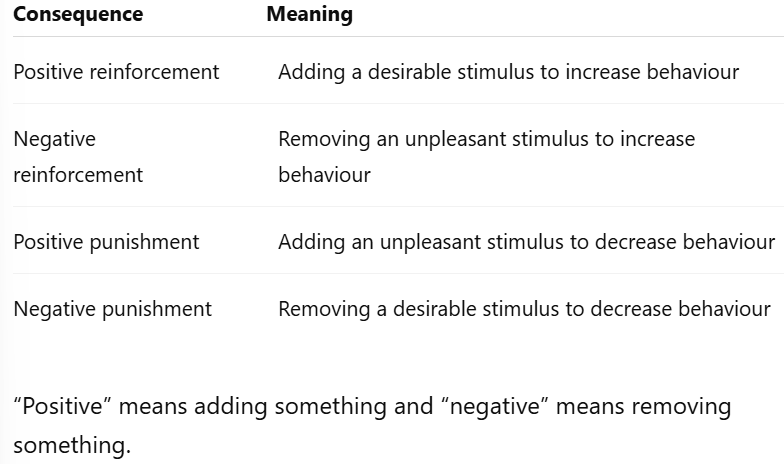
Discriminate between the four types of operant-conditioning consequences; positive reinforcement, negative reinforcement, positive punishment, and negative punishment.
300
A child who was bitten by one dog becomes afraid of all dogs but later learns to fear only large, aggressive dogs. Identify the two conditioning processes.
Fear of all dogs demonstrates stimulus generalisation because similar stimuli produce the conditioned response.
Learning to respond only to large, aggressive dogs demonstrates stimulus discrimination because the child distinguishes between different stimuli.
400
What is each cerebral-cortex lobes' primary function.
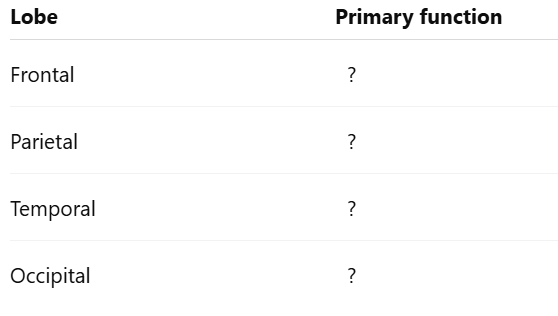
- Frontal lobe: planning, decision-making, personality and voluntary movement
- Parietal lobe: processing bodily sensations and spatial information
- Temporal lobe: auditory processing, language and aspects of memory
- Occipital lobe: visual processing
400
Match each neurotransmitter with one important physical or psychological function.
- Acetylcholine
- Epinephrine
- Norepinephrine
- Dopamine
- Serotonin
1. Acetylcholine: skeletal-muscle movement, attention and memory
2. Epinephrine: physiological arousal and the fight-or-flight response
3. Norepinephrine: alertness, attention, arousal and mood
4. Dopamine: movement, motivation, reward and reinforcement
5. Serotonin: mood, sleep and appetite regulation
400
Arrange the stages of auditory processing in the correct order and identify the lobe containing the primary auditory cortex.
- Cochlear hair cells
- Acoustic nerve
- Accessory structures of the ear
- Primary auditory cortex
- Thalamus
Accessory structures → cochlear hair cells → acoustic nerve → thalamus → primary auditory cortex
The primary auditory cortex is located in the temporal lobe.
400
A student is waiting for an important text message and repeatedly thinks they hear their phone notification in surrounding sounds. Explain this perception using perceptual set.
The student’s motivation and expectation create a perceptual set. This predisposes the student to interpret ambiguous sounds as the expected notification. Their emotional state may further increase attention to phone-related sounds.
400
Classify each example as an explicit or implicit memory and identify its subtype.
- Remembering your most recent birthday
- Knowing that Canberra is Australia’s capital
- Riding a bicycle
- Responding fearfully to a previously conditioned stimulus
- Explicit episodic memory
- Explicit semantic memory
- Implicit procedural memory
- Implicit classically conditioned memory
400
Match each study strategy with its description.
- Spacing
- Interleaving
- Chunking
- Elaborative rehearsal
- Method of loci
- Spacing: distributing study sessions over time
- Interleaving: mixing different topics or types of problems during study
- Chunking: grouping separate pieces of information into meaningful units
- Elaborative rehearsal: connecting new information to meaning and existing knowledge
- Method of loci: mentally placing information in familiar imagined locations
400
A student begins submitting homework regularly because doing so stops their teacher from sending reminder emails. Identify the operant-conditioning process and justify the response.
This is negative reinforcement. The student’s homework-submission behaviour increases because an unpleasant stimulus - the reminder emails - is removed.
400
Describe the learned fear response demonstrated in the Little Albert experiment.
A white rat initially acted as a neutral stimulus. Researchers repeatedly paired it with a loud noise, which naturally produced fear.
The rat became a conditioned stimulus that produced a conditioned fear response. Albert also showed stimulus generalisation by responding fearfully to other white, furry objects.
The research would be considered unethical under contemporary standards because of the distress caused, lack of effective deconditioning and inability of the infant to provide consent.
500
Explain how brain function can be viewed as both localised and distributed. Refer to language and memory in the response.
Some brain functions are localised because particular regions perform specialised roles. For example, Broca’s area is associated with speech production and Wernicke’s area with language comprehension.
Other functions are distributed across multiple regions. For example, explicit memory involves interactions between the hippocampus, amygdala and neocortex rather than being stored in one location.
500
Compare Parkinson’s disease and Alzheimer’s disease with reference to neurotransmitter interference, symptoms and treatment.
Parkinson’s disease involves degeneration of dopamine-producing neurons, particularly in the substantia nigra. Symptoms include tremors, muscle rigidity, slowed movement and impaired balance. Treatments can include levodopa, dopamine agonists and deep-brain stimulation.
Alzheimer’s disease involves progressive brain degeneration associated with abnormal amyloid and tau proteins and reduced acetylcholine activity. Symptoms include progressive memory loss, confusion and impaired thinking. Cholinesterase inhibitors may temporarily improve or stabilise symptoms, but they do not cure the disease.
500
Explain the role of receptive fields in sensation.
A receptive field is the particular region of sensory space within which stimulation affects the activity of a sensory neuron.
In vision, a retinal receptor or neuron responds to light from a particular area of the visual field. In hearing, sensory cells respond selectively to particular sound frequencies. Receptive fields help the nervous system locate and discriminate sensory stimuli.
500
Explain how culture can influence visual and auditory perception, with reference to de Bruine, Vredeveldt and van Koppen (2018) and Patel and Demorest (2013).
Cultural experience can shape the stimuli to which people are regularly exposed and the perceptual patterns they learn.
De Bruine, Vredeveldt and van Koppen’s research indicates that familiarity with faces from particular cultural or ethnic groups can influence face perception and recognition accuracy.
Patel and Demorest describe how exposure to a culture’s musical system shapes auditory expectations and the perception of rhythm, pitch and musical structure. Perception is therefore influenced by learning and cultural experience rather than sensory input alone.
500
Compare the three models of memory; the multi-store model, the working-memory model and the levels of processing model.
The multi-store model describes memory as information moving through separate sensory, short-term and long-term stores.
The working-memory model expands short-term memory into an active system containing the central executive, phonological loop, visuospatial sketchpad and episodic buffer.
The levels of processing model focuses on how information is encoded. It proposes that deep, meaning-based processing produces more durable long-term memory than shallow processing.
500
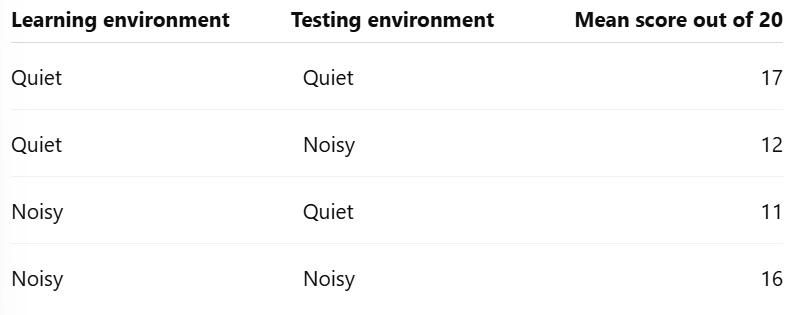
A modified replication of Grant et al. (1998) produced the following results.
 Interpret the results with reference to context-dependent memory.
Participants performed better when the learning and testing environments matched. The quiet–quiet group scored 17 and the noisy–noisy group scored 16, compared with scores of 12 and 11 in mismatched environments.
The results support context-dependent memory because environmental cues present during learning appear to assist retrieval when they are also present during testing. Inferential statistics would be needed to determine whether the differences were statistically significant.
500
Explain extinction and spontaneous recovery in both classical and operant conditioning.
In classical conditioning, extinction occurs when the conditioned stimulus is repeatedly presented without the unconditioned stimulus, causing the conditioned response to weaken.
In operant conditioning, extinction occurs when reinforcement is no longer provided, causing the behaviour to decrease.
Spontaneous recovery occurs when an extinguished conditioned response or operant behaviour briefly reappears after a rest period.
500
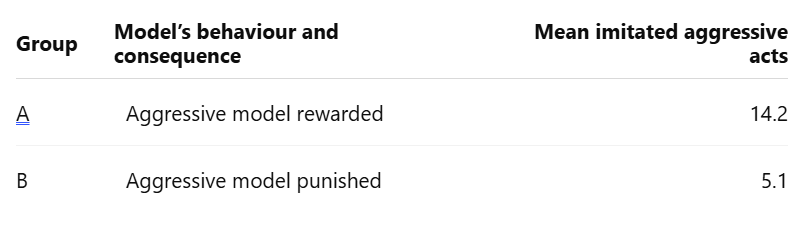
In a Bobo doll study, children observe one of two models.
Analyse the results using social learning theory.
Children who observed the aggressive model being rewarded demonstrated more imitated aggression than children who observed the model being punished.
This supports vicarious conditioning because the observed consequence influenced whether children performed the modelled behaviour. Vicarious reinforcement increased imitation, whereas vicarious punishment reduced its performance.
The results do not necessarily show that Group B failed to learn the behaviour. They may have learned it through observation but were less motivated to reproduce it after seeing the model punished.